Ascendo vs Knowledge Bases
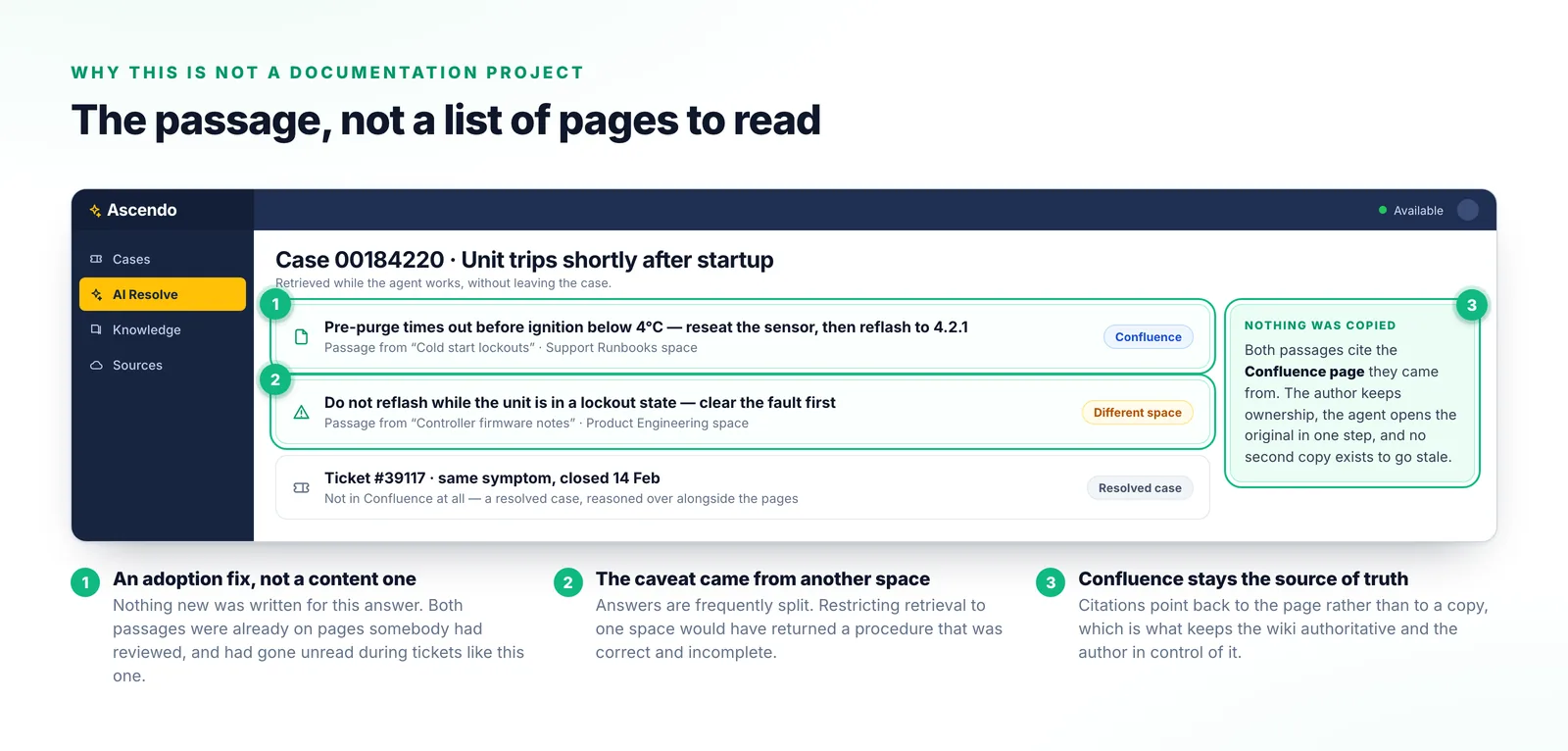
A knowledge base stores the articles someone wrote and returns them when searched, so it covers only what was documented. Ascendo reasons over those articles together with closed cases, service logs and asset history, and returns a cited resolution for faults nobody documented. It reads the knowledge base rather than replacing it.
Knowledge base alone
Works from
- Authored articles
Delivers
The article someone wrote, if one exists
pixels.png&w=48&q=75)
Ascendo
Works from
- Knowledge articles
- Closed cases
- Service logs
- Asset history
Delivers
A cited resolution for the fault in front of you
gain in customer support efficiency with AI-powered self-serviceKami Vision · customer case study
Where the difference actually is
Most service organisations have a knowledge base, and most know its limits from the inside. Coverage tracks authoring effort, articles age between reviews, and the hardest faults — the intermittent ones, the ones specific to a single asset configuration — are exactly the ones nobody had time to write up. The knowledge that resolves them sits in closed cases and in the heads of a few experienced engineers.
A better search box does not change that, because the limit is what the knowledge base contains rather than how it is searched. The useful distinction is between a store of what was written down and a system that reasons over everything the organisation has already resolved, with the written articles as one source among several.
What this looks like in Ascendo
How they differ
| Dimension | Knowledge base alone | Ascendo |
|---|---|---|
| Where answers come from | Knowledge base aloneArticles that someone authored, reviewed and published. | AscendoThose articles, plus closed cases, service logs, manuals and asset history. |
| A fault nobody wrote up | Knowledge base aloneNo article, so no answer. The case escalates to whoever has seen it before. | AscendoFinds comparable resolved cases and assembles a likely cause and fix, showing the cases it drew on. |
| Keeping current | Knowledge base aloneAccuracy depends on review cycles. Articles drift as products and fixes change. | AscendoA newly resolved case is available to the next question without an authoring step. |
| Asset and configuration context | Knowledge base aloneArticles are written for a product in general. | AscendoReasons about the specific asset in front of the technician — its history, configuration and prior faults. |
| Cost of coverage | Knowledge base aloneGrows with authoring effort. Every article is written and maintained by a person. | AscendoGrows with the service record, which the organisation is already producing. |
| Where it lives | Knowledge base aloneIts own system — Confluence, a help centre, a portal. | AscendoA reasoning layer that reads the knowledge base where it already is. Nothing is migrated. |
Which one you actually want
Neither answer is right for everyone. These are the conditions that decide it.
Stay with a knowledge base alone when
- Most questions are already well covered by existing articles, and the long tail of undocumented faults is small.
- The audience is customers looking up standard how-to answers, where a curated, approved article is the right response.
- There is little service history to reason over yet — a new product or a new support organisation. Writing the first articles is the right first step.
- Every answer must use pre-approved wording for regulatory reasons, so only reviewed articles may be shown.
Ascendo fits better when
- Escalations are driven by faults nobody documented, and the same few experts end up resolving them.
- Years of resolved cases hold the real troubleshooting knowledge, and nobody can practically read them.
- Article coverage has stalled because authoring cannot keep pace with product and fault variety.
- Technicians need answers specific to the asset in front of them, not to the product in general.
Frequently Asked Questions
See it against your own service data
The honest way to settle a comparison is to run it on your own cases and assets rather than on anyone’s feature table.