Agentic AI vs Field Service Management Software
Field service management software is the system of record: it stores work orders, assets, contracts and technician schedules, and tracks work through to completion. Agentic AI is the system of judgment: it predicts which asset will fail, which part to pre-position, which technician to send and what the likely fix is. Most organisations run both, with Ascendo supplying the judgment layer over the FSM record.
FSM software
Works from
- Work orders
- Schedules
- Asset register
Delivers
A record of what happened and what is scheduled
pixels.png&w=48&q=75)
Ascendo
Works from
- That same record
- Case notes
- Manuals
- Telemetry
Delivers
Decisions: likely failure, part, fix and technician
Where the difference actually is
This comparison is framed wrongly more often than any other in service operations, because the two are not substitutes. An FSM platform is a record of what happened and what is scheduled. It answers "what work exists and who is assigned to it". It does not answer "which of these will fail next week" or "what is actually wrong with this unit", because those are inferences, not records.
The practical consequence is that replacing an FSM platform with agents is the wrong project, and so is expecting an FSM platform’s reporting to produce decisions. The useful question is which decisions in your operation are currently made by an experienced person reading a screen, because those are the ones an agent layer can take on while the FSM platform stays exactly where it is.
What this looks like in Ascendo
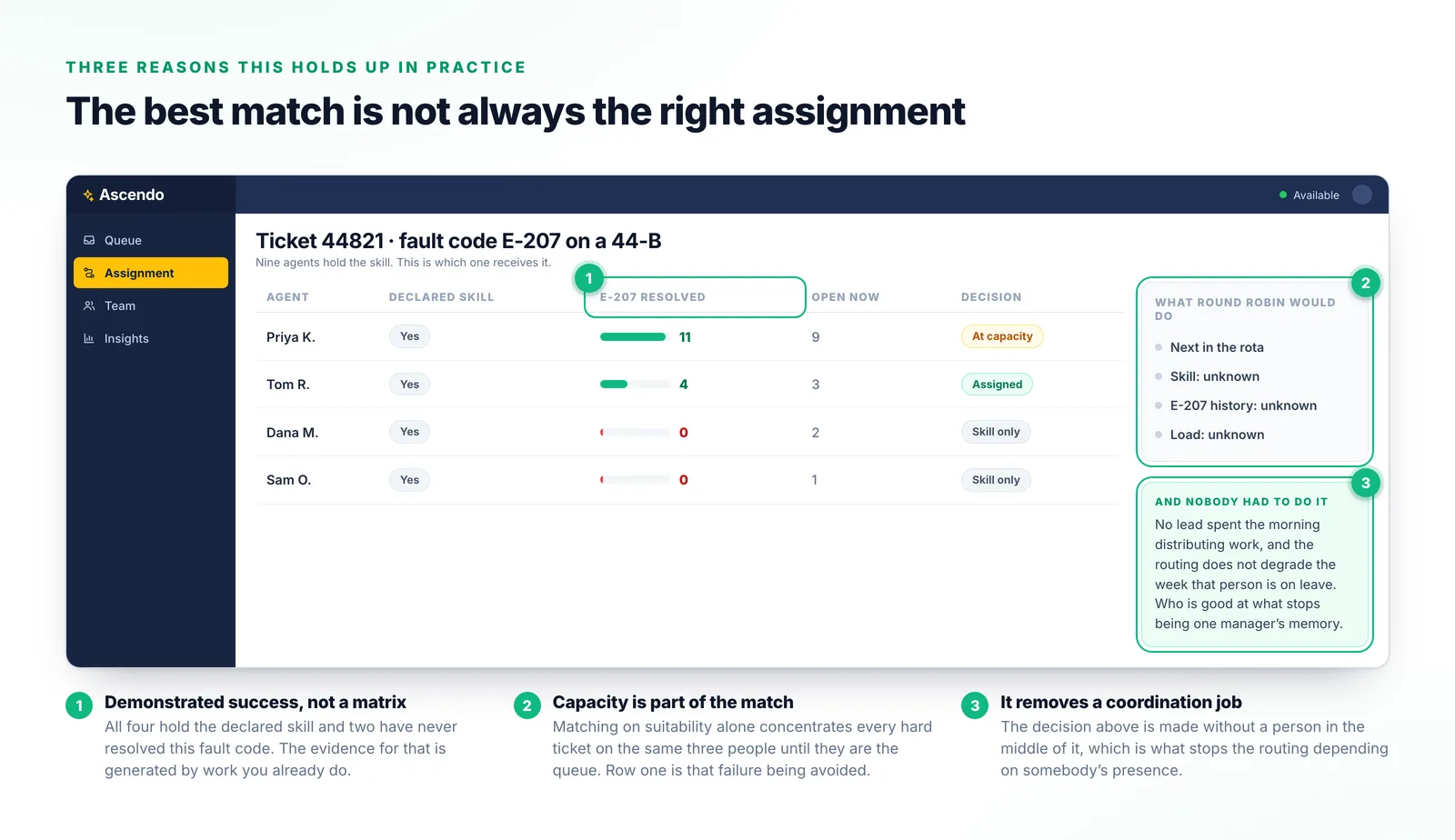
How they differ
| Dimension | FSM software | Ascendo |
|---|---|---|
| Primary job | FSM softwareRecord and coordinate: work orders, assets, entitlements, schedules, mobile execution. | AscendoInfer and decide: failure risk, likely cause, part required, best-matched technician. |
| Scheduling | FSM softwareOptimises against stated constraints — skills, geography, time windows, SLA. | AscendoAdds demonstrated success rate on the specific fault, not just nominal skill match. |
| Parts | FSM softwareTracks stock and consumption; reorders against thresholds and history. | AscendoPredicts demand from failure signals, so a part can be positioned before it is consumed. |
| Diagnosis | FSM softwareStores the resolution a technician recorded after the fact. | AscendoProposes the likely cause and repair path before the visit, from comparable history. |
| Knowledge | FSM softwareAttaches documents to assets and work orders for a person to read. | AscendoReads the corpus and returns the specific passage that applies to this fault. |
| Relationship to your data | FSM softwareOwns it. The FSM platform is where the record lives. | AscendoReads it and writes recommendations back. It is a layer, not a replacement. |
Which one you actually want
Neither answer is right for everyone. These are the conditions that decide it.
Stay with field service management software when
- You do not yet have a system of record. Adding a reasoning layer on top of spreadsheets solves the wrong problem first — get the FSM platform in.
- The operation is small enough that a dispatcher holds the whole picture in their head. Scheduling optimisation will beat inference at that size.
- Your constraint is execution in the field — mobile forms, offline capture, parts consumption at the van — rather than deciding what to do.
- Compliance requires a validated system of record with a controlled change process, which is what FSM platforms are built and certified to be.
An agent system fits better when
- Experienced people are the bottleneck: the same few experts are consulted on everything hard.
- Repeat visits and no-fault-found are driven by arriving without the right part or the right diagnosis.
- Your FSM platform holds years of resolved work that nobody can practically read.
- Scheduling is technically optimal but still assigns people who have not solved this fault before.
Frequently Asked Questions
See it against your own service data
The honest way to settle a comparison is to run it on your own cases and assets rather than on anyone’s feature table.