Smart Backlog
Provide your experts at all times and all channels with virtual agent.

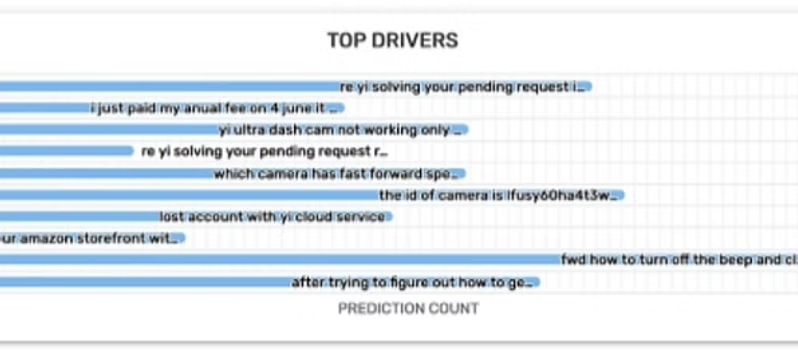
Top Call Drivers
As the volume of data increases, the complexity of the issues also goes higher exponentially. This leads to the immediate need of not just tracking issues, but also keeping an eye on how issues are changing over time, which issues are causing continuous customer dissatisfaction, what latent factors are causing issues to go up/down and which ones are completely new or unseen.
With Ascendo's AI Engine, the above challenge, which takes almost 17.2 hours a week on an average for an agent, becomes a click of a button!
Auto-triage
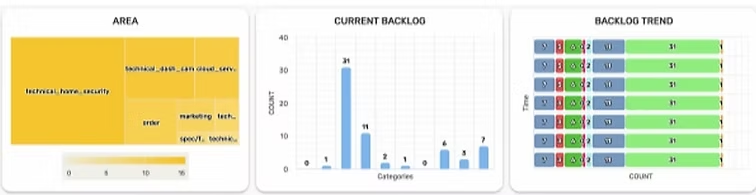
Dealing with the continuous flurry of new issues in the form of tickets is always a challenge. Ascendo surmounts this by providing you a smart backlog for your tickets that entails not only actions to prioritize, sort and keep track of your tickets but also predictions to automatically group similar tickets together and solutions to resolve them, then and there.
Ascendo performs contextual clustering on your tickets and groups them into similar buckets. From here, not only can you see the number of tickets for each type of issue, but also take actions on these tickets from within Ascendo itself. Ascendo also provides predictive solutions based on the history of your tickets, contextual information and hidden intent.
Understanding the Problem
While it is incredibly difficult to deal with the high volume, velocity and variety of data, Ascendo has created algorithms that can help you understand the data deeply. Utilizing the state of the art NLP and ML models, we are able to generate data insights and relevant solutions at the same time.
Recommendation Engine
Ascendo uses its custom advanced ranking system to choose the most valuable and relevant solutions for the problem searched. To set the right relevance, our ranking system also keeps track of any human feedback and other features such as solution's recency, expert technicians and the number of clicks.
Autonomous
Along with understanding keyword importance, Ascendo AI Engine uses Advanced Transformers and Attention networks to depict the text in the vector space. With the Attention mechanism and Positional Encoding, Ascendo is able to find context for any position within the sentence.
Categories & Sub Categories
Ascendo AI engine is able to inspect the incoming issues to find the related symptoms, problem categories and problem subcategories. This gives knowledge to the agents, which otherwise goes undetected. Consequently, the agents can take the right actions and result in fewer escalations.
A Guide for Agents
Gone are the days when agents had to do everything by themselves. Ascendo provides an always available guide to agents that intelligently pilots the agents towards the right solutions, actions, and the right game plan.
Resolve with Minimal Bias
No matter how careful you are, where your ticket ends up always involves a bias. With Ascendo's AI, you need not worry any more, as it removes the undetected subjectivity that often comes into play when a ticket is being routed to the right assignee.
Frequently Asked Questions
What is auto-triage and how does it work?
Auto-triage uses contextual clustering to automatically group incoming tickets by symptom, product category, and hidden intent. Instead of agents manually reading and sorting each ticket, the Smart Backlog Agent buckets similar issues together and surfaces predictive resolutions based on historical outcomes, so teams can act on clusters rather than individual cases.
How much time does the Smart Backlog Agent save per agent per week?
Tracking issue trends, identifying new patterns, and manually prioritizing backlogs takes an average of 17.2 hours per week per agent. The Smart Backlog Agent reduces this to a single click by continuously analyzing incoming volume, detecting trend shifts, and surfacing the highest-impact resolution opportunities automatically.
Can it detect issue types it has never seen before?
Yes. The agent uses advanced transformer models with positional encoding and attention mechanisms to represent tickets in vector space, capturing contextual meaning rather than just keywords. This allows it to identify latent and novel issue patterns that rule-based systems and keyword matching would miss entirely.
How does the ranking system decide which tickets to prioritize?
Ascendo's recommendation engine uses a custom ranking model that balances multiple signals: solution recency, expert technician endorsements, click-through rates, symptom match confidence, and customer impact. Human feedback continuously refines the ranking so the most relevant and proven resolutions rise to the top.
Does the agent remove routing bias from ticket assignment?
Yes. Manual routing always carries implicit bias: who is available, who is familiar, or who is easiest to contact. The Smart Backlog Agent assigns tickets based purely on skill match, workload balance, and resolution probability, removing subjectivity from the process and ensuring fairer, more accurate distribution across the team.
Smart Backlog
Start hiring your Digital Workforce
Cluster, prioritize, and clear open work with AI-ranked batching, before SLAs slip and queues snowball.
Contact usFrequently Asked Questions
What is the Smart Backlog Agent?
It is Ascendo's queue-management agent, built to eradicate the "infinite backlog." It analyzes every open service request, clusters similar issues by asset type, fault code, and location, and finds mass-resolution opportunities where a single action clears many tickets at once.
How does it reduce ticket backlog?
By batching related tickets and identifying where one expert guidance or a bulk parts shipment resolves dozens simultaneously, it clears the queue procedurally instead of one ticket at a time, typically cutting average backlog age by around 30%.
Does it prioritize tickets by SLA risk?
Yes. It ranks the queue by SLA risk so the tickets closest to breaching are cleared first, and it surfaces the systemic bottlenecks hidden inside the backlog so leaders can fix causes, not just symptoms.