AI for Clinical Engineering: Expert Guidance for Every BMET, at the Point of Repair
Your service history, OEM manuals and senior-tech know-how, in front of every BMET at the device. On top of the CMMS you already run.
- Works with your CMMS
- No rip-and-replace
- Live in 2–4 weeks
Likely the downstream pressure sensor drifting. The same fault showed up on 3 pumps of this model in the last 90 days.
- 1Run the pressure-sensor calibration check OEM service manual §4.2, p. 37
- 2If drift is out of spec, swap the sensor assembly 1 in stock · Central Biomed, shelf B4
- 3Close the work order PM record and audit trail update automatically
Trusted by service teams at

.webp)




Results our customers bank on
- 6xROI in year one
- $11Ma year at EDF Renewables
- 70%fewer escalations
Why Clinical Engineering Needs AI Now
Bigger fleets, fewer senior BMETs, tighter PM rules and zero tolerance for downtime. A CMMS schedules the work; AI agents prevent the failures that break the schedule.
Every BMET Fixes It Like Your Most Senior Tech
The fix is usually already in your hospital: an old work order, a service bulletin, a senior tech's memory. Ascendo hands the BMET one cited answer, in steps.
- Step-by-step fix for the exact model and fault
- Sources cited, so the tech can check the answer
- Knowledge stays when senior techs retire
AI Agents for Medical Device Service, Start to Finish
Troubleshooting, PM compliance, and parts forecasting running on medical-device service scenarios.
- Guided troubleshooting for a technician on site
- PM status and compliance evidence without the spreadsheet
- Parts forecast tied to the failures it predicts

AI Agents for Medical Device Service: Faster Troubleshooting & HTM Compliance
What Is AI for Clinical Engineering?
AI agents that make a healthcare technology management (HTM) team's daily calls: which device to service next, which BMET to send, which part to stage, and which asset is about to fail. Your CMMS records the work; the agents act on it.
How the Agents Work Together in a Hospital
One imaging system, from the first warning sign to a planned repair.
- Day 0
Signal
Error logs, telemetry, and service history show an imaging system drifting toward failure.
- Day 1
Risk flagged
The predictive agent scores the asset and tells the HTM lead the likely failure mode.
- Day 2
Part staged
The parts agent confirms the replacement board is in the nearest depot, or orders it now.
- Day 5
BMET scheduled
Dispatch books the right BMET in a low-utilization window, with the procedure attached.
- Day 6
Fixed on a planned visit
No unplanned downtime. The PM record and audit trail update themselves.
Core AI Capabilities for HTM
Each one runs as its own AI agent.
BMET Knowledge Support
Manuals, repair history and known issues for the exact device, at the point of repair.
Learn morePredictive Device Uptime
Telemetry, service history and recalls flag at-risk equipment before it fails.
Learn moreMedical Spare Parts Forecasting
Boards, probes and consumables staged near each facility before they’re needed.
Learn morePM Compliance Automation
PMs scheduled and tracked against Joint Commission and OEM rules, always survey-ready.
Learn moreAsset Risk & Escalation
Every work order and asset scored for risk, so critical devices surface early.
Learn moreReactive CMMS vs. an Agentic HTM System
Ascendo doesn't replace your CMMS. It reasons over it and acts.
Traditional CMMS software
- ✕Records work orders and PM schedules
- ✕Opens a work order after the device fails
- ✕BMETs hunt for manuals and history
- ✕Parts ordered after the failure
- ✕Compliance gaps found at survey time
Ascendo AI agents
- ✓Recommends the next best action
- ✓Predicts at-risk devices before they fail
- ✓Procedure and history at the point of repair
- ✓Right part staged in the nearest depot
- ✓Survey-ready PM evidence, always
Built for Every Role in Clinical Engineering
Each role gets the decision and the context it needs.
HTM & Clinical Engineering Directors
Critical equipment available and survey-ready, without adding headcount.
Biomedical Technicians (BMETs)
The exact procedure, history and part for each device, fixed on the first visit.
Parts & Supply Leads
Boards, probes and consumables at the right depot before a device goes down.
See your HTM ROI
What undocumented know-how costs your team, in your own numbers.
The Future of Healthcare Technology Management
Ascendo AI with clinical engineering and HTM leaders, on where AI fits in keeping medical equipment available, compliant and fixed right the first time.
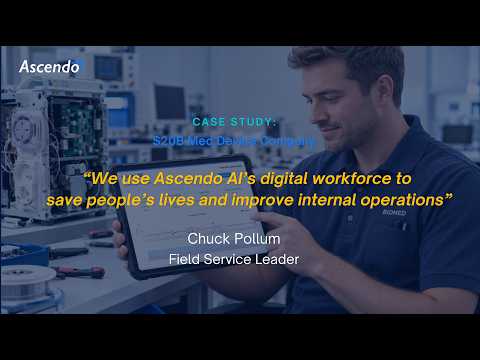
Ascendo AI with the HTM Community | The Future of Healthcare Technology Management
What Service Leaders Say About Ascendo
From the service and support leaders who run Ascendo today, plus verified reviews on G2.
“Integrating Ascendo AI into our ServiceNow workflow has allowed our team to quickly diagnose complex cases and understand customer sentiment in real time. The platform's 'Solve' feature provides clear resolution steps that have significantly improved our team's efficiency and response times.”
 Cesar FeghaliCloud Solution Architect
“Ascendo AI has transformed our operations by automating 200 unique troubleshooting guides in just two days—a task that previously took weeks of manual effort. The platform's transparent UX and parts prediction capabilities ensure our technicians are fully prepared before heading into the field, consistently driving first-visit resolutions.”
 Anton MaesSenior Digital Product Manager
Rated #1 Most Likely to Recommend on G2
Verified reviews from service and support leaders.
See It on Your Own Devices and CMMS
Twenty minutes with our team, built around your fleet rather than a generic script.
What you'll see
- BMET guidance on a device model you choose
- How a prediction becomes a staged part and a scheduled PM
- How it plugs into ServiceNow, SAP, or your HTM CMMS
- 1We reply within one business day
- 2A short call on your systems and goals
- 3A live demo on your own data
Related Research
Knowledge Management to Knowledge Intelligence
Forget clunky knowledge management! KI, powered by AI, makes it smarter and more helpful for customer support. It learns, creates, and shares knowledge. KCI, an advanced KI approach, prioritizes valuable content and guides workflows. The result: exceptional customer service through intelligent knowledge.
Read the research Research PaperHow AI Agents Can Boost Field Service Operations
Discover how Ascendo AI's Knowledge First Agentic AI platform is revolutionizing field service management. Learn how AI Agents can boost field service operations.
Read the researchFrequently Asked Questions
What is AI for clinical engineering?
AI for clinical engineering uses machine-learning agents to run the decisions a healthcare technology management (HTM) department makes every day: which medical device to service next, which BMET to dispatch, which spare part to pre-position, and which asset is at risk of failing. Instead of manually triaging work orders and PM schedules, clinical engineering teams get real-time recommendations that keep patient-critical equipment available and compliant.
How does AI help healthcare technology management (HTM) teams?
AI helps HTM teams by predicting device failures before they disrupt care, automating preventive maintenance scheduling and compliance evidence, guiding biomedical equipment technicians (BMETs) with device-specific repair knowledge, and forecasting spare parts so critical devices are never down waiting on a part. The result is higher equipment uptime with the same or smaller team.
Can AI reduce medical equipment downtime?
Yes. AI reduces medical equipment downtime by moving clinical engineering from reactive break-fix to predictive maintenance. It analyzes device telemetry, service history, and recall data to flag at-risk assets, then automatically pre-positions the right parts and dispatches the right BMET before the device fails. Teams typically cut unplanned downtime on monitored equipment by 25–35%.
Does Ascendo AI support BMETs and biomedical technicians in the field?
Yes. Ascendo equips biomedical equipment technicians with step-by-step resolution guides, historical repair data, service manuals, and known-issue intelligence for each specific device model, delivered at the point of repair. New and cross-trained BMETs reach senior-technician first-time fix rates far faster.
How does AI help with medical device PM compliance and audit readiness?
AI automates preventive maintenance (PM) scheduling, tracks PM completion rates against Joint Commission and manufacturer requirements, and keeps a continuous audit trail of every intervention. Instead of scrambling before a survey, HTM leaders have always-current compliance evidence and can see which PMs are at risk of slipping in advance.
Does Ascendo integrate with CMMS and hospital asset systems?
Yes. Ascendo integrates with the CMMS and enterprise asset management systems clinical engineering already runs, including ServiceNow, SAP, and common HTM platforms. It ingests live work-order, PM, and asset data and pushes recommendations back into existing workflows. No rip-and-replace of your system of record.
How is Ascendo AI different from a traditional CMMS?
A CMMS records what you tell it: work orders, PM schedules, and asset inventory. Ascendo AI reasons over that data and acts on it. It predicts which device will fail, recommends which BMET to dispatch, forecasts which part to stock, and flags which asset is at escalation risk, turning a passive record into decisions and completed work.
Ready to Modernize Your Clinical Engineering Team?
BMET guidance, uptime, parts and PM compliance, on your own equipment.
Explore all 16 agents · Also serving Medical Device Field Service.