Dispatch
Send the right technician to the right job at the right time. Skill-based dispatch weighs expertise, success history, location, and parts availability to maximize first-time fix, minimizing delays and raising customer satisfaction.
Smart Routing
Precision Assignment
Leaderboard
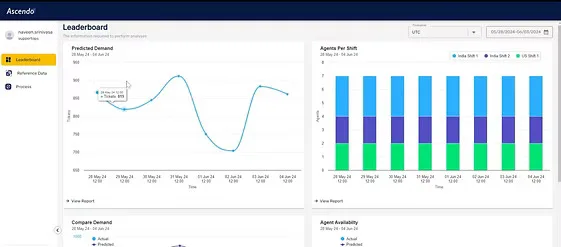
The leaderboard contains all the necessary information for conducting the analysis. It provides key data points, visualizations, and metrics essential for deriving insights. Users can efficiently utilize the dashboard to explore trends, identify patterns, and support decision-making.
Reference Data
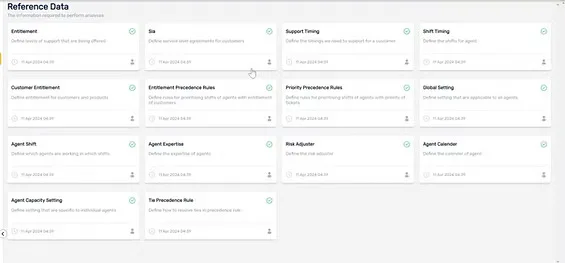
Entitlement, SLA, Support Timing, Shift Timing, Customer Entitlement, Entitlement Precedence, Priority Precedence Rules, Global Setting, Agent Shift, Agent Expertise, Risk Adjuster, Agent Calendar, Agent Capacity Setting, Tie Precedence Rule. These comprehensive insights ensure seamless tracking and evaluation of operational metrics for informed decision-making.
SLA Tracking
Real-time monitoring of service levels.
Agent Expertise
Skill-based routing optimization.
Process
Set a schedule and customize settings to automatically see trending issues. This allows users to automate updates and receive notifications for critical trends. This ensures timely access to insights, improving efficiency and decision-making.

Frequently Asked Questions
What is skill-based dispatch and how is it different from round-robin assignment?
Round-robin assigns whoever is next in the queue. Skill-based dispatch evaluates each technician's expertise profile, historical success rate on similar fault types, live location, and parts availability before making an assignment. The result is higher first-time fix rates because the right expert arrives with the right parts.
What data does the Dispatch Agent use to select a technician?
The agent weighs a multi-factor matrix: technician skill certifications, fault-specific success history, shift availability, current location relative to the job site, SLA tier of the customer, and real-time parts inventory on the truck. All signals are scored simultaneously before an assignment is made.
How does Dispatch handle SLA priorities and entitlements?
Dispatch references your configured SLA rules, customer entitlement tiers, and priority precedence settings to ensure time-sensitive accounts are always handled within contracted response windows. Entitlement and SLA data are pulled directly from your CRM or ERP via bi-directional integration.
Does the Dispatch Agent integrate with our existing FSM or CRM?
Yes. Ascendo connects natively to platforms like Salesforce, SAP, ServiceMax, and ServiceNow. The Dispatch Agent reads live ticket data and technician calendars from your system of record and pushes assignments back, so your team works from tools they already use.
How does the leaderboard improve technician performance over time?
The leaderboard surfaces each technician's first-time fix rate, resolution speed, and customer satisfaction scores by fault category. Managers can identify top performers and use their workflows as coaching baselines. Over time, the system learns from high performers and incorporates their patterns into future dispatch decisions.
Dispatch
Start hiring your Digital Workforce
Route work by skill, success history, and context, so the right expert handles every ticket the first time.
Contact usFrequently Asked Questions
What is the Dispatch agent?
Dispatch is Ascendo's AI dispatch and scheduling agent. It matches every work order to the technician with the highest success rate on that fault, the right parts on hand, and the shortest path to a first-time fix. It optimizes for first-time fix rate, not simply the shortest drive.
How does Dispatch improve first-time fix rates?
It uses a multi-dimensional match across technician skill, historical success on specific fault codes, live location, and parts availability to send the right person with the right tools. Optimizing for the fix rather than proximity lifts first-time fix and technician utilization.
What does Dispatch optimize for?
It balances cost, speed, and first-time fix rate at the same time, factoring in real-time traffic and the parts already on the truck. Teams typically see around a 15% reduction in total travel time alongside higher utilization and customer satisfaction.
How is it different from geographic dispatch?
Traditional dispatch sends the closest available technician. Dispatch sends the one most likely to fix it in one visit, for example choosing a technician with a 98% success rate on a specific fault who has the required calibration tool, even if they are slightly farther away.