Ascendo vs Generic AI Assistants
General-purpose AI assistants such as ChatGPT and Microsoft Copilot answer from broad training data and whichever documents they are connected to, which suits general questions better than diagnosing a specific fault on a specific asset. Ascendo works from an organisation’s own service records, asset history and resolved cases, cites its sources, and acts in the systems of record.
Generic AI assistant
Works from
- Public training data
- Connected documents
Delivers
A fluent answer about the fault in general
pixels.png&w=48&q=75)
Ascendo
Works from
- Resolved cases
- Asset history
- Service logs
- Manuals
Delivers
A grounded answer for this asset, with its sources
Where the difference actually is
Most service teams already use a general-purpose assistant — ChatGPT, Microsoft Copilot or similar — for drafting, summarising and general questions, and it is good at them. The harder question is whether the same tool can diagnose a fault on a particular piece of equipment, and the honest answer depends on what it can see. Out of the box it knows what was public when it was trained; connected to documents, it knows those documents.
What resolves a service issue is usually neither. It is the organisation’s own record: how this fault was fixed on comparable assets, what this unit’s history shows, which part was actually replaced. A generic assistant can be fluent about a fault in general while having none of that. Ascendo also runs on large language models; the difference is what it is grounded in and what it is permitted to do.
What this looks like in Ascendo
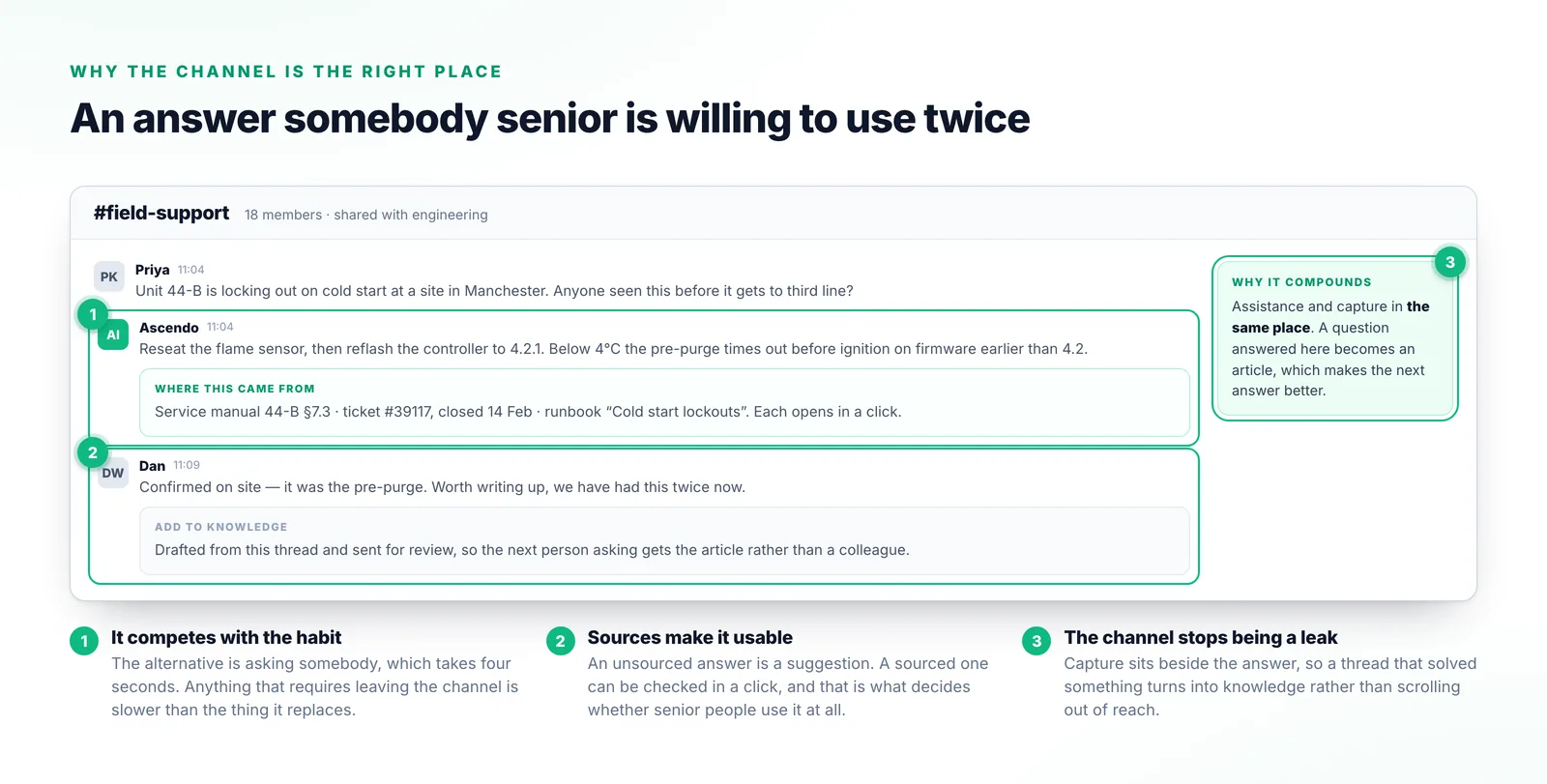
How they differ
| Dimension | Generic AI assistant | Ascendo |
|---|---|---|
| What it knows | Generic AI assistantBroad public knowledge from training, plus any documents it has been connected to. | AscendoThe organisation’s own resolved cases, service logs, manuals and asset history. |
| A fault on a specific asset | Generic AI assistantAnswers about the fault in general. Asset history and configuration are out of view unless someone pastes them in. | AscendoReasons about that asset — its configuration, its prior faults and how comparable units were fixed. |
| Showing its work | Generic AI assistantCan point to connected documents; answers from general knowledge have no source to check. | AscendoAttributes each answer to the cases, documents or records it came from. |
| Sensitive data | Generic AI assistantGoverned by the product tier, the organisation’s agreement with the provider, and what staff choose to paste in. | AscendoThe PII Redaction Agent strips PII, PHI and proprietary schematics before any data enters the reasoning layers. |
| Taking action | Generic AI assistantMostly produces text for a person to act on; acting in service systems needs integrations built for it. | AscendoActs in the systems of record — categorising, routing and updating cases — within the permissions it is given. |
| Consistency across the team | Generic AI assistantAnswers vary with how each person phrases the question and what context they supply. | AscendoEvery technician draws on the same resolved record, so answers rest on the same evidence. |
Which one you actually want
Neither answer is right for everyone. These are the conditions that decide it.
Stay with general-purpose AI assistants when
- The work is drafting, summarising, translating or general research, where broad knowledge is exactly what is needed.
- Questions concern widely documented products and public standards rather than your own installed base.
- Individual productivity is the goal, and nothing needs to be written back into a service system.
- There is no meaningful service history or asset data to ground answers in yet.
Ascendo fits better when
- Technicians are pasting case details into a general assistant and getting plausible answers nobody can verify.
- The fix depends on a specific asset’s history and configuration, not on the product in general.
- Sensitive customer or equipment data has to be filtered before it reaches a model.
- The answer needs to become an action — a routed case, an updated record, a dispatched technician.
Frequently Asked Questions
See it against your own service data
The honest way to settle a comparison is to run it on your own cases and assets rather than on anyone’s feature table.