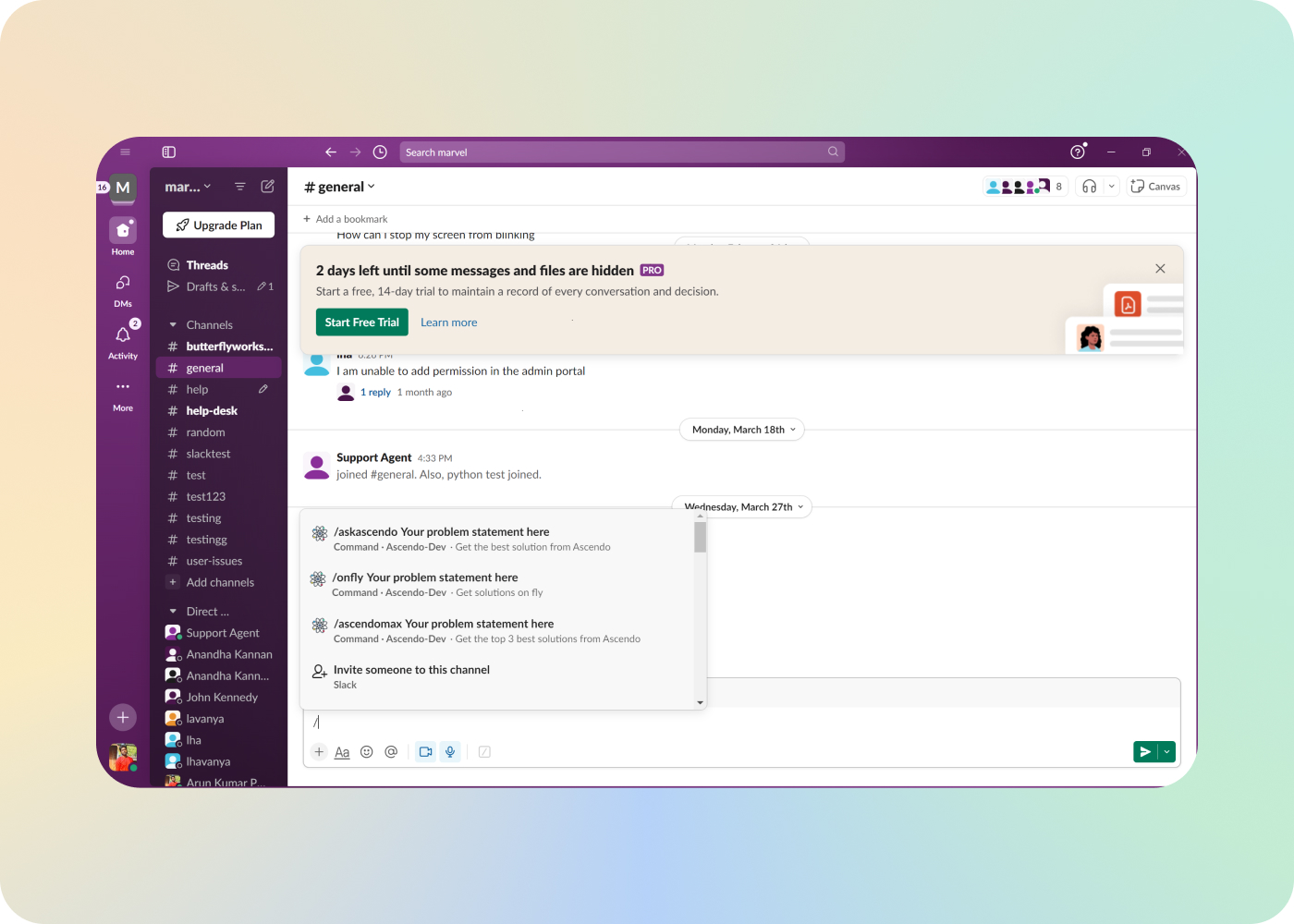
Resolution Agent

Agent assist in Slack

The lightest possible way to put Ascendo in front of a team that already lives in Slack. An engineer asks in channel and gets an answer grounded in your documentation and your previous resolutions, with the sources attached so they can check the reasoning rather than take it on trust.

  • Answers in the channel your team already uses
  • Grounded in your docs and previous resolutions
  • Sources attached so the reasoning can be checked
  • No new tool for anyone to adopt

Watch the full tour

Verify your work email once and every research paper, case study and product tour on ascendo.ai opens, right here, without leaving the page.

  • Takes about 30 seconds
  • Work email only, no spam

The question gets asked in Slack whatever you deploy

When an engineer is stuck they ask in the channel — not because there is no knowledge base, but because asking costs one message and searching costs ten minutes and might return nothing.

The cost is spread thin enough to be invisible: every question consumes two people, the same one is answered repeatedly by whoever is most helpful, and none of it becomes findable. Any tool requiring a different application competes with a habit that takes four seconds.
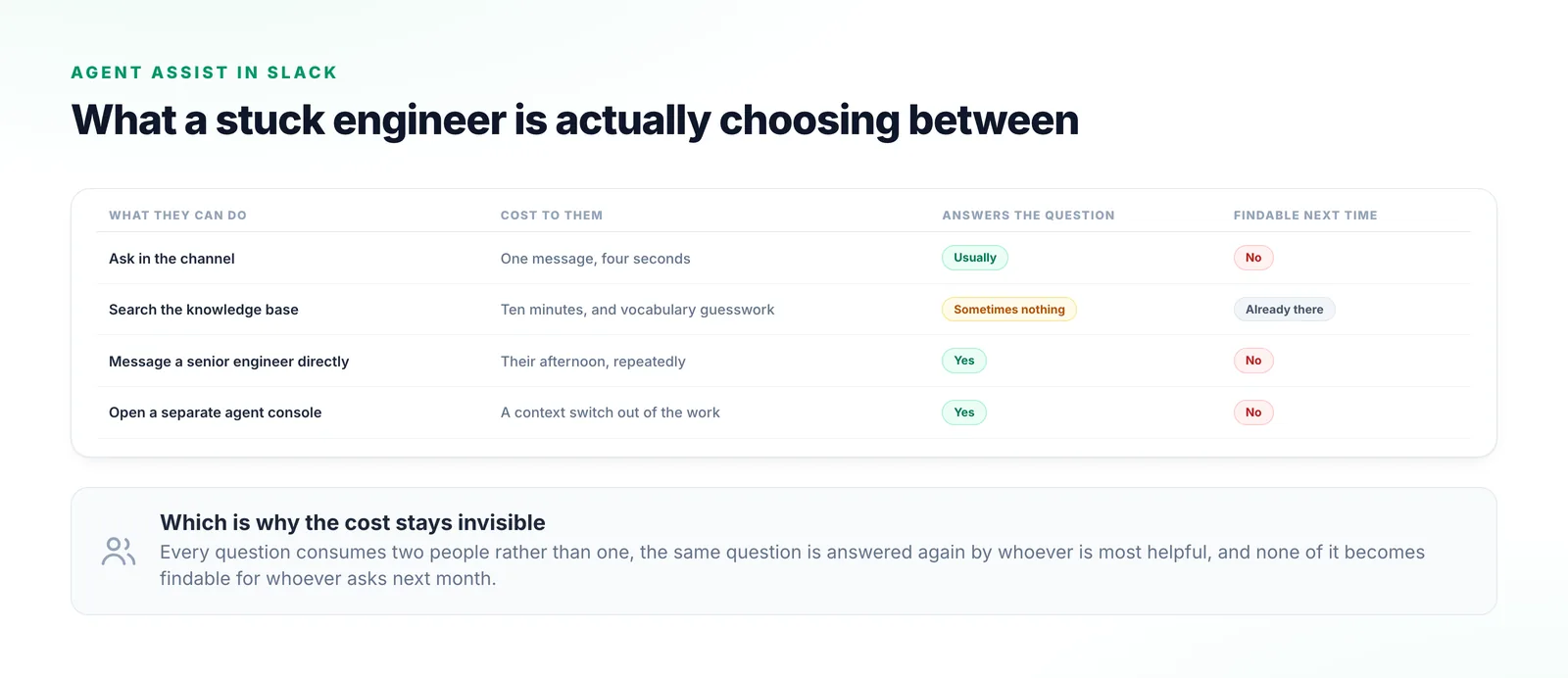
A four-row table pricing what a stuck engineer can do — ask in the channel, search the knowledge base, open a separate console or message a senior engineer — against what each costs and whether the answer becomes findable.
Asking in the channel wins on the only column an engineer weighs in the moment, and loses on the one the organisation cares about.

Answering where the question gets asked

Nothing here asks anyone to change what they already do.

  1. Step 1

    Ask in the channel

    Asked the way it would have been anyway: in the channel, in ordinary language.

  2. Step 2

    Answer from your own material

    Grounded in your connected documentation, resolved tickets and knowledge base, which is what makes it specific enough to act on.

  3. Step 3

    Attach the sources

    What the answer came from is shown beside it. Assistance nobody can check is assistance nobody senior uses twice.

  4. Step 4

    Keep what is worth keeping

    Where the exchange resolves something new it is captured into the knowledge base, so it does not consume a person again.
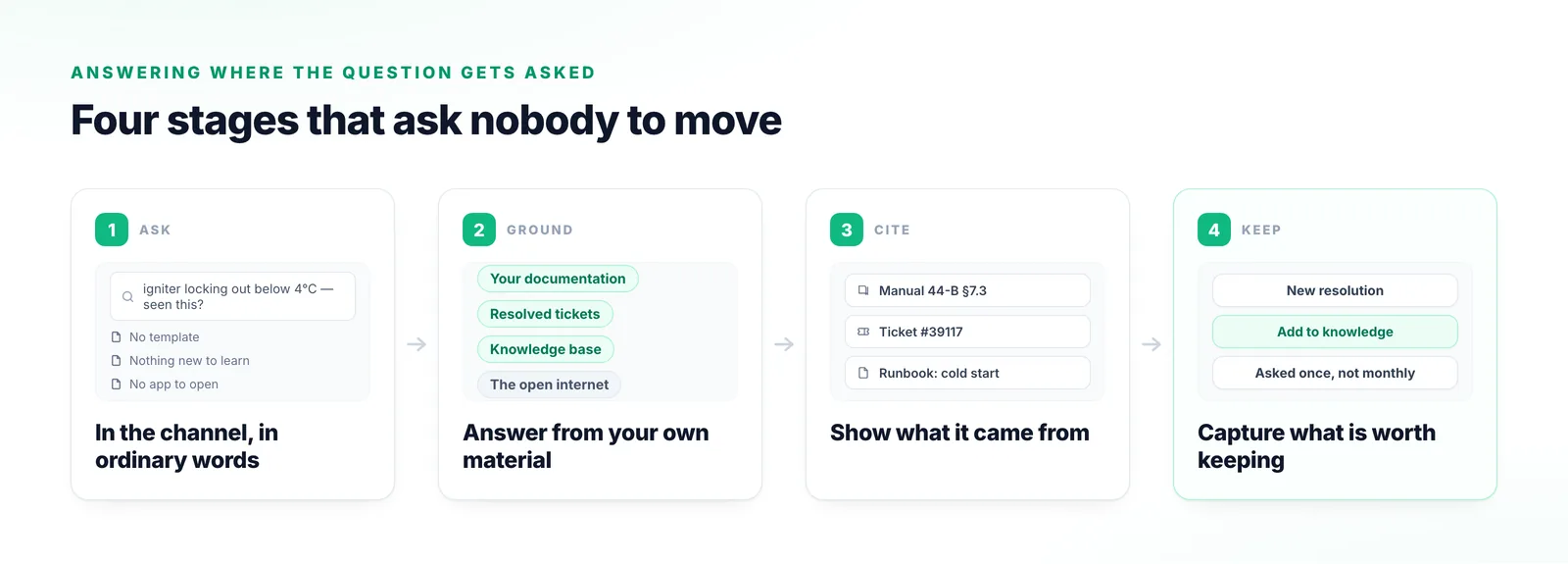
Four stages: a question typed into a channel, an answer grounded in connected documentation and resolved tickets, the sources shown alongside it, and the exchange captured into the knowledge base.
Nobody changes what they already do at stage one, which is the only reason the remaining three ever run.

Why the channel is the right place for this

The competitor is not your knowledge base. It is the habit of asking a colleague.

It competes with the behaviour, not with a tool

The alternative is asking somebody, which takes four seconds. Anything requiring an agent to leave Slack is slower than the thing it replaces.

Sources are what make it usable

An unsourced answer is a suggestion; a sourced one can be checked in a click. That distinction decides whether senior people use it at all.

It compounds

A question answered in channel can become an article, which makes the next answer better — so the channel turns from where knowledge disappears into where it accumulates.
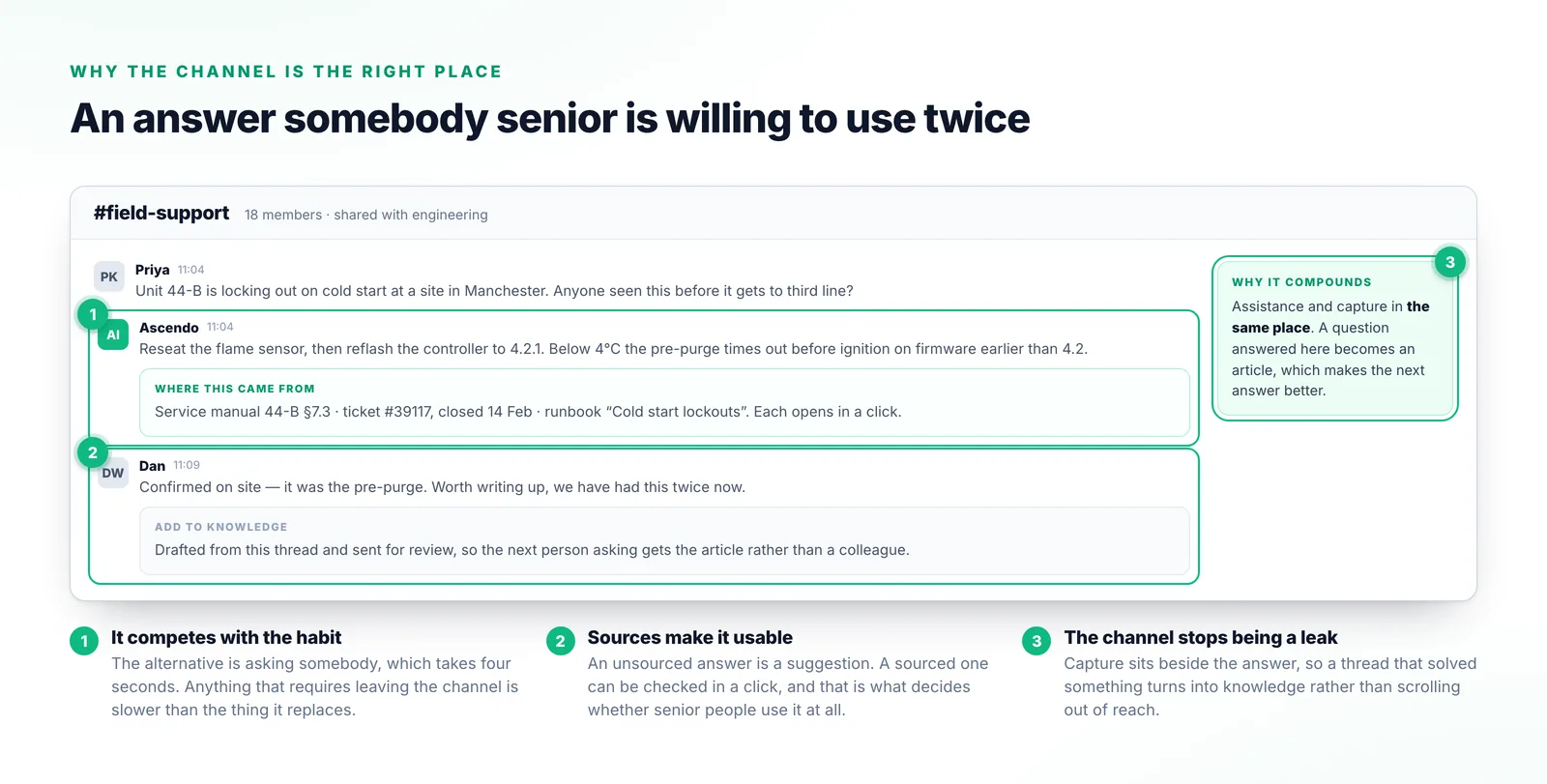
A support channel showing an engineer’s question, a grounded reply citing a manual section and two resolved tickets, and a follow-up capturing the exchange into the knowledge base.
The reply names three places it drew on, which is what lets a senior engineer check it in a click instead of taking it on trust.

Why the usual approaches fall short

Each of these is slower than asking the person sitting next to you.

A knowledge base portal

Requires leaving the conversation and guessing at vocabulary. It loses to a colleague every time.

Asking a colleague

Fast and accurate, and it costs two people without ever making the answer findable.

A general assistant in Slack

Fluent on everything except your data, which is the worst combination on your own equipment.

A separate agent console

Capable, and a context switch. Usage tracks how far it sits from the work.
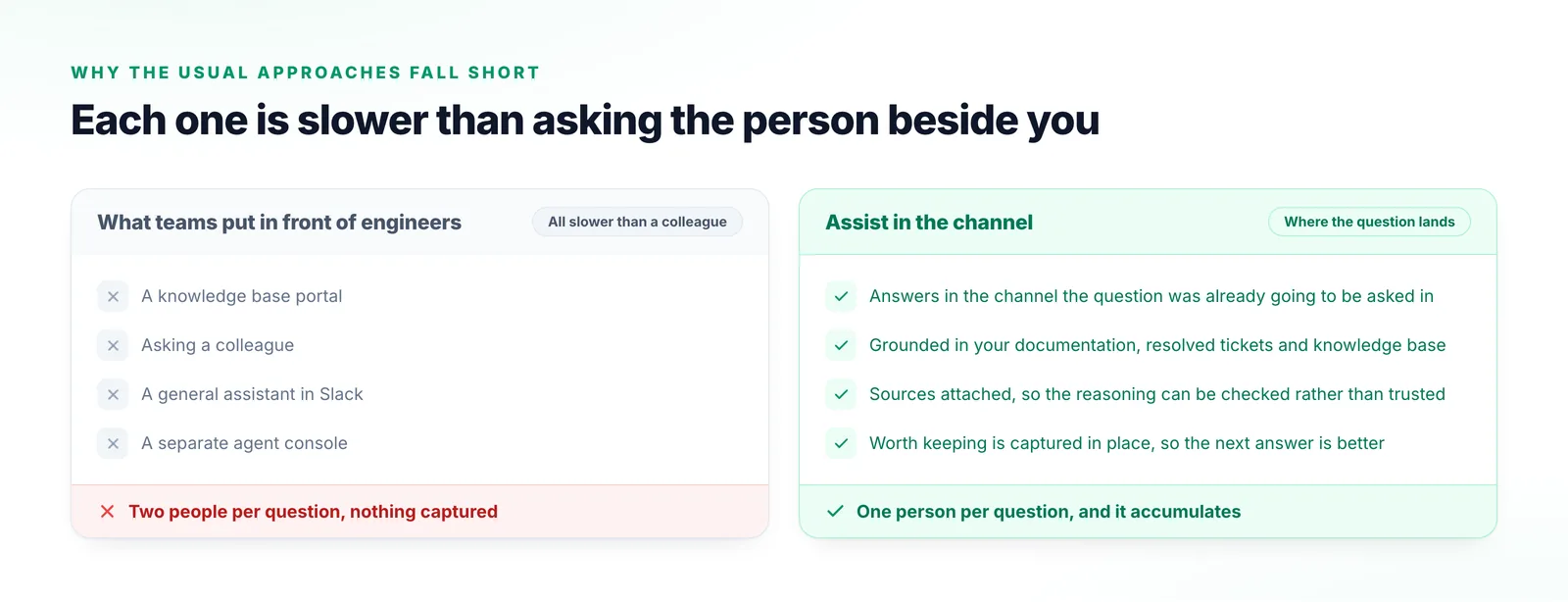
Two columns comparing a knowledge base portal, asking a colleague, a general assistant in Slack and a separate agent console with grounded assistance in the channel.
Usage tracks how far a tool sits from where the work happens, which is why three of the four on the left lose to a colleague.

What things are called

Grounding and citation are the two that matter here.

Agent assist
Suggestions and answers offered to a person, who decides what to do with them.
Grounding
Restricting answers to your own documentation and resolved work.
Citation
The source shown alongside an answer so it can be verified.
Add to knowledge
The Slack flow that captures a solution from a conversation into the knowledge base.
Connected source
A system Ascendo indexes and can answer from — documentation, tickets, Confluence, Jira.

Frequently Asked Questions

Your team. This is Slack as an internal surface, where your engineers ask each other questions. Using Slack as a shared channel with customers is a different tour and a genuinely different problem.

Resolution Agent

Pilot it in one channel

This is the smallest useful starting point we have. Pick a single engineering channel and we will show you what it answers over your own material.

Talk to us