Resolution Agent

Knowledge from a Slack thread

Support teams solve real problems in Slack every day and almost none of it becomes reusable. This is Ascendo recognising that a thread resolved something and drafting an article from it — ready for review rather than written from scratch, captured in the channel where the work actually happened.

  • A resolved thread becomes a draft article
  • Captured where the work happened, not afterwards
  • A person reviews before anything is published
  • The knowledge base grows from work already done

Watch the full tour

Verify your work email once and every research paper, case study and product tour on ascendo.ai opens, right here, without leaving the page.

  • Takes about 30 seconds
  • Work email only, no spam

The answer was given, in a thread, and that was the end of it

Slack is where a lot of technical organisations actually solve things. Somebody asks, somebody who knows replies, the problem goes away, and the thread scrolls out of reach.

Everyone agrees it should have been written up. Nobody does, because writing it up is a separate task afterwards for a person who has already moved on. The result is a knowledge base whose gaps sit exactly where the interesting problems are.
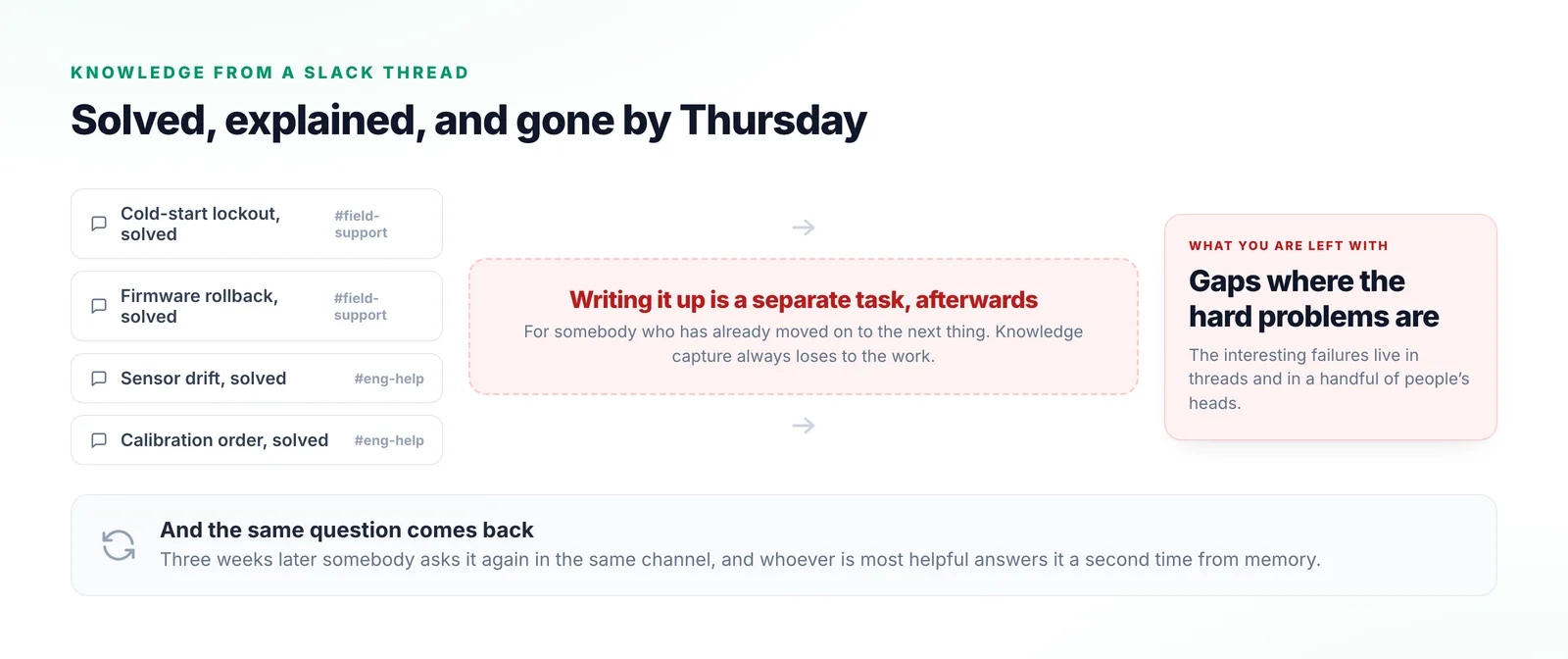
Four solved Slack threads feeding into a step marked as a separate task after the fact, producing a knowledge base whose gaps sit exactly where the hard problems are.
The easy things are documented because they were easy to document. Everything on the left of this diagram was solved and then lost.

From thread to reviewable article

The second step is what stops this filling your knowledge base with conversation.

  1. Step 1

    Recognise that something was resolved

    Not every thread contains an answer. Only the ones where a problem was genuinely solved get picked up.

  2. Step 2

    Separate the answer from the conversation

    A thread is mostly not the answer. What gets extracted is what was wrong and what fixed it, not a transcript.

  3. Step 3

    Draft it into shape

    Structured the way your knowledge base expects, so what lands in review is something to edit rather than a raw excerpt.

  4. Step 4

    A person approves it

    It goes for review before publication. Editing a specific draft takes minutes; a blank page does not.
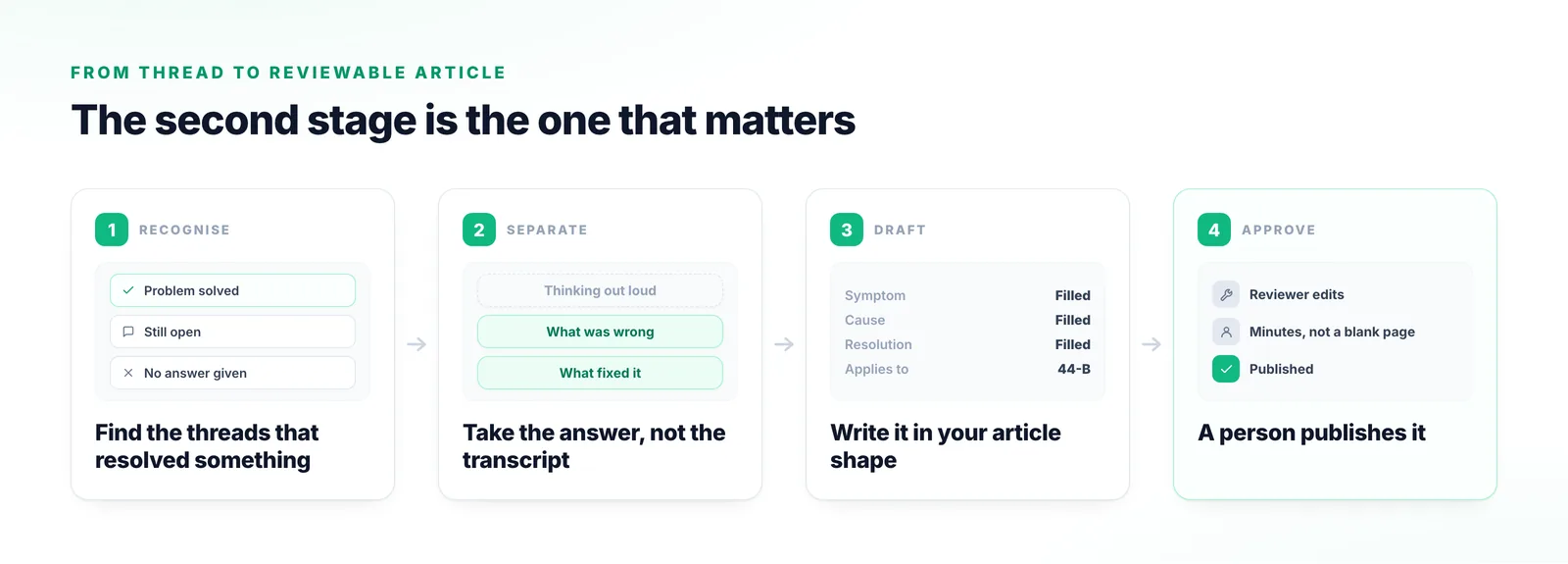
Four stages: recognising that a thread resolved something, extracting the resolution from the conversation around it, drafting it into the shape of a knowledge article, and sending it for human review.
Stage two is what keeps conversation out of the knowledge base; stage four is why a reviewer spends minutes rather than an afternoon.

Why capture has to happen in the channel

Every step that asks somebody to go elsewhere is a step where capture stops.

Capture at the moment of resolution

The explanation is complete and precise while the person giving it still has the problem in their head, and it decays from that moment.

It happens where the work already is

Nobody has to open a knowledge tool, remember a template or leave the channel. Each of those is a place where the process stops, and one of them always does.

The base grows from real demand

What gets written up is what came up, so coverage follows the problems your team really has rather than a content plan drawn up a year ago.
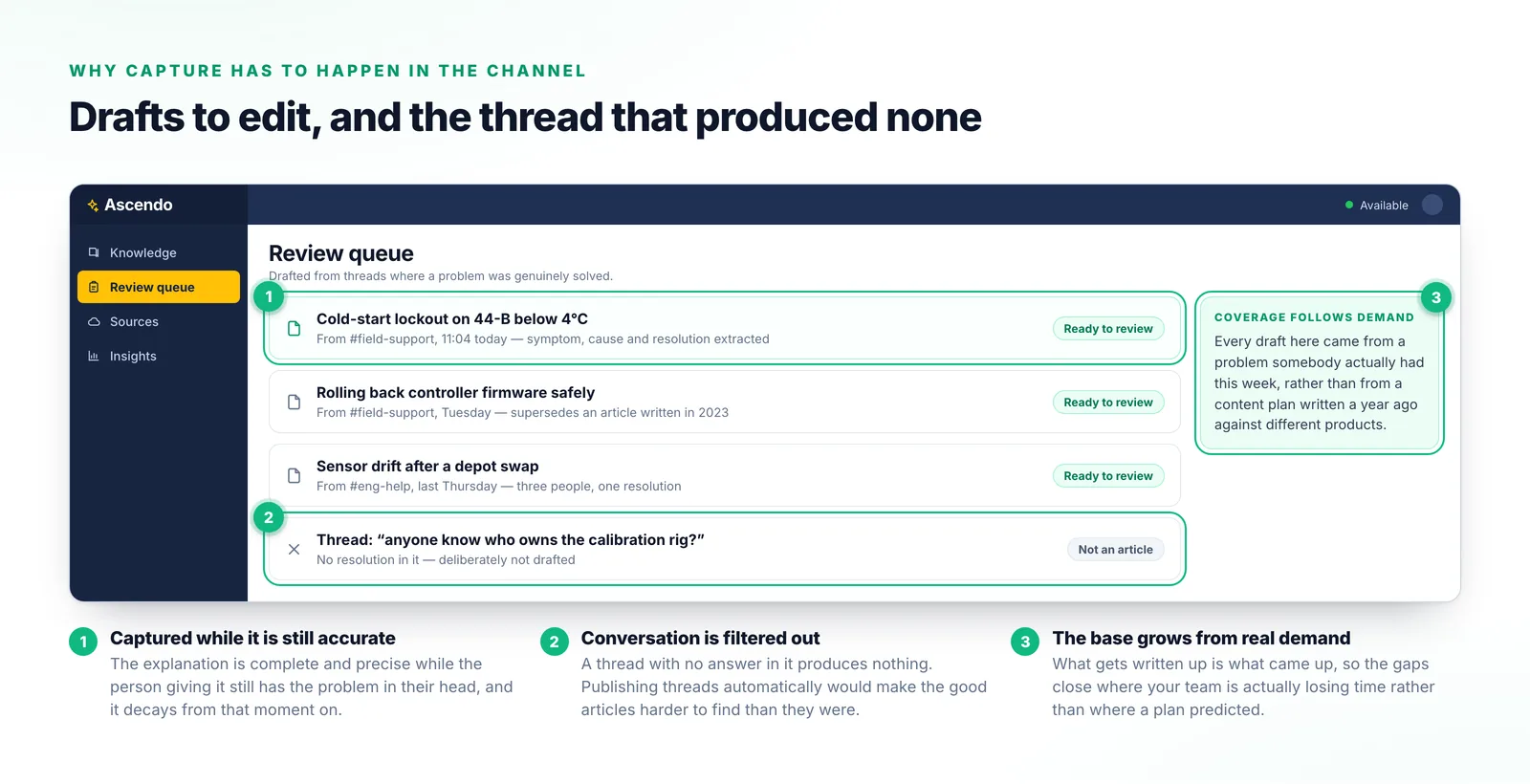
A review queue of articles drafted from Slack threads, each showing the channel it came from and the problem it covers, with one thread listed as not drafted because it contains no resolution.
The fourth row is the point: a thread with no resolution in it produces no article, which is what publishing threads wholesale cannot do.

Why the usual approaches fall short

The last one is the tempting shortcut, and it is the worst of them.

Asking people to document afterwards

Competes with the queue and loses. Coverage is thinnest on the hard problems.

Searching Slack history

The thread is still there and nobody finds it. Search returns messages, not answers.

A quarterly documentation sprint

Written from memory weeks later. Right in outline, wrong in the details that mattered.

Publishing threads automatically

Fills the knowledge base with conversation, which makes the good articles harder to find.
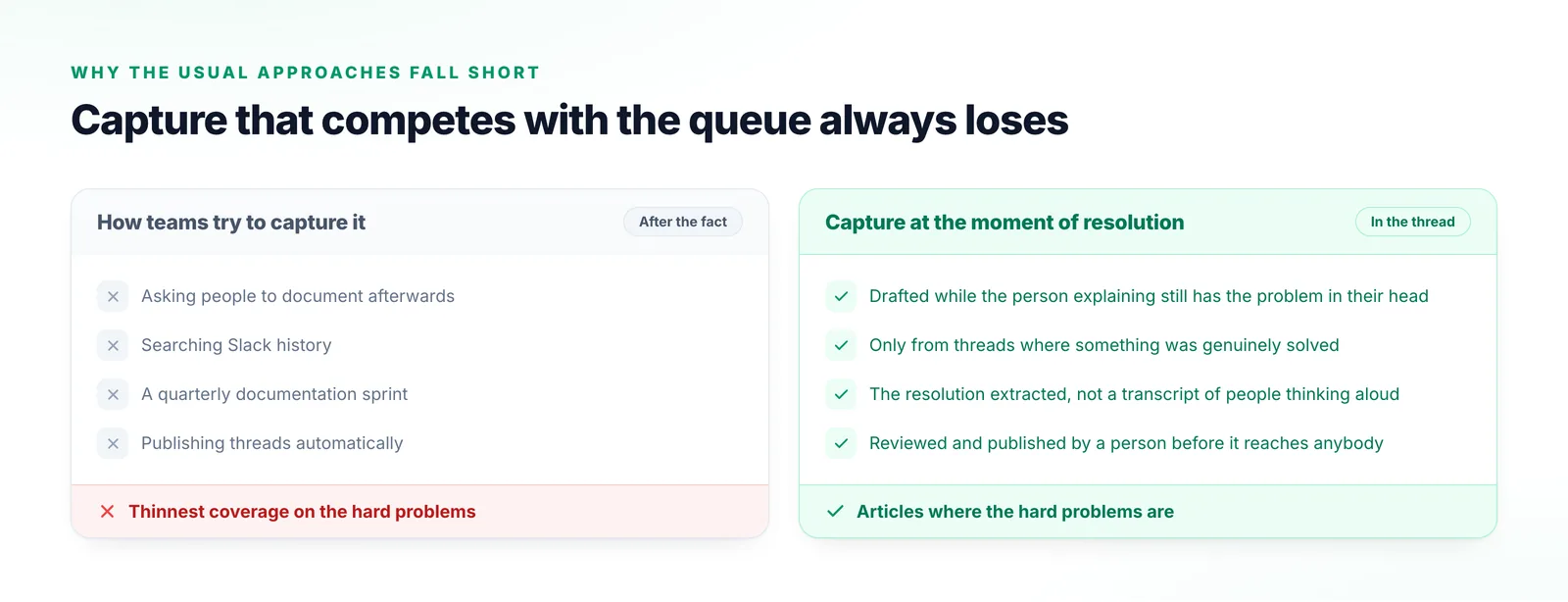
Two columns comparing asking people to document afterwards, searching Slack history, quarterly documentation sprints and publishing threads automatically with capture at the moment of resolution.
Publishing threads wholesale is the tempting one, and it is the worst: it buries the good articles under conversation.

What things are called

Draft is the load-bearing word here.

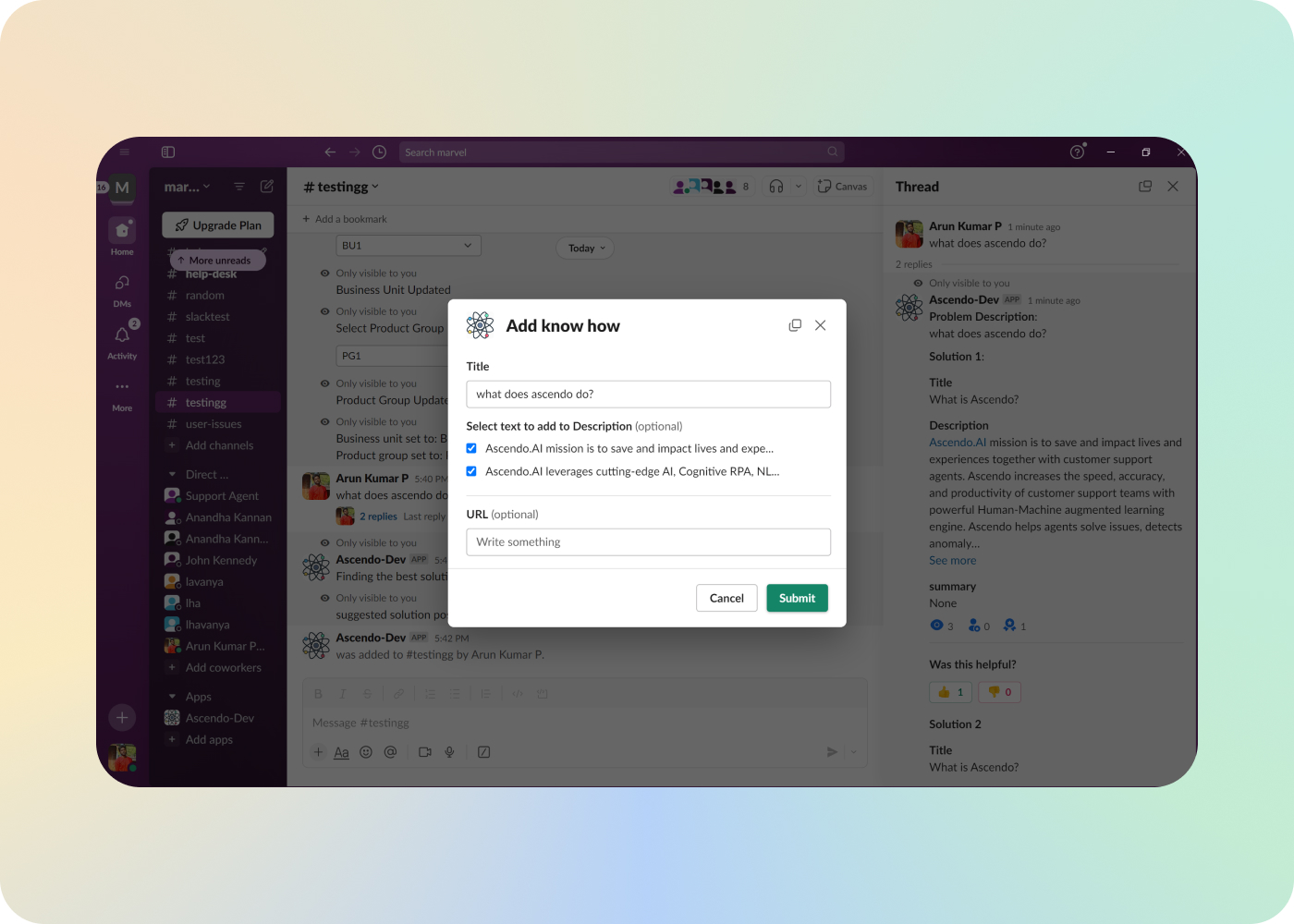
Add to knowledge
The Slack flow that captures a solution from a conversation into the knowledge base.
Draft
A generated article awaiting human review. Not a publication.
Resolution extraction
Separating what actually fixed the problem from the discussion around it.
Knowledge Intelligence
The agent that generates, structures and maintains articles.
Capture at source
Recording knowledge in the channel where the work happened rather than afterwards in a separate tool.

Frequently Asked Questions

No. Everything goes to a person as a draft for review before publication. Automatic publication would fill your knowledge base with unverified content, which costs more than the empty space it was filling.

Knowledge Agent

Look at last month’s threads

Pick a channel where your team solves things. We will show you the articles that could have come out of it without anybody being asked to write one.

Talk to us