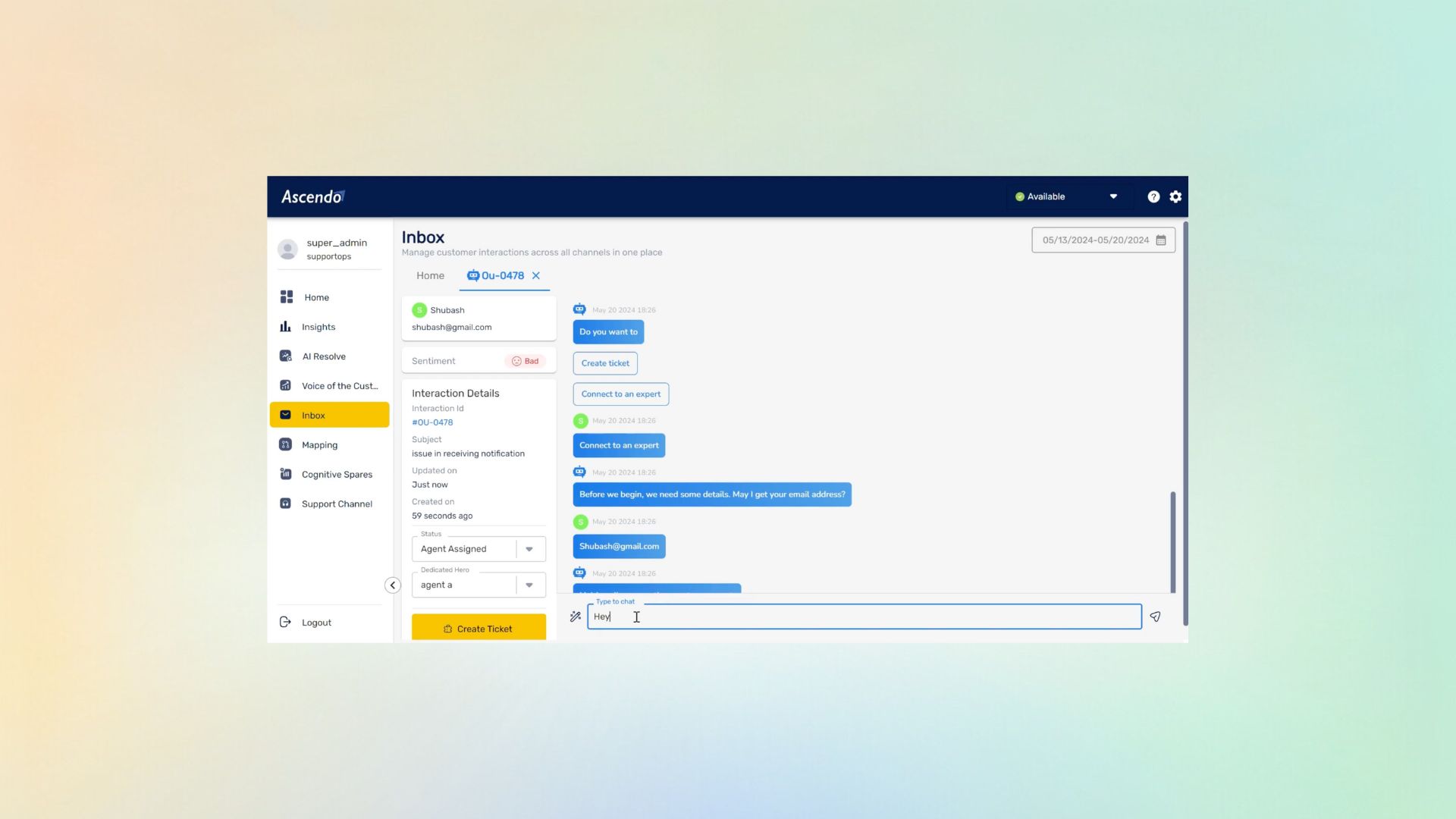
Resolution Agent

Automatic agent assignment

Tickets matched to the agent most likely to resolve them — on skill, on past success with similar fault codes, and on current workload — rather than round robin or whoever happens to be free at the time.

  • Matched on skill and demonstrated success
  • Current workload weighed into the decision
  • Fewer reassignments and fewer cold starts
  • The field service version also weighs parts and location

Watch the full tour

Verify your work email once and every research paper, case study and product tour on ascendo.ai opens, right here, without leaving the page.

  • Takes about 30 seconds
  • Work email only, no spam

Round robin is fair to agents and expensive for everyone else

Most assignment is round robin or first-available. Both are easy to explain and neither has any relationship to who will actually resolve the ticket.

The reassignment is the visible cost and the smaller one. The larger cost is the tickets never reassigned, worked slowly by somebody capable but unfamiliar while a person two desks away had closed the same fault three times.
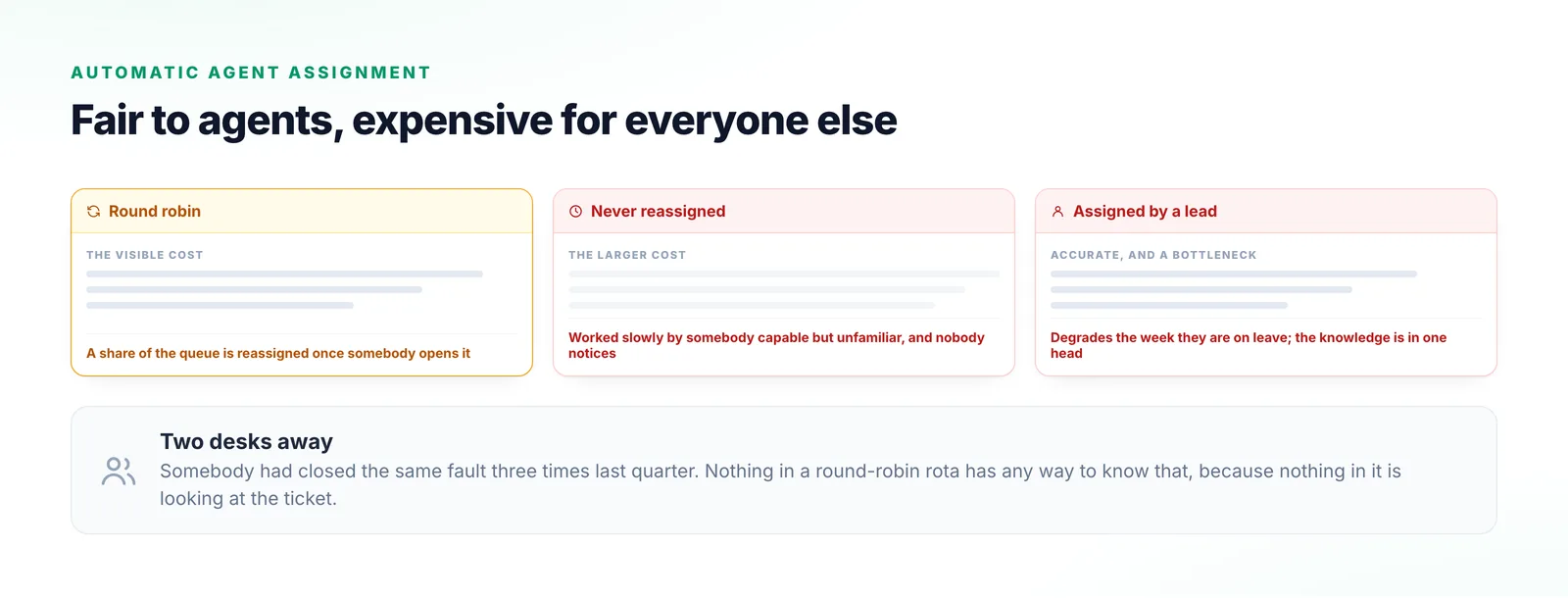
Three cards on how work gets distributed: round robin unrelated to who will resolve it, the tickets never reassigned and worked slowly, and manual assignment consuming a senior person every morning.
The middle card is the expensive one, and it is the only one that never appears in a reassignment count.

What goes into the decision

Most routing rules stop after the second step. The third is where the difference is.

  1. Step 1

    What the ticket actually is

    Assignment starts from a categorised, understood request rather than a subject line.

  2. Step 2

    Who has skill in it

    Skills and product coverage narrow the field to who could handle it at all, which is where most routing rules stop.

  3. Step 3

    Who has actually resolved it

    Past success with similar fault codes is what makes this more than a skills matrix.

  4. Step 4

    Who has capacity now

    Current workload is weighed in, so the best-matched person is not handed everything until they become the bottleneck.
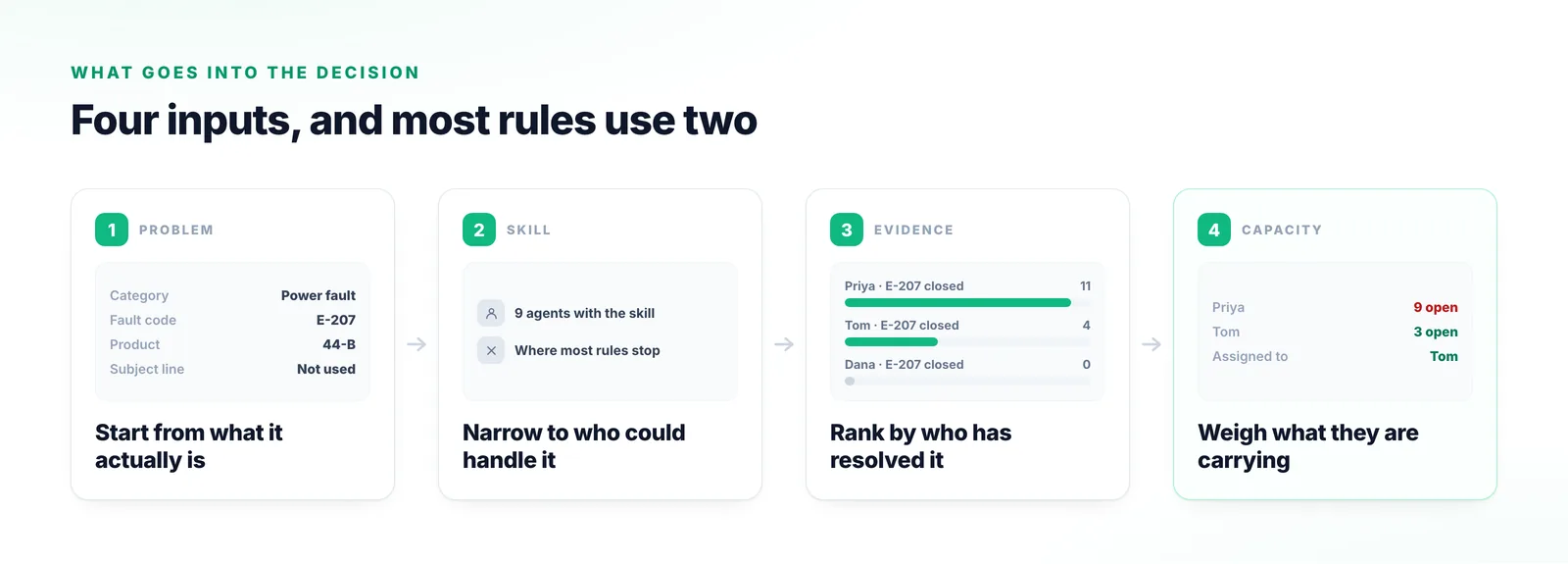
Four stages feeding an assignment decision: understanding what the ticket is, narrowing to people with the skill, ranking by who has actually resolved this fault before, and weighing current workload.
Most routing rules stop after the second stage. The third is where a skills matrix and demonstrated outcomes part company.

Three reasons this holds up in practice

Skills-based routing has a well-known failure mode, and the second point is the fix.

Demonstrated success, not a skills matrix

Every organisation has a skills list and most are out of date, self-declared, or both. Matching on who has actually resolved similar fault codes uses evidence you already generate.

Capacity is part of the match

Matching on suitability alone concentrates every hard ticket on the same three people until they are the queue. Weighing workload is what makes it sustainable.

It removes a coordination job

When assignment is automatic, nobody spends their morning distributing work and the routing does not degrade the week that person is on leave.
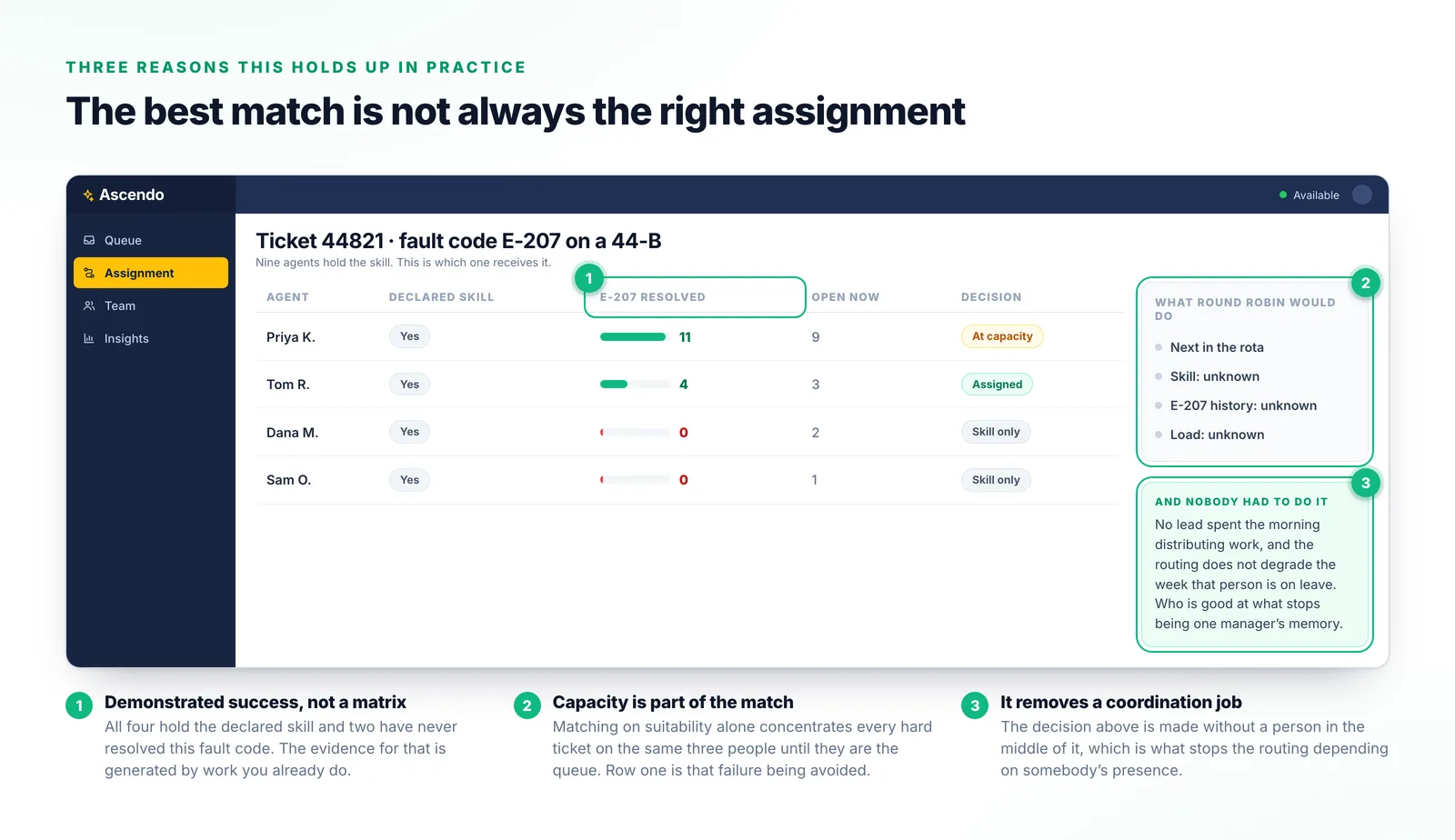
An assignment view listing four candidate agents with their declared skills, how many tickets with this fault code they have actually resolved, their current workload and the resulting decision.
The best-matched agent is not the one assigned, because she is already carrying nine open cases.

Why the usual approaches fall short

Two optimise the wrong thing and two do not scale.

Round robin

Perfectly fair and entirely unrelated to who will resolve it.

First available

Optimises speed of pickup rather than speed of resolution, which are frequently opposite.

Manual assignment by a lead

Accurate while that person is there, and it consumes a senior person every morning.

Routing by product only

Says nothing about who inside the team has solved this before.
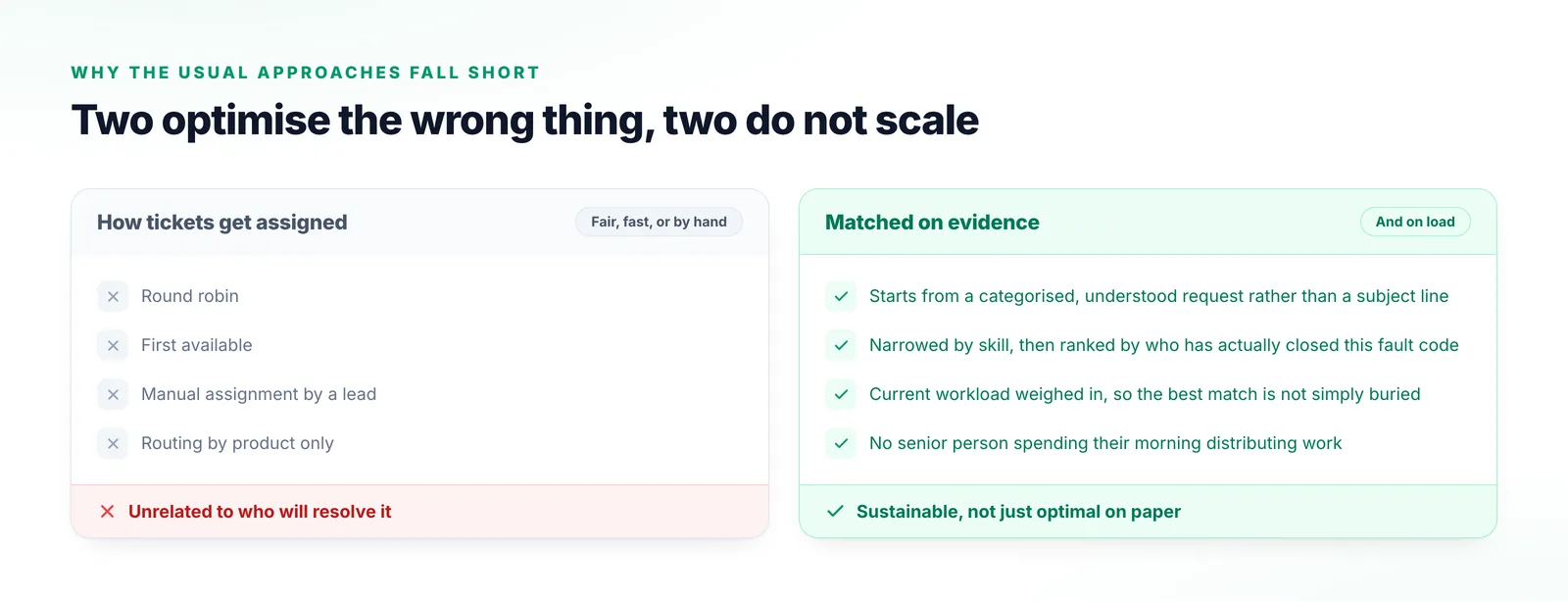
Two columns comparing round robin, first available, manual assignment by a lead and routing by product only with assignment on demonstrated success and current capacity.
First-available optimises pickup speed, which is frequently the opposite of resolution speed on a hard fault.

What things are called

Assignment and dispatch solve the same problem under different constraints.

Assignment
Matching a request to the person who will work it.
Skill match
Narrowing to the people who could handle the request at all.
Demonstrated success
Past resolution outcomes on similar fault codes, used as evidence in place of a declared skill.
Load balancing
Weighing current workload so that the best match does not become the bottleneck.
Dispatch
The field service version, which also accounts for parts availability and technician location.

Frequently Asked Questions

This is the support-desk version: ticket to agent. Dispatch is the field service version, where the same idea also has to account for parts availability and where the technician physically is. Related, and genuinely not the same decision.

Resolution Agent

Look at your reassignment rate

Reassignments are the cheapest measure of bad routing, and you already collect them. Show us yours and we will show you how much of it was avoidable.

Talk to us