AI Spare Parts Planning vs ERP Forecasting
ERP forecasting projects spare parts demand from past consumption, so it plans accurately for parts that move steadily and poorly for parts that fail rarely and unpredictably. AI spare parts planning predicts demand from failure signals — asset telemetry, service history and open cases — so a critical slow-moving part can be positioned before the failure that consumes it. Ascendo’s spare-parts agent forecasts this way.
ERP forecasting
Works from
- Consumption history
Delivers
Accurate demand for parts that move steadily
pixels.png&w=48&q=75)
Ascendo
Works from
- Failure signals
- Telemetry
- Service history
- Open cases
Delivers
Critical parts positioned before the failure
SLA commitment on spare parts managementNokia · customer case study
Where the difference actually is
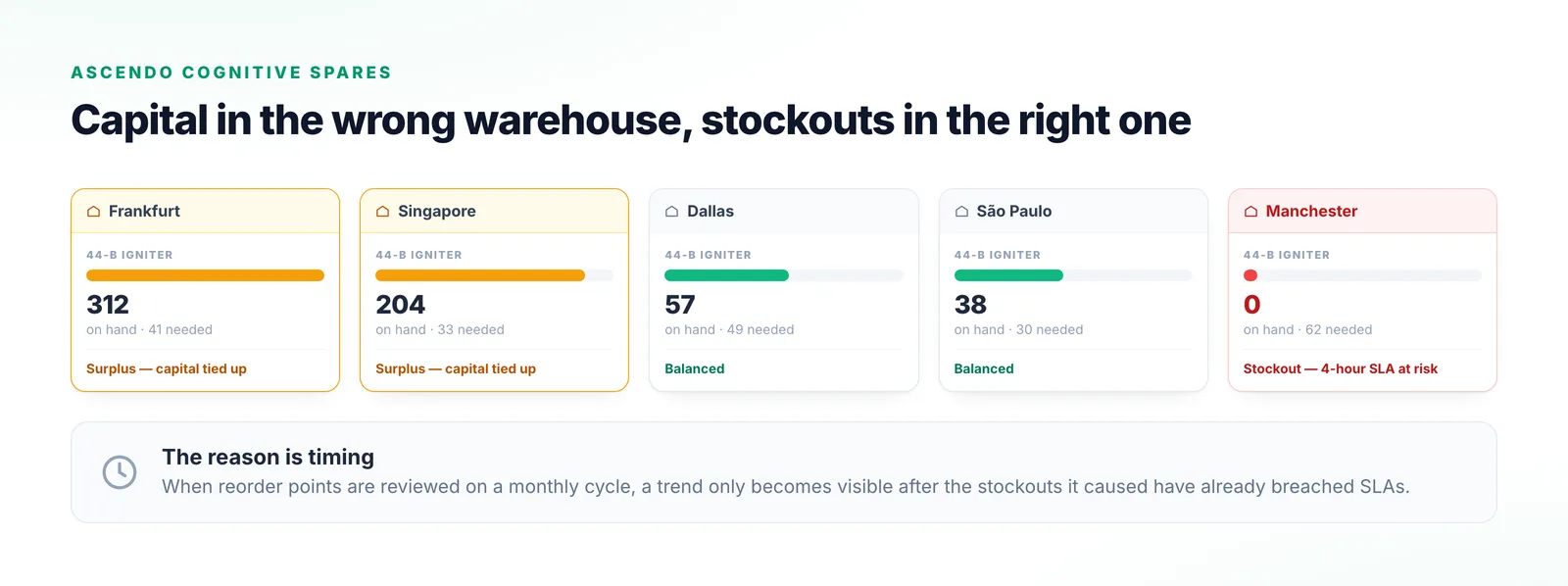
Every service organisation has two populations of parts, and one forecasting method. The fast-moving consumables behave statistically: they are consumed at a rate, history predicts the future, and ERP handles them well. The slow-moving critical spares do not behave statistically at all. A part consumed four times a year has no usable demand curve, and those are precisely the parts whose absence strands an engineer and breaks an SLA.
Averaging across both populations is what produces the familiar result: high inventory value and stockouts at the same time. The distinction that matters is not better maths on the same input. It is a different input — moving from what was consumed to what is about to fail.
What this looks like in Ascendo
How they differ
| Dimension | ERP forecasting | Ascendo |
|---|---|---|
| What demand is inferred from | ERP forecastingHistorical consumption of the part. | AscendoFailure signals on the installed base — telemetry, fault patterns, service history, open cases. |
| Fast-moving consumables | ERP forecastingStrong. Stable series, mature statistical methods, well understood. | AscendoComparable. There is little to add where history is already predictive. |
| Slow-moving critical spares | ERP forecastingWeak. Too few events to form a series, so planning defaults to safety stock or judgment. | AscendoPredicts from the condition of the assets that consume the part rather than from its own history. |
| New products and new installs | ERP forecastingNo history, so no forecast until failures accumulate. | AscendoInfers from behaviour of comparable assets and shared components. |
| Positioning | ERP forecastingPlans quantity at a location against reorder points. | AscendoTies the part to the predicted job, so it can be moved to the engineer who will need it. |
| Where it lives | ERP forecastingThe system of record for stock, purchasing and finance. | AscendoA planning layer that writes recommendations back into that system. |
Which one you actually want
Neither answer is right for everyone. These are the conditions that decide it.
Stay with ERP demand forecasting when
- Your parts are mostly fast-moving consumables with years of stable history. ERP statistical forecasting is mature, cheap and already paid for.
- Purchasing, finance and stock control are the actual constraint, rather than forecast accuracy.
- You have no telemetry or structured service history on the installed base — without failure signals there is nothing better than consumption to predict from.
- Inventory is centralised with short lead times, so a stockout is an inconvenience rather than an SLA breach.
An agent system fits better when
- Critical spares are slow-moving and a stockout strands an engineer or breaches an SLA.
- You are carrying high inventory value and still seeing stockouts — the signature of averaging across two populations.
- Lead times are long enough that reacting to consumption is already too late.
- The installed base emits usable failure signals, or the service history is rich enough to stand in for them.
Frequently Asked Questions
See it against your own service data
The honest way to settle a comparison is to run it on your own cases and assets rather than on anyone’s feature table.