AI Agents vs Hiring More Technicians
Hiring adds capacity, but a new service technician takes months to a year to reach senior productivity, and that expertise leaves when the person does. AI agents capture how experienced technicians diagnose and deliver it at the point of work, so newer technicians resolve unfamiliar faults like experienced ones. The two solve different constraints. Ascendo captures that expertise as a company brain.
Hiring more technicians
Works from
- New headcount
Delivers
More capacity, after months of ramp-up
pixels.png&w=48&q=75)
Ascendo
Works from
- Resolved work
- Expert reasoning
- Asset history
Delivers
Expert diagnosis delivered to every technician
Where the difference actually is
Framed as a budget question this comparison is misleading, because headcount and agents relieve different bottlenecks. If the constraint is hands — someone has to physically be at the site, and there are more sites than people — no software resolves it. If the constraint is judgment, where the work is waiting on the three people who know the fault, then hiring is a slow and expensive way to buy something the organisation already owns but cannot distribute.
The demographics make the second constraint harder every year. Experienced technicians retire faster than they are replaced, and what leaves with them was never written down. That is the case for capturing expertise as infrastructure rather than continuing to hold it in individuals, whichever way the hiring decision goes.
What this looks like in Ascendo
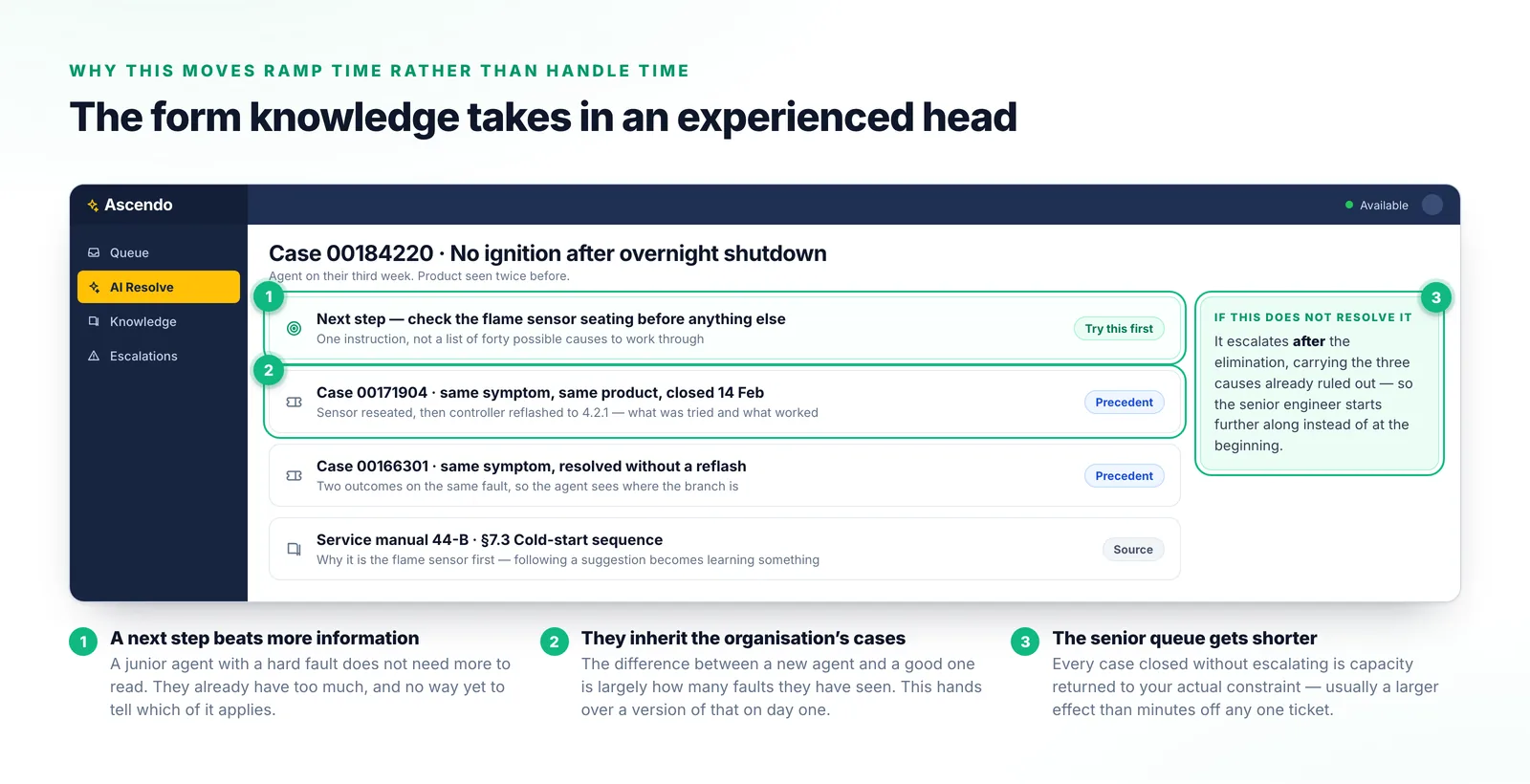
How they differ
| Dimension | Hiring more technicians | Ascendo |
|---|---|---|
| Time to productive | Hiring more techniciansMonths to a year to reach senior first-time-fix rates, depending on equipment complexity. | AscendoAvailable to the whole team from the point the sources are connected. |
| What happens when someone leaves | Hiring more techniciansTheir diagnostic knowledge leaves with them unless it was written down, which it rarely is. | AscendoReasoning captured from resolved work stays and keeps compounding. |
| Scaling with volume | Hiring more techniciansRoughly linear — more work needs more people. | AscendoMarginal cost of another query is near zero; capacity is not the limit. |
| Physical presence | Hiring more techniciansThe only option. Someone has to be at the asset. | AscendoCannot replace it. It changes what the person can do once there. |
| Coverage and geography | Hiring more techniciansSolves it directly by putting people where the work is. | AscendoHelps indirectly — fewer repeat visits, less travel wasted on the wrong part. |
| Effect on the senior team | Hiring more techniciansMore people to mentor. Short-term load on the experts increases. | AscendoReduces interruptions by answering the questions that would have reached them. |
Which one you actually want
Neither answer is right for everyone. These are the conditions that decide it.
Stay with hiring more technicians when
- The constraint is physical coverage — jobs are queued because nobody is free to attend, not because nobody knows the fix.
- You are entering a new territory and need people on the ground within it.
- Work requires certification, licensing or physical capability that cannot be delegated to a system.
- There is not enough recorded service history for agents to learn from, and hiring an expert imports that knowledge directly.
An agent system fits better when
- The queue is waiting on a few experts rather than on available hands.
- Senior technicians are retiring and their knowledge is undocumented.
- New hires take months to become effective and the ramp is the cost you are actually paying.
- Repeat visits are driven by diagnosis quality rather than by staffing levels.
Frequently Asked Questions
See it against your own service data
The honest way to settle a comparison is to run it on your own cases and assets rather than on anyone’s feature table.