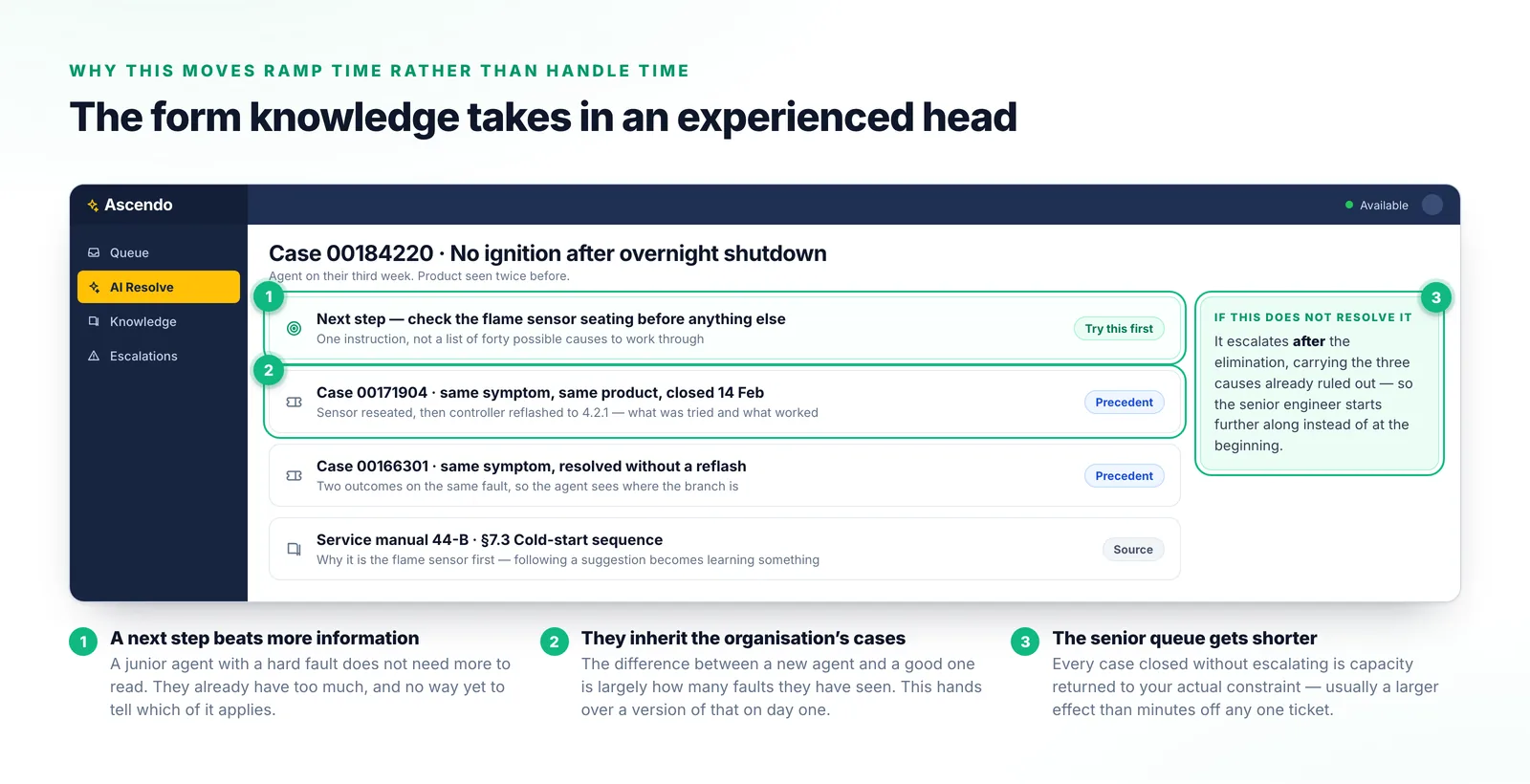
A next step beats more information
A junior agent with a hard fault does not need more to read. The useful output is the single next thing to check, which is the form knowledge takes in an experienced head.
Follow a newer agent taking a problem they have never seen from first contact through to a closed ticket. Ascendo suggests the next diagnostic step, pulls the matching history from similar cases, and keeps them moving — instead of the escalation that would otherwise happen in the first four minutes.
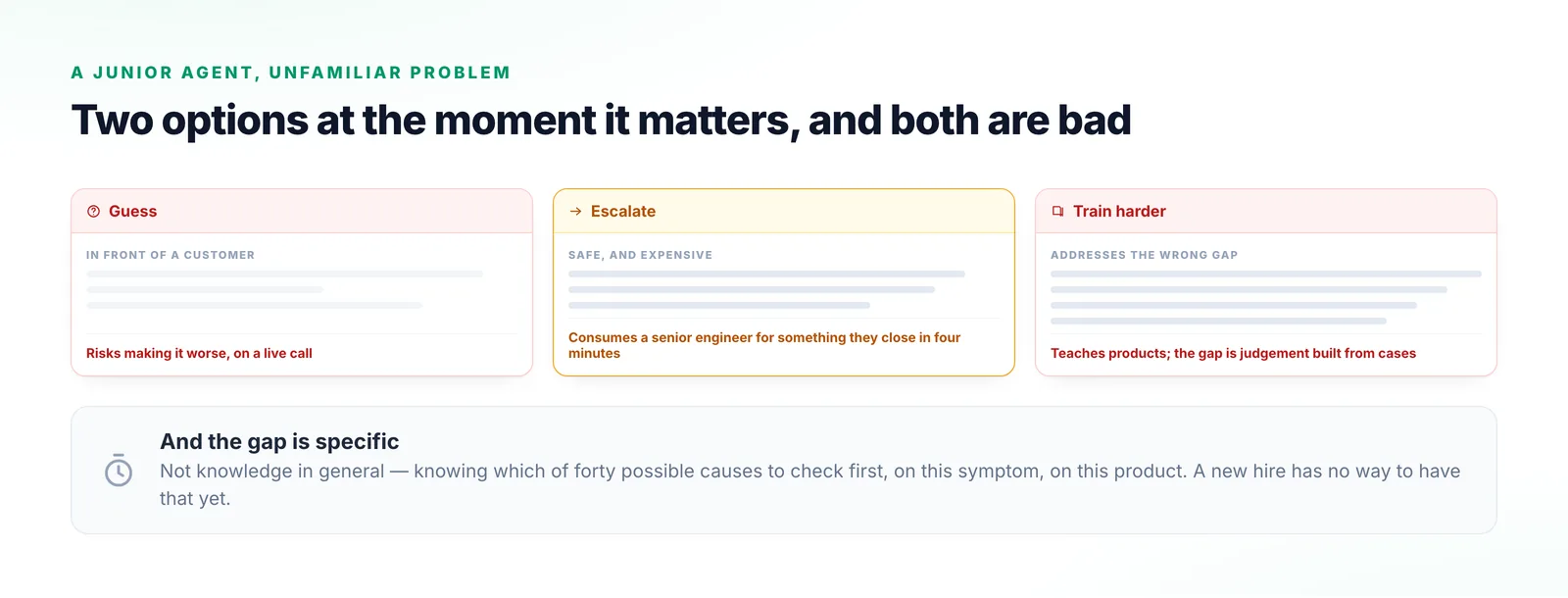
A new agent facing an unfamiliar fault has two options and both are bad. Guess, and risk making it worse in front of a customer. Or escalate, which is safe, slow, and consumes a senior engineer for something they will close in four minutes.
Most escalate, and they are right to. That is how the majority of Tier 1 volume ends up on the desk of the five people who can least afford it — and training does not close the gap, because the gap is judgement built from cases.
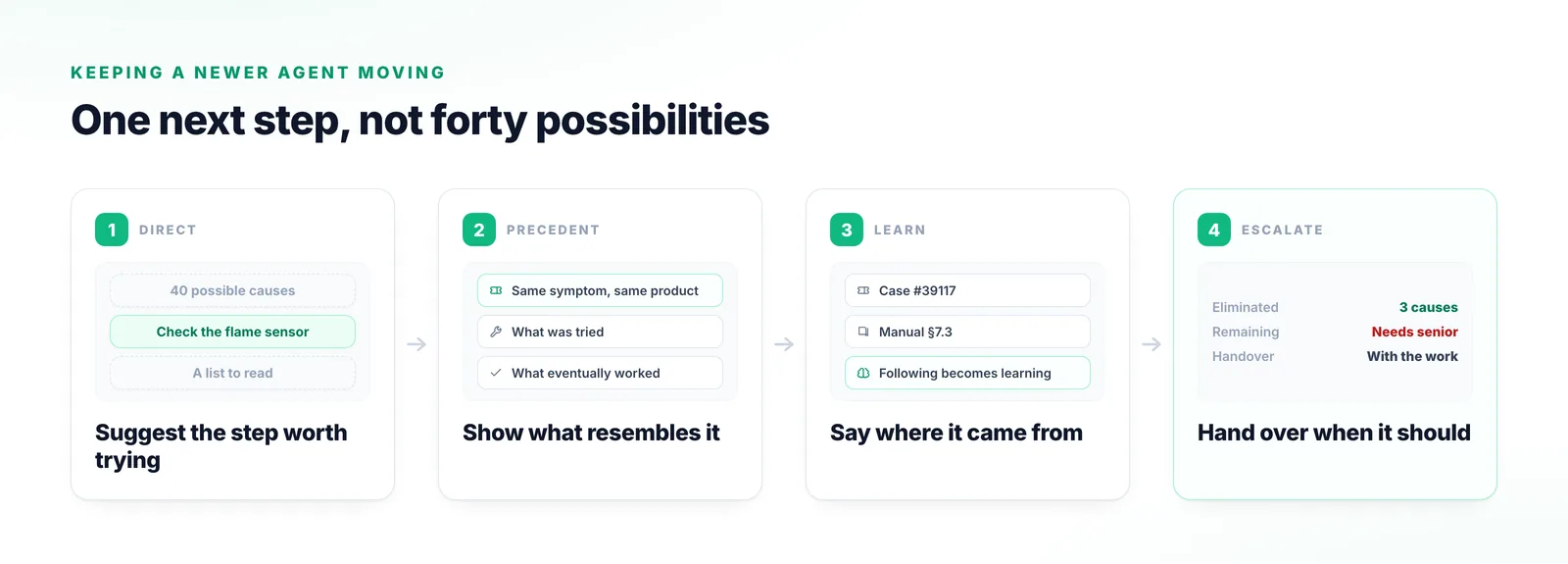
The fourth step matters as much as the first three.
Not a list of possibilities. The step worth trying next on this symptom, so an agent without the instinct still starts in the right place.
Cases with the same symptom on the same product, including what was tried and what worked.
Each suggestion carries the case or document behind it, which turns following one into learning something.
Some cases genuinely need a senior engineer. What changes is that the escalation happens after the elimination rather than instead of it.
The operational effect lands on your senior engineers, not on the individual ticket.
A junior agent with a hard fault does not need more to read. The useful output is the single next thing to check, which is the form knowledge takes in an experienced head.
The difference between a new agent and a good one is largely how many faults they have seen. Retrieval across resolved cases hands over a version of that on day one.
Every case closed without escalating is capacity returned to your actual constraint — usually a larger effect than minutes off any individual ticket.
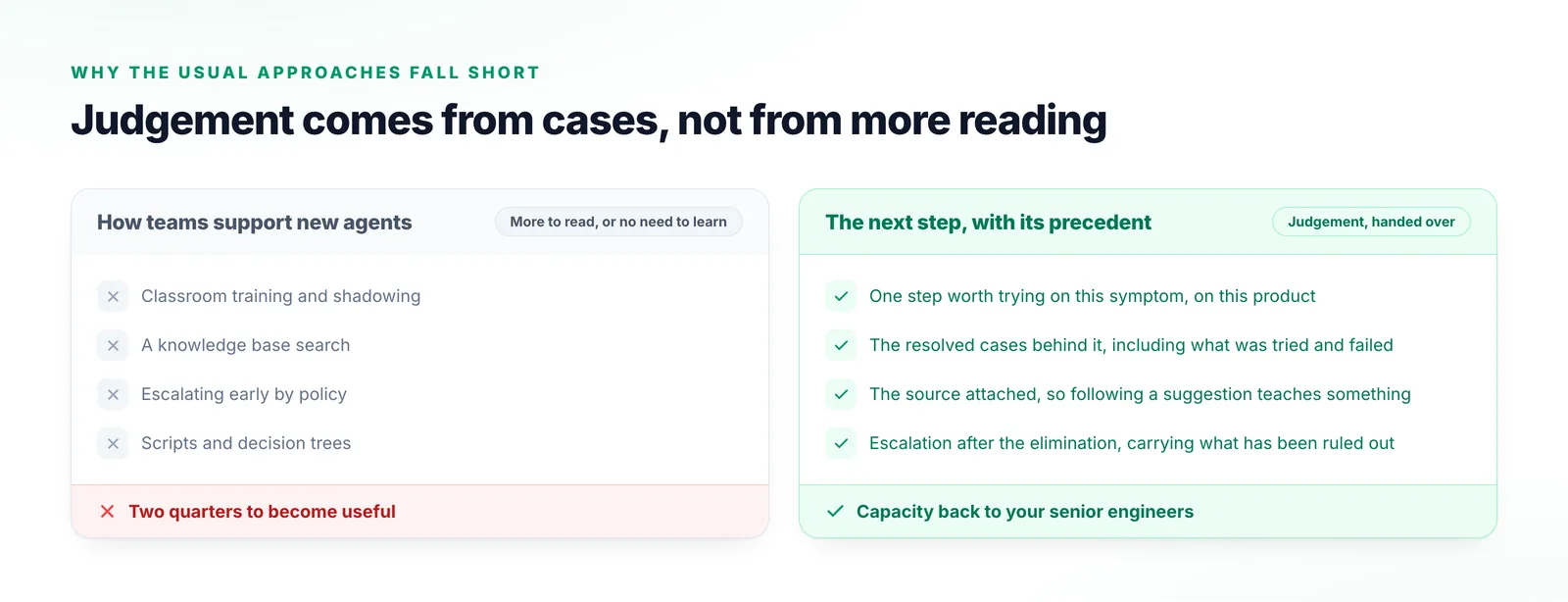
Three of these give a new agent more to read. The fourth removes the need to learn.
Necessary, and it teaches products rather than judgement.
Returns documents to somebody who cannot yet tell which one applies.
Safe, and it turns your senior engineers into the Tier 1 queue.
Work for the faults somebody anticipated and collapse on anything phrased differently.
Elimination is the word that describes what a diagnosis mostly is.
The other end of the same system: prior art and install-base patterns for senior engineers.
What happens when a case genuinely needs an expert, and how their answer gets captured.
The agent reasoning across manuals, tickets and service records at once.
Resolution Agent
Take the cases your junior team escalated last month. We will show you which of them would not have needed to leave Tier 1 at all.
Talk to us