Ascendo vs Building It In-House
Building service AI in-house on a foundation model gives full control, and commits an engineering team to data pipelines for every source, evaluation, security review and maintenance as models change. Ascendo provides that layer already built for service operations, with agents for resolution, dispatch, parts and root cause that connect to existing systems.
In-house build
Starts with
- A foundation model API
- Your engineering team
Delivers
Whatever the team builds, then maintains
pixels.png&w=48&q=75)
Ascendo
Starts with
- Platform connectors
- PII redaction
- Service agents
Delivers
Agents in production on the systems you already run
SLA commitment on spare parts managementNokia · customer case study
Where the difference actually is
With capable foundation models a single API call away, an in-house support assistant looks like a short project: connect the documents, add retrieval, write a prompt. The first demo usually does arrive quickly. The work that decides whether it reaches production comes afterwards — connecting every source system and keeping those connections current, evaluating answers against real faults, handling sensitive data, and maintaining all of it as the models underneath change.
None of that is a reason not to build. Some organisations should: those with a strong platform team, a narrow use case close to their core product, or requirements no vendor can meet. The useful question is whether service AI is a product the engineering team should be building, or infrastructure the service organisation needs to be running.
What this looks like in Ascendo
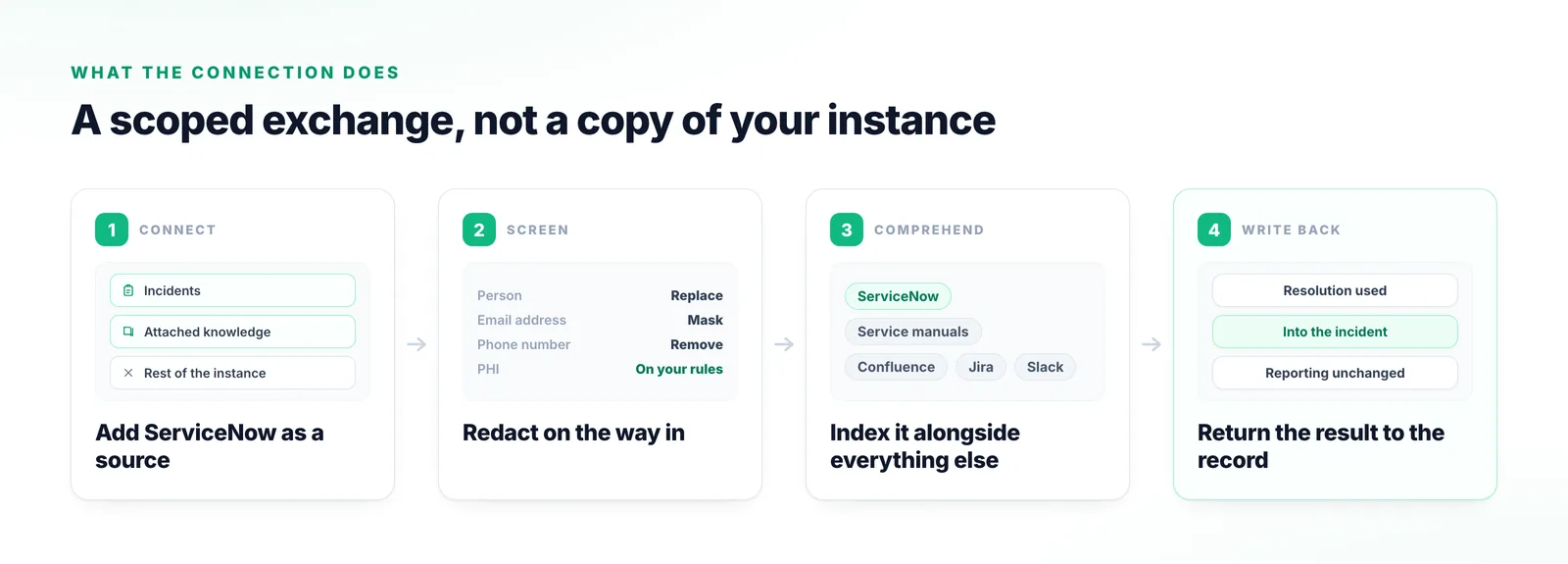
How they differ
| Dimension | In-house build | Ascendo |
|---|---|---|
| Control | In-house buildComplete. Model choice, architecture, data handling and roadmap are all yours. | AscendoConfigured rather than owned. The platform and its roadmap are maintained by Ascendo. |
| Getting to production | In-house buildSet by source integrations, evaluation, security review and edge cases, which is where most of the effort goes. | AscendoThose layers already exist for service operations; the work is connecting sources and configuring agents. |
| Service-specific capability | In-house buildEach capability — dispatch, parts prediction, root cause, escalation — is its own project. | AscendoAgents for resolution, dispatch, spare parts, root cause and escalation are already built. |
| Data protection | In-house buildDesigned, built and reviewed by the team, including redaction before any model call. | AscendoThe PII Redaction Agent strips PII, PHI and proprietary schematics before data enters the reasoning layers. |
| Keeping it working | In-house buildModel upgrades, prompt regressions, connector changes and evaluation fall to the team for as long as it runs. | AscendoMaintained by Ascendo as models and connected systems change. |
| Service platforms | In-house buildEach integration is built and maintained in-house as those systems change. | AscendoConnects to existing platforms such as Salesforce, Zendesk, SAP, Jira and Confluence. |
Which one you actually want
Neither answer is right for everyone. These are the conditions that decide it.
Stay with an in-house build when
- A strong ML platform team already exists, and service AI is close enough to the core product to be a differentiator worth owning.
- The use case is narrow and stable — one document set, one type of question — so the maintenance burden stays small.
- Regulatory or contractual requirements dictate model, hosting or data-handling choices that a vendor cannot accommodate.
- Building internal AI capability is a goal in its own right, and service is the chosen proving ground.
Ascendo fits better when
- Engineering capacity is committed to the core product, and service AI would compete with it for the same people.
- The need spans several service jobs — resolution, dispatch, parts, root cause — rather than one narrow assistant.
- A prototype exists but has stalled on evaluation, integrations or security review.
- The service organisation needs results this year rather than a platform programme.
Frequently Asked Questions
See it against your own service data
The honest way to settle a comparison is to run it on your own cases and assets rather than on anyone’s feature table.