Ascendo vs Glean, ClickUp Brain and Notion AI
A company brain turns what an organization knows into answers people and AI agents can use. Glean, ClickUp Brain and Notion AI build one from workplace apps and documents, for every team. Ascendo builds one for service operations from resolved cases, manuals and asset history, and reasons to the likely cause and fix on a specific asset.
Workplace company brain
Works from
- Docs, tasks and chat
- Connected work apps
Delivers
Answers, drafts and actions across every team

Ascendo
Works from
- Resolved cases
- Manuals
- Logs and telemetry
- Asset history
Delivers
The likely cause and fix on a specific asset, with sources
projected annual ROI, deployed in under an hourEDF Renewables North America · customer case study
Where the difference actually is
As of October 2026, three general-purpose tools are the ones most often meant by "company brain". Glean describes itself as "enterprise AI that understands your company", with search, assistants and agents over 275+ connectors. ClickUp sells Brain² as "your company AI" with a "self-updating Company Brain" across tasks, docs, chat and connected apps. Notion AI works across a Notion workspace and, when enabled, connected apps such as Slack, Google Drive and GitHub.
All three are built for the whole company: every department, every kind of question, inside the tools people already write in. A service organization asks a narrower question with a harder finish line. A technician does not need the document that mentions a fault code; they need the likely cause on this asset and the fix that worked last time, which usually sits in closed cases, logs and asset history rather than in any document.
What this looks like in Ascendo
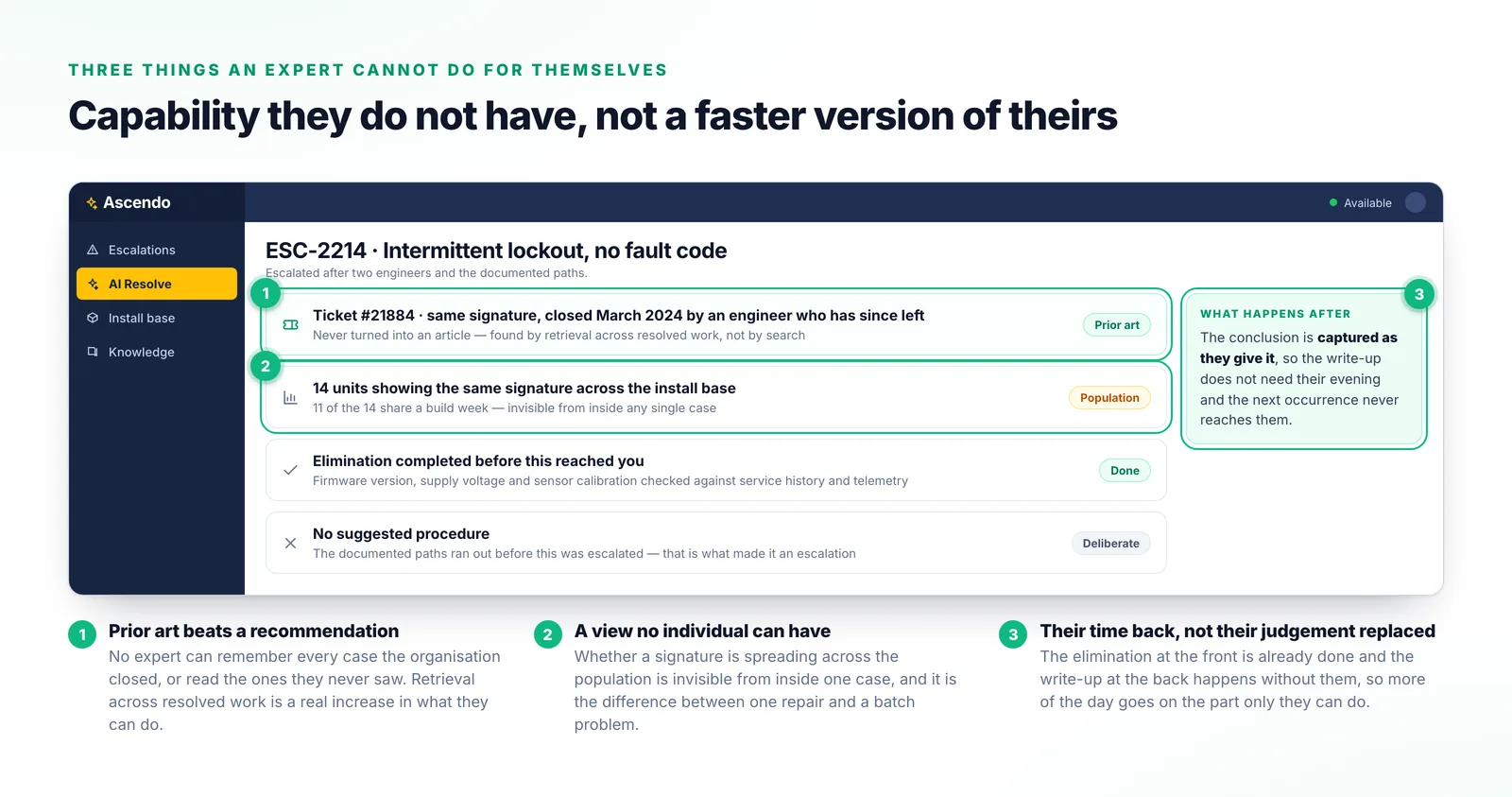
How they differ
| Dimension | Workplace company brain | Ascendo |
|---|---|---|
| Built for | Workplace company brainEvery team in the company: engineering, HR, sales, operations and the rest. | AscendoService operations: field service, technical support and service engineering. |
| Learns from | Workplace company brainDocuments, pages, tasks, chat and the work apps it connects to. | AscendoResolved cases, work orders, manuals, logs, telemetry and asset records, as well as documents. |
| Unit of knowledge | Workplace company brainThe document, page or message. | AscendoThe fault pattern: symptom, asset, cause and the fix that worked. |
| Asset context | Workplace company brainNot modelled. Content about a product reads the same for every installation. | AscendoReasons about the specific asset, its configuration and its fault history. |
| What it hands back | Workplace company brainAnswers, summaries, drafts and actions in the workspace. | AscendoA likely cause, repair steps and parts, with the cases and documents behind them. |
| Measured by | Workplace company brainTime saved finding and producing work across the company. | AscendoFirst-time fix, resolution time, repeat visits and escalations. |
Which one you actually want
Neither answer is right for everyone. These are the conditions that decide it.
Stay with Glean, ClickUp Brain and Notion AI when
- The goal is one AI layer for every department, and service questions are a small share of what people ask.
- Most of the knowledge you need is already written down in documents, pages and tickets, and the job is finding and using it.
- Your teams already plan and write their work in ClickUp or Notion and want the AI where they work.
- You need company-wide search across hundreds of applications before anything service-specific.
A service company brain fits better when
- Technicians find the right documents and still escalate, because the fix is not written in any of them.
- The knowledge that resolves faults lives in closed cases, logs and asset history, and with the senior people about to retire.
- Answers have to be specific to the asset, model and configuration in front of the technician.
- Success is measured in first-time fix and escalations, and the answer has to turn into a work order, a part or a dispatch.
Frequently Asked Questions
See it against your own service data
The honest way to settle a comparison is to run it on your own cases and assets rather than on anyone’s feature table.