Resolution Agent

Confluence, at the moment it matters

Your best documentation is probably already written and sitting in Confluence, where nobody looks during a live ticket. This is Ascendo reading across your spaces and putting the relevant passage in front of an agent while they work, without anyone leaving the case to go and search for it.

  • Reads across your spaces, not one page at a time
  • The relevant passage arrives during the ticket
  • Nobody leaves the case to go searching
  • An adoption fix, not another content project

Watch the full tour

Verify your work email once and every research paper, case study and product tour on ascendo.ai opens, right here, without leaving the page.

  • Takes about 30 seconds
  • Work email only, no spam

The documentation exists. Nobody reads it during a ticket.

Confluence is where most technical organisations keep their best material — runbooks, product documentation, the page somebody wrote after a bad incident. It goes almost entirely unread during a live ticket.

That is not laziness. Searching it while a customer waits means leaving the ticket, guessing at the author’s vocabulary and reading several pages to find which applies. So the organisation concludes it has a documentation problem. It usually has a retrieval problem, and writing more pages makes it worse.
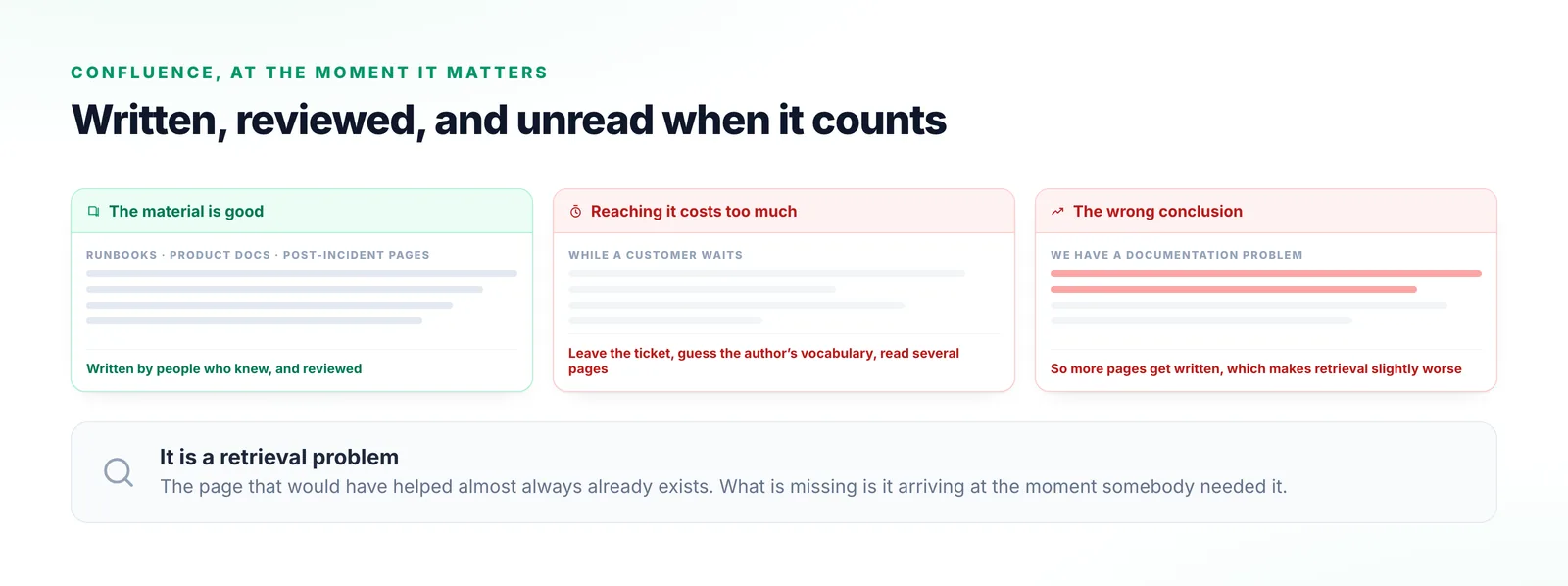
Three cards: good material written and reviewed in Confluence, the friction of searching it while a customer waits, and the wrong conclusion that the organisation has a documentation problem.
The third card is where the money goes. Writing more pages addresses authoring, and the failure was in retrieval.

Bringing the page to the ticket

The material is already written. All four of these are about it arriving in time.

  1. Step 1

    Index the spaces

    The spaces you nominate are read in and kept current, so retrieval reflects the page as it is now.

  2. Step 2

    Search on the problem, not the wording

    Retrieval runs on what the ticket is about, so the right passage is found without guessing which words the author chose.

  3. Step 3

    Read across spaces at once

    Answers are frequently split — the procedure in one space, the caveat in another. Both are found together.

  4. Step 4

    Deliver it into the case

    The passage appears where the agent is already working, which is the difference between documentation being available and being used.
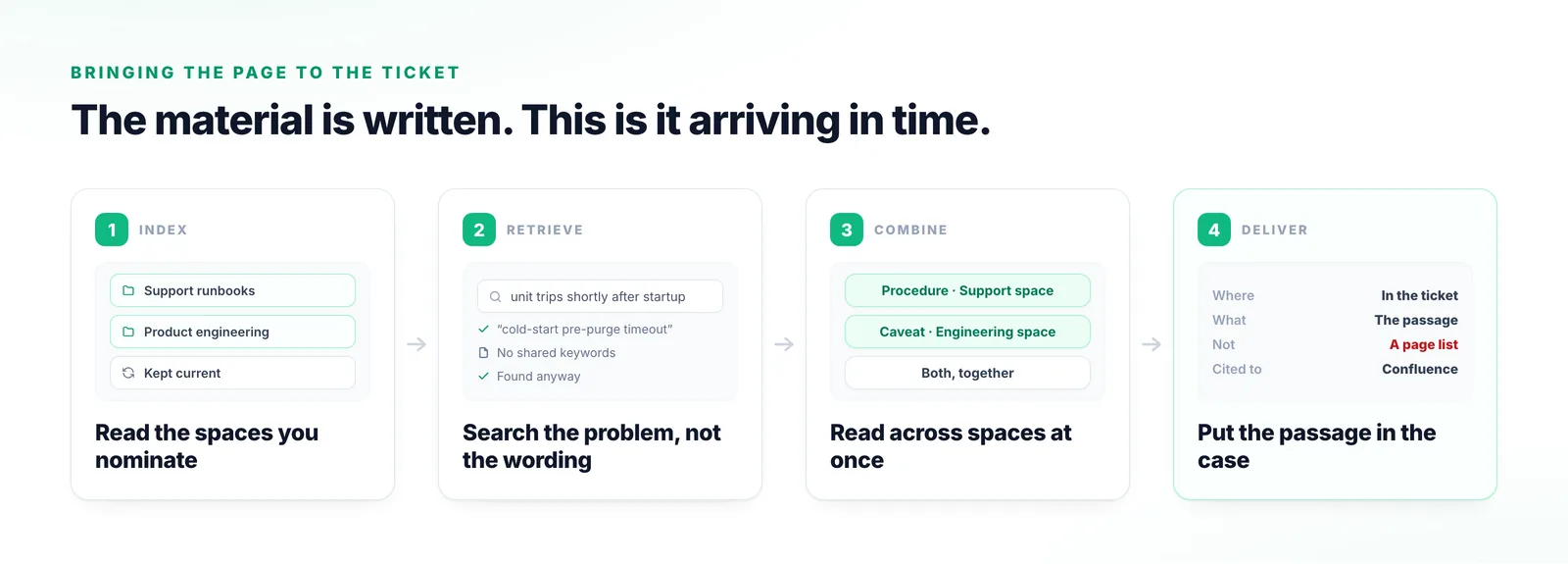
Four stages: nominated spaces indexed and kept current, retrieval run on the problem rather than the wording, several spaces read together, and the passage delivered into the case.
Stage two is where the vocabulary gap closes: the ticket says one thing, the page says another, and they still meet.

Why this is not a documentation project

The page you needed almost always already existed.

It is an adoption fix, not a content one

Most teams respond to unused documentation by writing more of it. The page that would have helped usually exists; what is missing is it arriving in time.

Confluence is one source, not the only one

Restricting an answer to Confluence would rebuild the silo. The same request also reaches your resolved tickets, your manuals and whatever else you have connected.

The page stays the source of truth

Nothing is copied into a second system to go stale. Answers cite the page they came from, so the author keeps ownership.
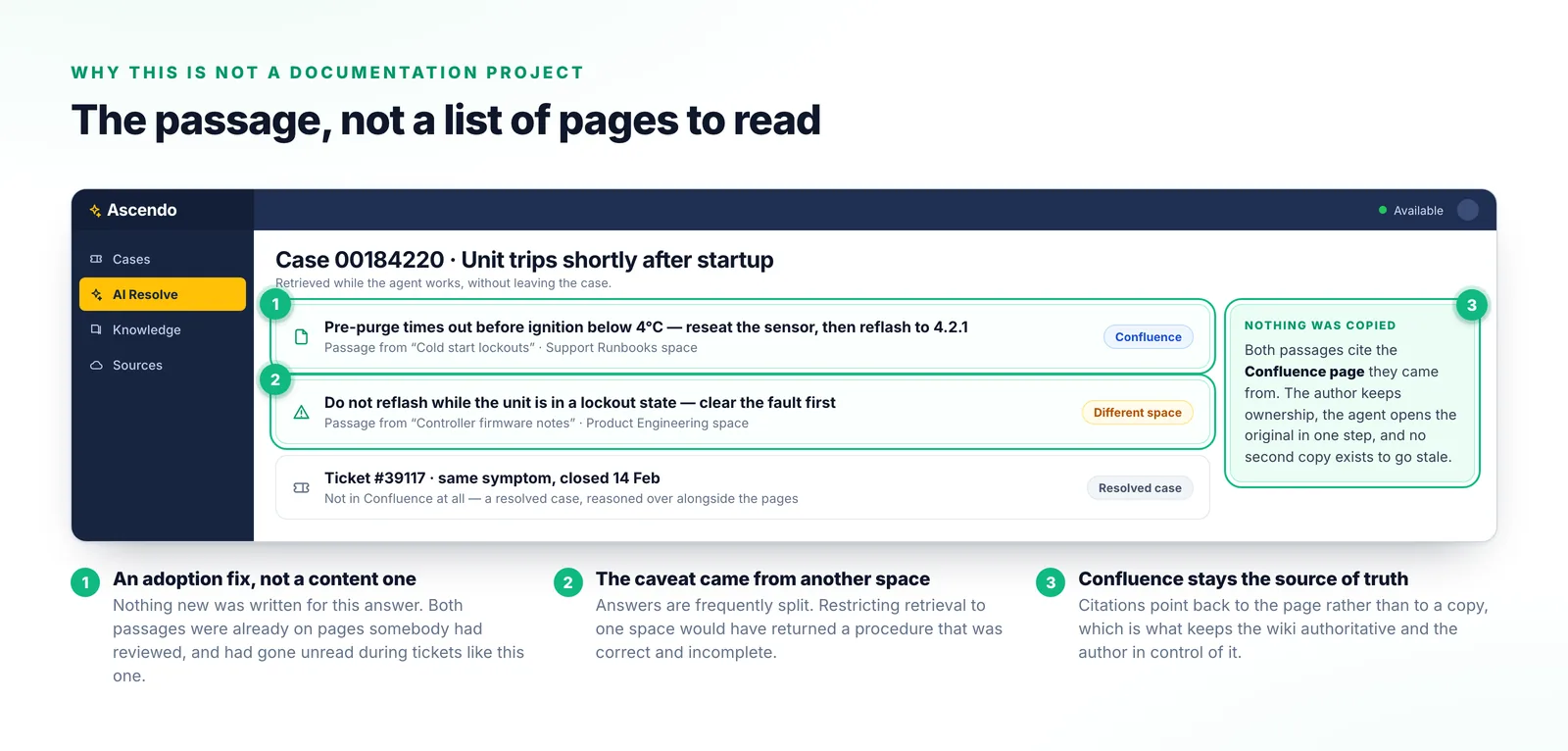
A case view showing a passage retrieved from a support space, a caveat from an engineering space, and a resolved ticket, each citing the Confluence page it came from.
Two spaces and a resolved ticket in one answer, each citing back so the author keeps ownership of the page.

Why the usual approaches fall short

Three of these lose to asking a colleague, which takes four seconds.

Confluence search itself

Matches the author’s words against the agent’s guess, and returns pages rather than passages.

Copying content into a support tool

Creates a second copy that diverges. Within a quarter nobody can say which is current.

Asking a colleague

Fast, accurate, and it consumes two people. It is how the same question gets answered forty times.

Writing more documentation

The reflex response, and it addresses authoring rather than retrieval.
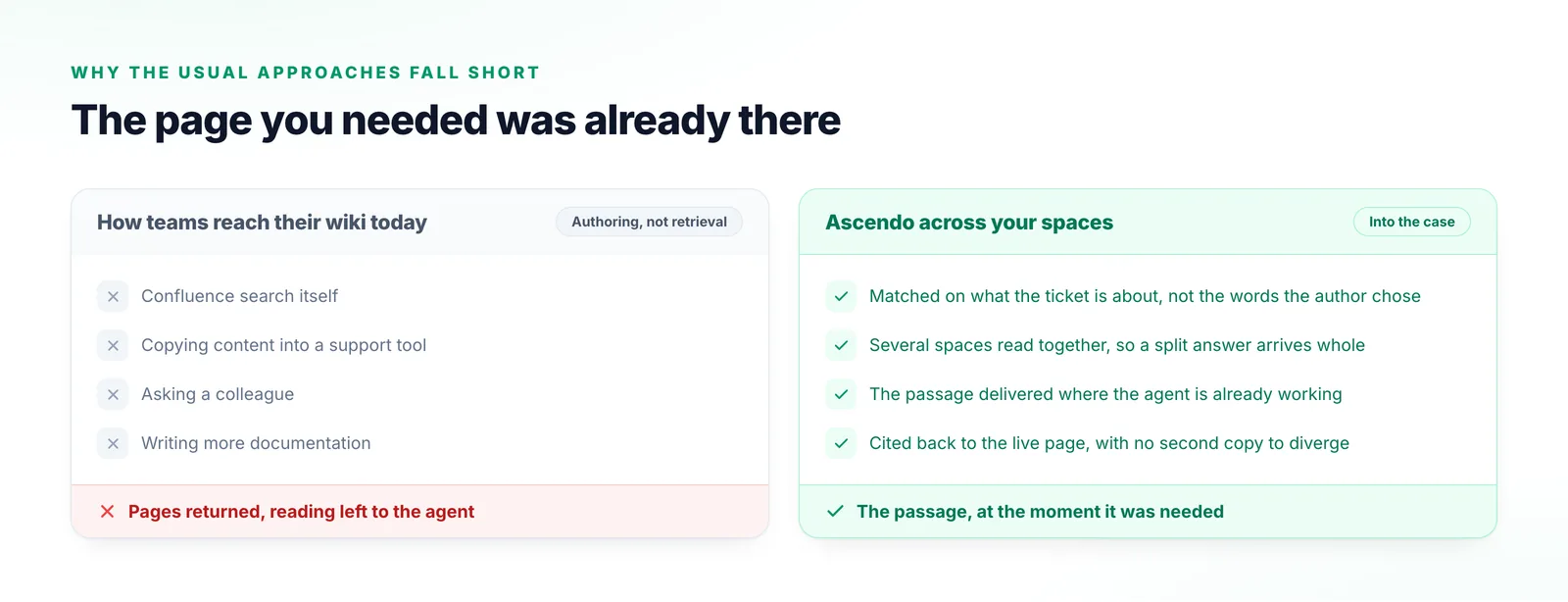
Two columns comparing Confluence search, copying content into a support tool, asking a colleague and writing more documentation with retrieval delivered into the case.
Three of the four on the left lose to a colleague, which takes four seconds and answers the same question forty times.

What things are called

Confluence vocabulary, and the two Ascendo terms it meets.

Space
A Confluence area holding related pages, and the unit you nominate for indexing.
Passage retrieval
Returning the relevant part of a page rather than the page itself.
Data source
A connected system Ascendo indexes and reasons over. Confluence is one among several.
Citation
The link back to the source page, so an answer can be checked and the original opened.
Mapping
Associating a source with products or product groups, which also controls who can see it.

Frequently Asked Questions

No, and you should not. Confluence stays the system of record and the author keeps ownership. Ascendo indexes it and cites back to it, so there is no second copy drifting out of date behind your back.

Resolution Agent

Test it on your own spaces

Point us at the Confluence spaces your team relies on and we will show you what Ascendo answers from them — including the pages nobody has opened in a year.

Talk to us