Resolution Agent

Bot to human, without starting over

A bot conversation reaches its limit and moves to a person. What carries across decides everything: the full transcript, what the customer has already tried, and the context the bot gathered — so the agent does not open with "can you explain the issue again?"

  • The transcript and gathered context carry across
  • The customer does not repeat themselves
  • The agent starts from what has been established
  • Where most bot deployments lose customer trust

Watch the full tour

Verify your work email once and every research paper, case study and product tour on ascendo.ai opens, right here, without leaving the page.

  • Takes about 30 seconds
  • Work email only, no spam

The handoff is where the goodwill gets spent

Customers are more tolerant of bots than support teams expect. They will answer questions and work through steps, provided it is clearly going somewhere. What they will not forgive is doing all of that and then being asked to start again.

That moment is worse than never having offered the bot. It goes unsolved because it belongs to nobody: the bot team measures containment, the agent team measures handle time, and the join appears on neither scorecard.
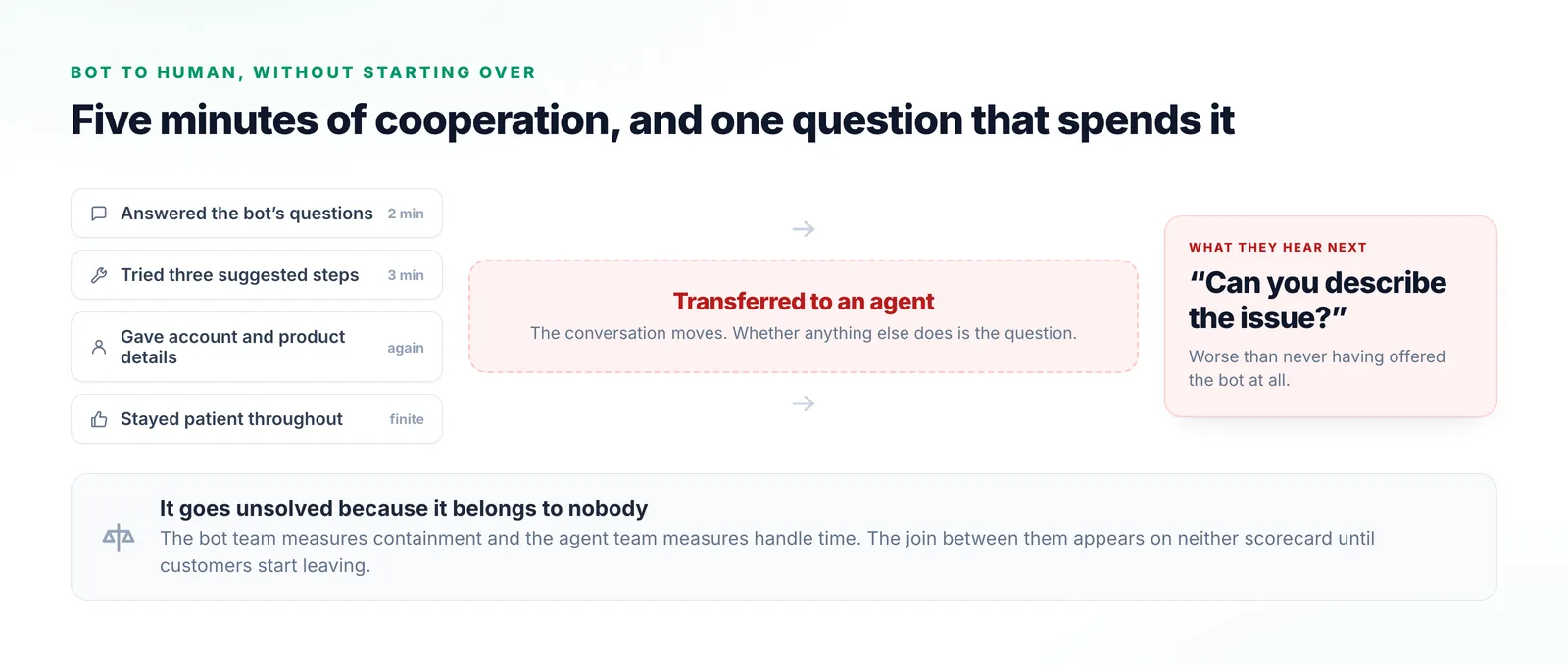
Four things a customer has already done in a bot conversation feeding into a transfer, and arriving at an agent’s opening question asking them to describe the issue from the beginning.
Everything on the left was real work the customer did. The message on the right tells them none of it was recorded.

What has to survive the transfer

The second item is the one most often lost and the one customers most notice.

  1. Step 1

    The full transcript

    Everything that was said, so nothing depends on the customer’s recollection or their willingness to repeat it.

  2. Step 2

    What has already been tried

    The steps the bot suggested and what happened. Re-suggesting something that already failed is the fastest way to lose a conversation.

  3. Step 3

    The context that was gathered

    Product, account and entitlement, so the agent starts from a filled-in picture rather than an empty form.

  4. Step 4

    Why it handed over

    What the bot could not do. That tells the agent where to begin.
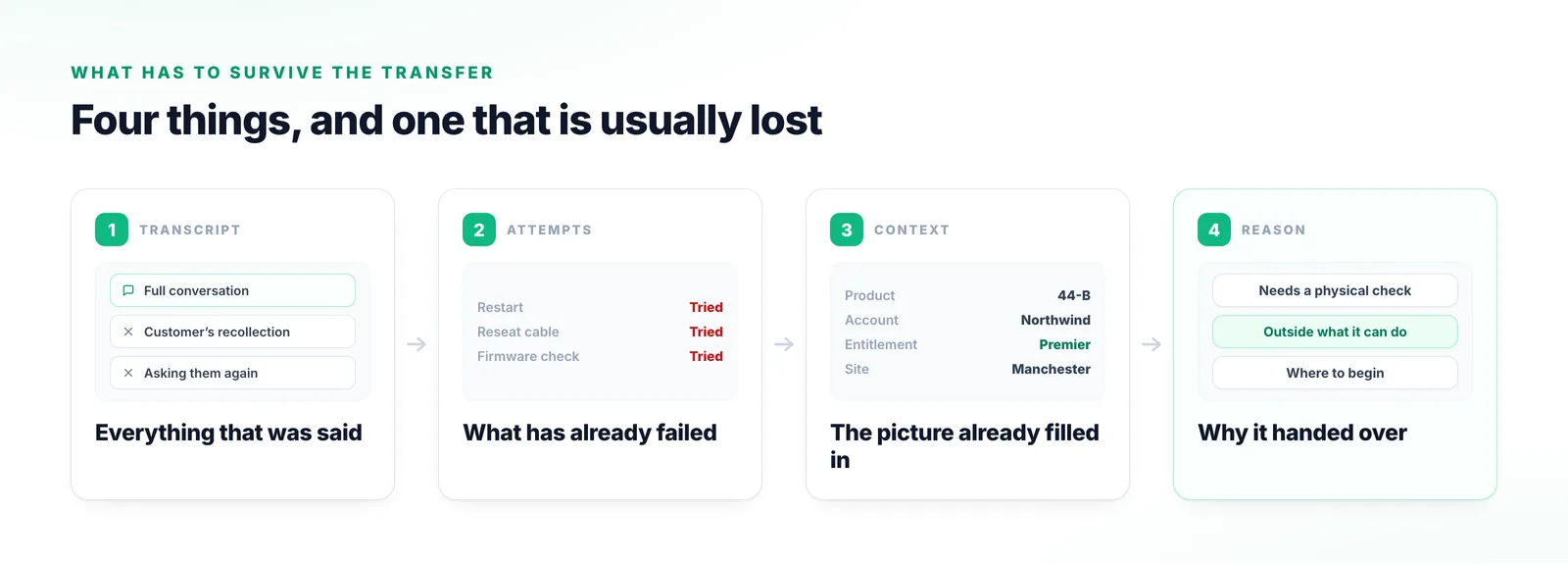
Four things carried across a bot-to-agent transfer: the full transcript, the steps already tried and their outcomes, the context the bot gathered, and the reason it handed over.
The second of these is the one most often dropped and the one a customer notices fastest when it is.

Three things that decide how the moment feels

Customers judge the whole channel on this transition.

Continuity is the whole product

Whether the bot answered well matters less than whether the transition felt like one conversation. A good bot with a bad handoff scores worse with customers than no bot at all.

The agent starts further along

The agent inherits completed work — steps tried and ruled out — so the case is genuinely more advanced than one arriving cold.

Knowing when to stop is a design decision

The handover has to fire at the right moment as well as carry the right information. A bot that loops while a customer becomes frustrated has already failed.
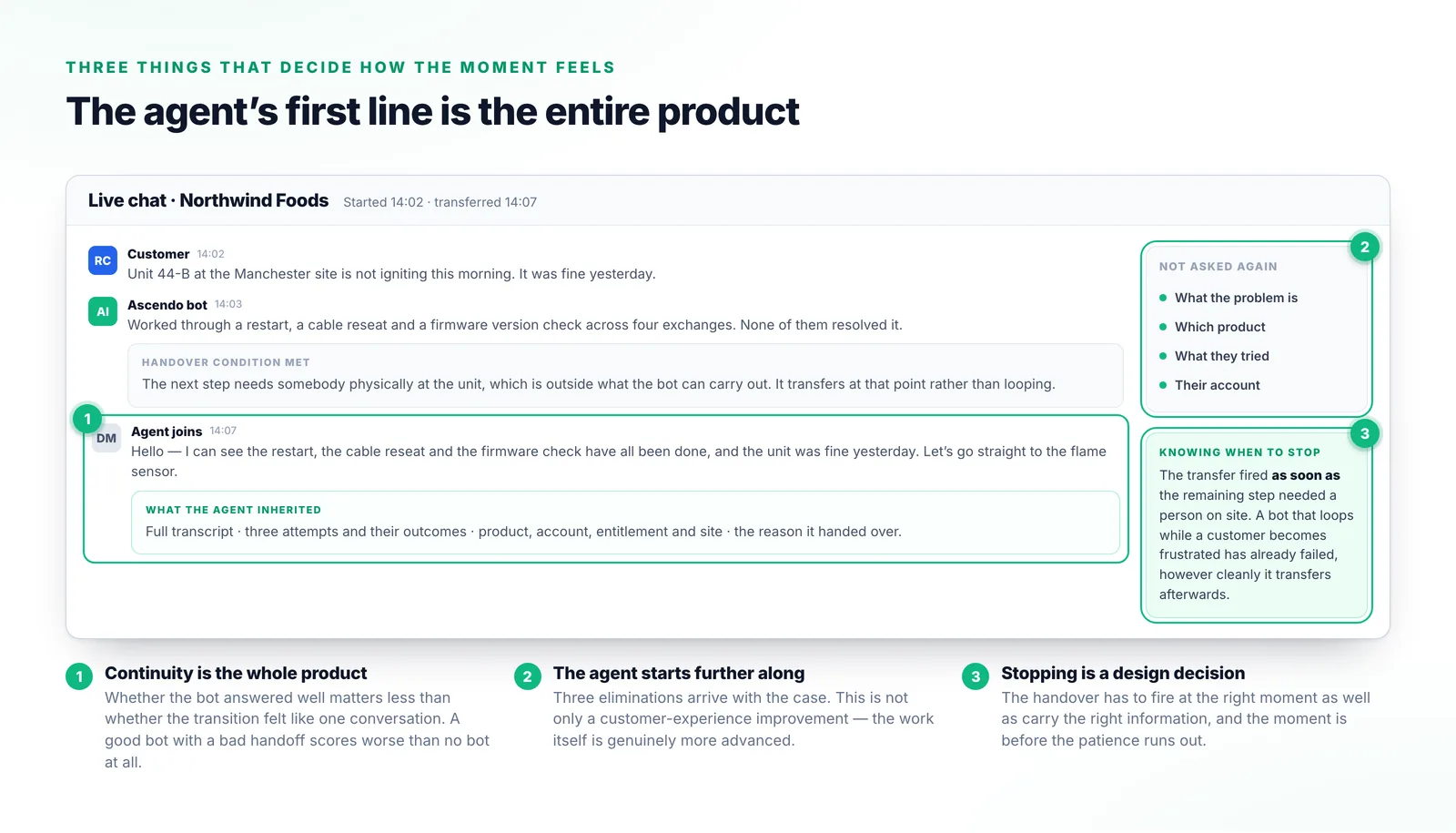
A live chat where a bot has worked through three steps with a customer and an agent joins mid-conversation, opening with what has already been ruled out rather than asking the customer to explain.
The agent’s first line names the three steps that already failed, which is the whole difference the customer experiences.

Why the usual approaches fall short

The first one is the most common, and it fails quietly.

Transferring with a chat link

Technically the transcript is available. Under queue pressure nobody reads it.

A bot that hands over only on "agent"

Misses every customer who is stuck but polite, and those are the ones who leave quietly.

A summary generated at handoff

Better than nothing, and it drops the specific detail that turns out to matter.

No bot at all

Keeps every routine contact in a human queue, including the ones that never needed a person.
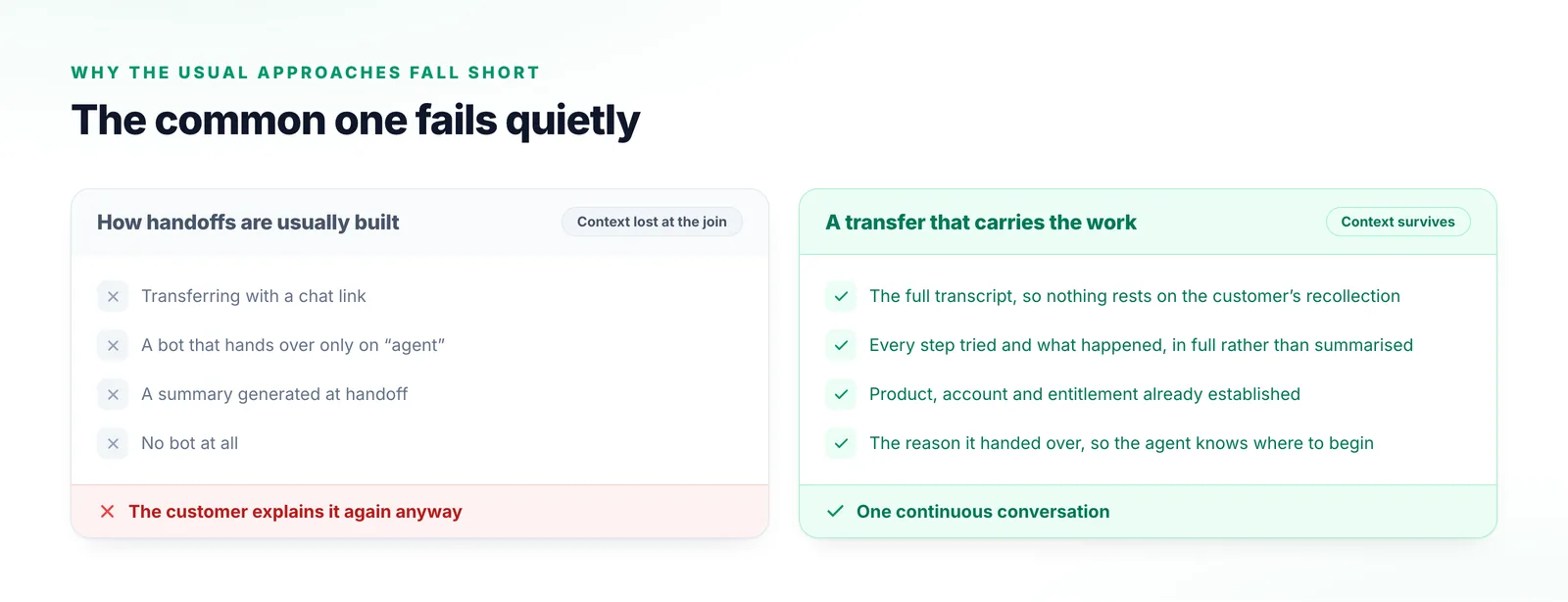
Two columns comparing transferring with a chat link, handing over only on the word agent, a generated summary and having no bot at all with a transfer that carries the full context.
A summary is the respectable failure: it drops the specific step that already failed, which is the detail that mattered.

What things are called

Warm and cold are the words that matter here.

Handoff
The transfer of a conversation from a bot to a person.
Warm transfer
A handoff carrying transcript and context, as opposed to a cold one that carries nothing.
Containment
The share of conversations resolved without a person. Only meaningful if the customer got their answer.
Handover condition
The rule deciding when the bot should stop and bring a human in.
Context
Product, account, entitlement, and what the customer has already tried.

Frequently Asked Questions

Because it is where bot deployments lose customer trust, and it is the part least often shown. Handling the easy conversation is straightforward; the transition is where the design either holds or does not.

Support Channels

Read your own handoffs

Look at the first agent message after your bot transfers a conversation. If it asks the customer to explain the problem again, we can show you what that is costing.

Talk to us