The handover is the design
A bot that answers well and hands over badly is worse than no bot, because it has spent the customer’s patience and then made them start over.
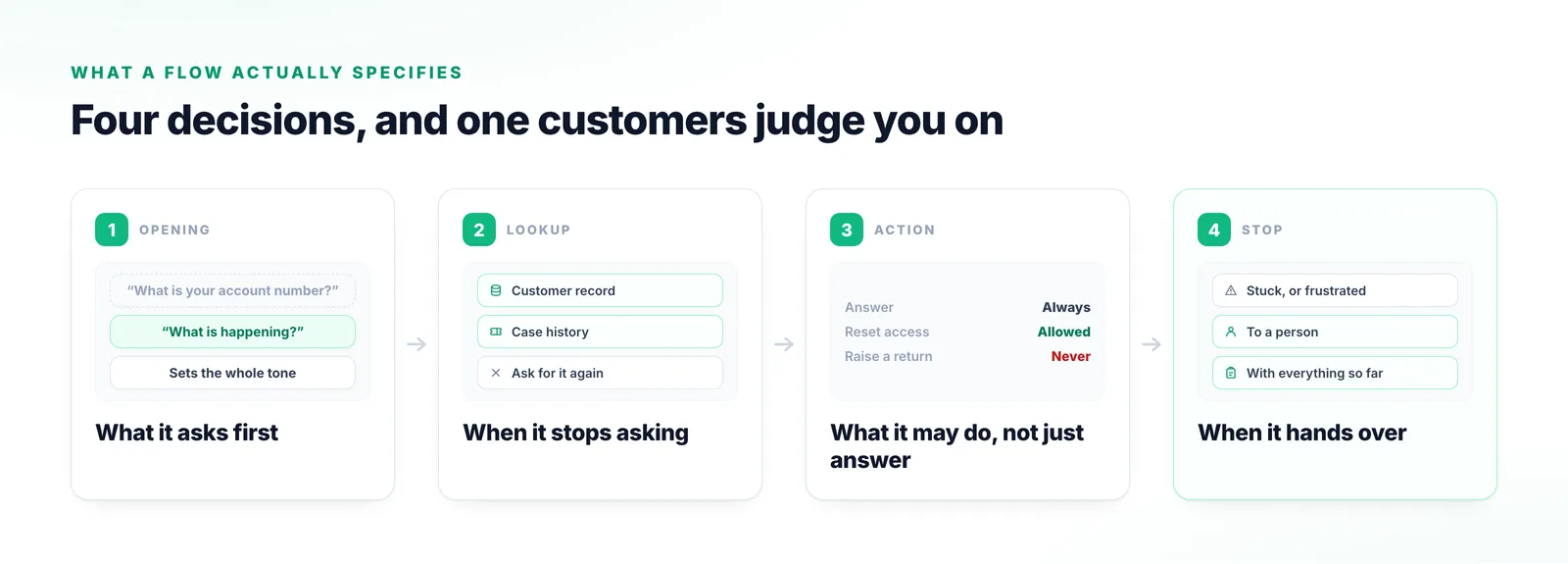
A bot is not a personality, it is a set of decisions: what it asks first, when it goes and looks something up, when it is allowed to act, and — the one that matters most — when it stops and brings in a person. This is where those decisions get made, and tested before a customer meets them.
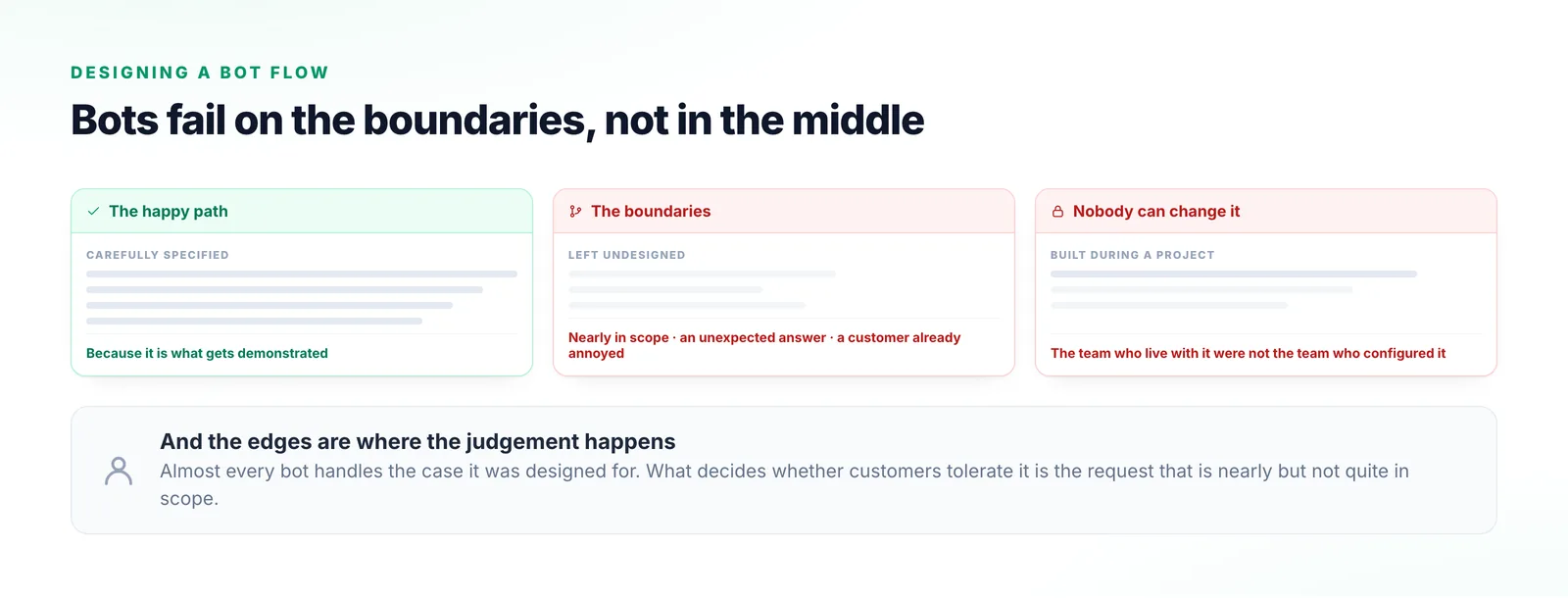
Almost every bot handles the case it was designed for. What decides whether customers tolerate it is everything else: the request nearly but not quite in scope, the customer who answers a question with something unexpected.
Those are design decisions and they usually go undesigned, because the happy path is what gets demonstrated. The other half is ownership: the flow is built during a project by people who move on, and the team who live with it cannot change what it does.
Four decisions. The last one is the one customers judge you on.
The opening question shapes everything after it. Asking for the wrong thing first is how a conversation turns into an interrogation.
The point at which the bot goes to the knowledge base or the customer record, instead of asking for things the system already knows.
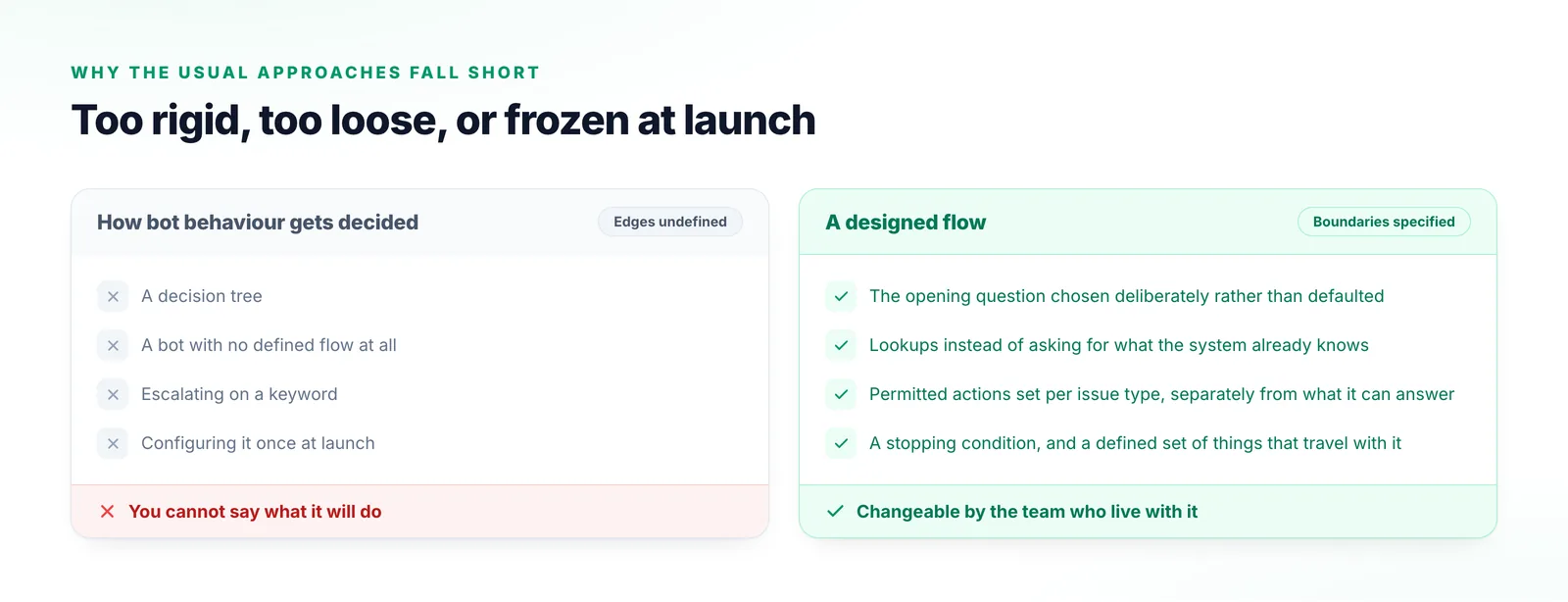
What the bot can do on its own as distinct from what it can answer, set per issue type the same way autonomy is set everywhere else.
The condition that hands the conversation to a person, and what travels with it. The most important line in the flow, and the least specified.
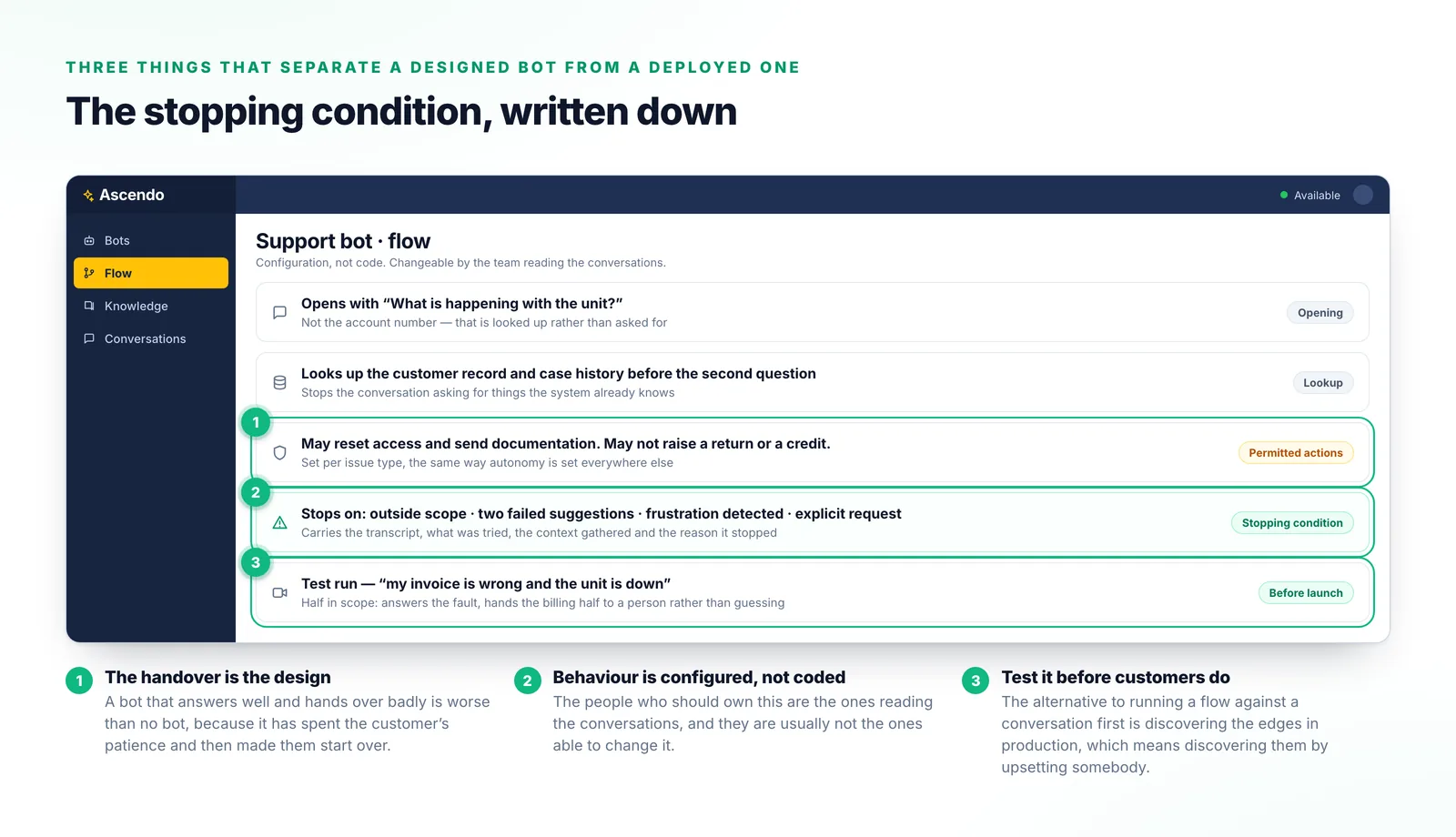
All three are about what happens outside the path somebody demonstrated.
A bot that answers well and hands over badly is worse than no bot, because it has spent the customer’s patience and then made them start over.
The people who should own bot behaviour are the ones reading the conversations, and they are usually not the ones able to change it.
A flow can be run against a conversation before it reaches a customer, which is the only responsible way to find the edges. The alternative is finding them by upsetting somebody.
Too rigid, too loose, or nobody can change it afterwards.
Deterministic and rigid. It falls over on anything phrased outside the branches somebody predicted.
Fluent, unpredictable and impossible to reason about. You cannot tell anyone what it will do.
Uses “speak to a human” as the only exit, and misses every customer who is stuck but polite.
Fits the products and the queue as they were on day one, and nobody afterwards can move it.
Containment in particular is worth defining carefully before anyone reports on it.
Running several bots with different behaviour over one shared knowledge foundation.
The stopping condition in practice, and exactly what carries across to the agent.
How much a bot is permitted to do, set per issue type rather than once for everything.
AI Inbox
Bring us the conversations your current bot gets wrong. The handover is usually where the problem is, and it is normally the fastest thing to fix.
Talk to us