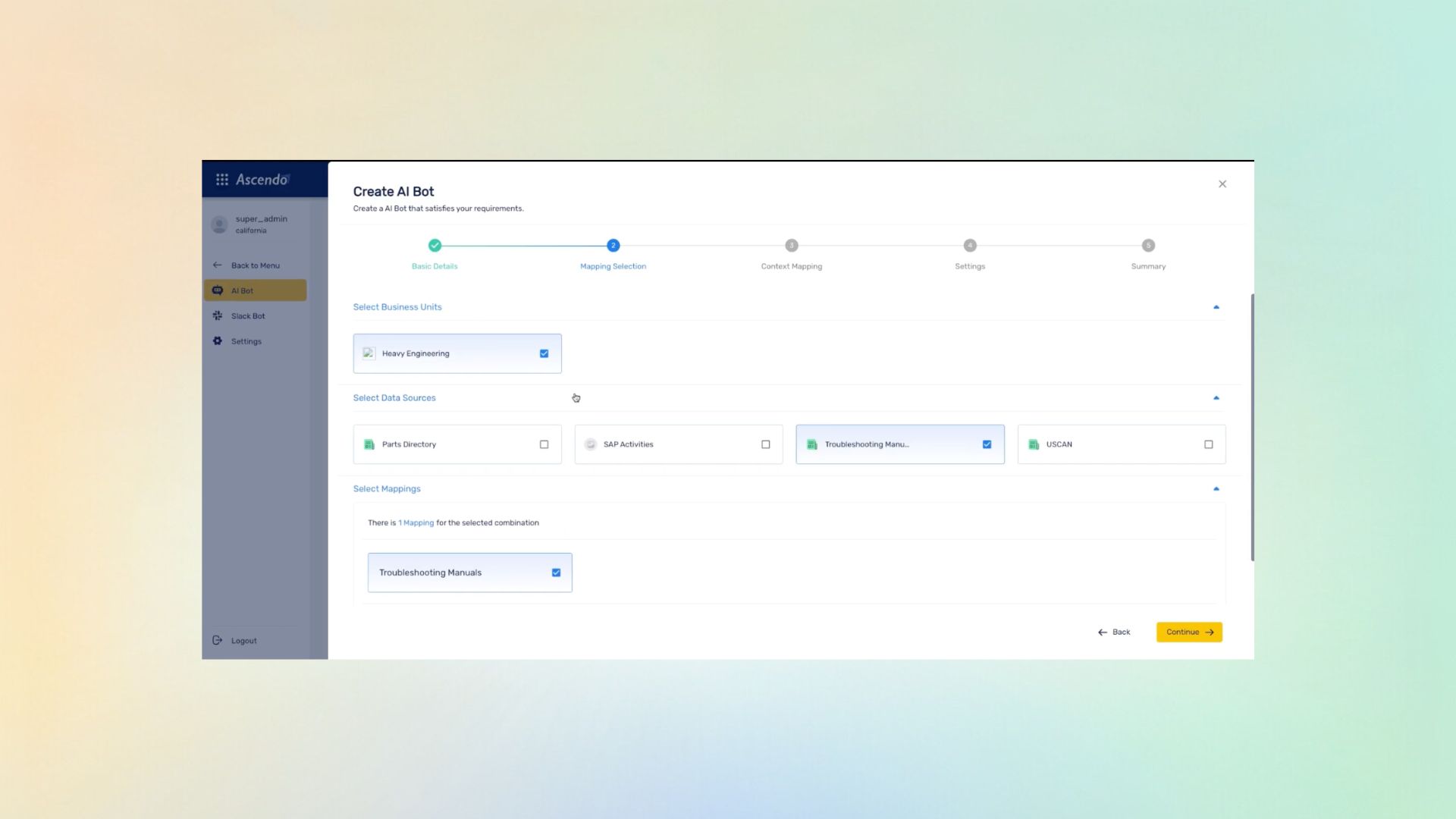
Support Channels

Multiple AI bots

One assistant covering every product, segment and channel serves all of them slightly badly. Several bots, each tuned to what it is actually for, over a single shared knowledge foundation — so behaviour differs where it should and nobody ends up maintaining the same answer in four places.

  • A bot per product line, segment or channel
  • Behaviour tuned separately, knowledge shared
  • No maintaining the same fact in four places
  • Add a bot without rebuilding the foundation

Watch the full tour

Verify your work email once and every research paper, case study and product tour on ascendo.ai opens, right here, without leaving the page.

  • Takes about 30 seconds
  • Work email only, no spam

One bot for everything is a compromise nobody chose

A company with several products, a partner channel and a range of customer sizes does not have one support conversation.

A single assistant has to average across all of it, and averaging produces something generic — the state in which everybody agrees the bot is fine and nobody relies on it. The obvious fix is worse: four bots means four knowledge bases, and a corrected fact that has to be updated in four places will be updated in two.
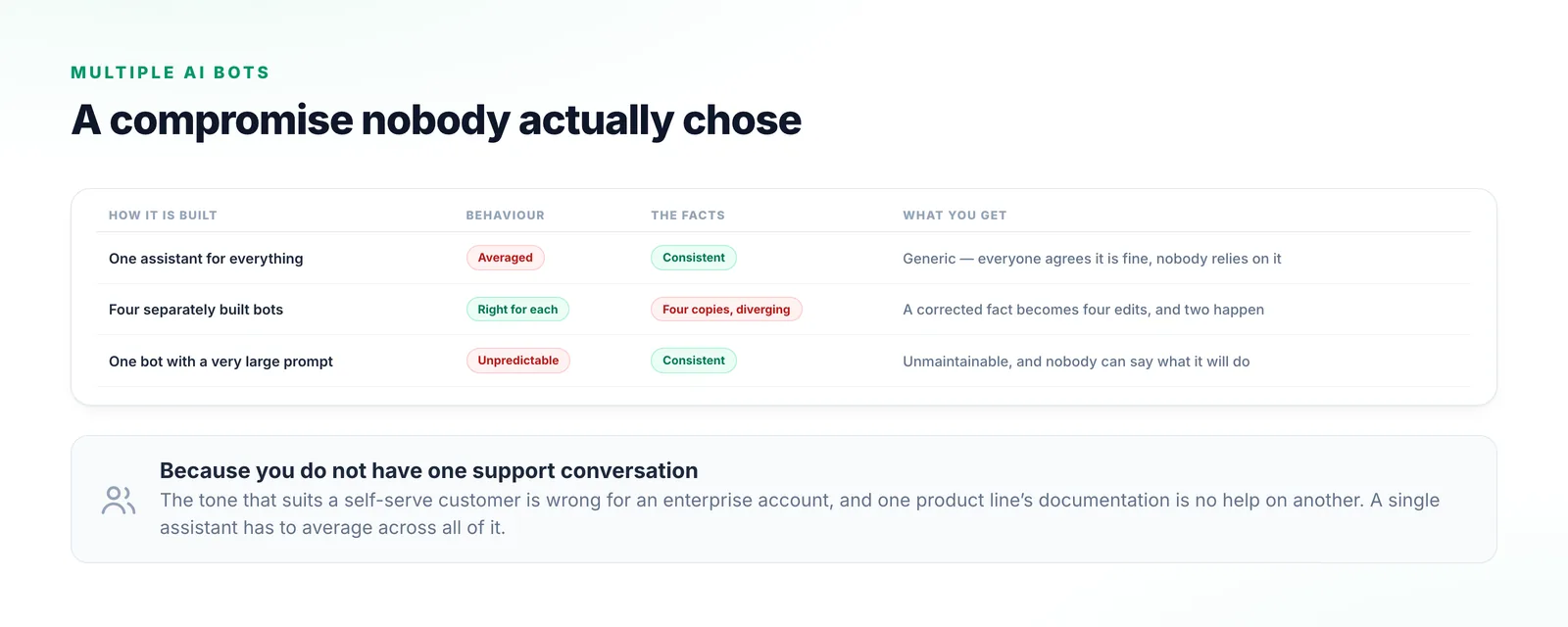
A table comparing three ways of running assistants across several products and segments, showing what happens to behaviour and to the underlying facts in each, and the result of both.
Behaviour and facts fail in opposite directions here, which is why picking either column leaves you with the other problem.

Separate where it matters, shared where it does not

The split is behaviour on one side and facts on the other.

  1. Step 1

    One knowledge foundation

    Every bot reasons over the same indexed manuals, resolved cases and knowledge articles, so a fact is maintained once.

  2. Step 2

    Scoped to what each one covers

    A bot is given the products and content that belong to it, so nobody is answered out of another line’s documentation.

  3. Step 3

    Behaviour set per bot

    Tone, what it asks first, how far it goes before handing over and what it may do are configured per bot.

  4. Step 4

    Deployed where it belongs

    Each bot goes to its own surface — a product portal, a partner site, a channel.
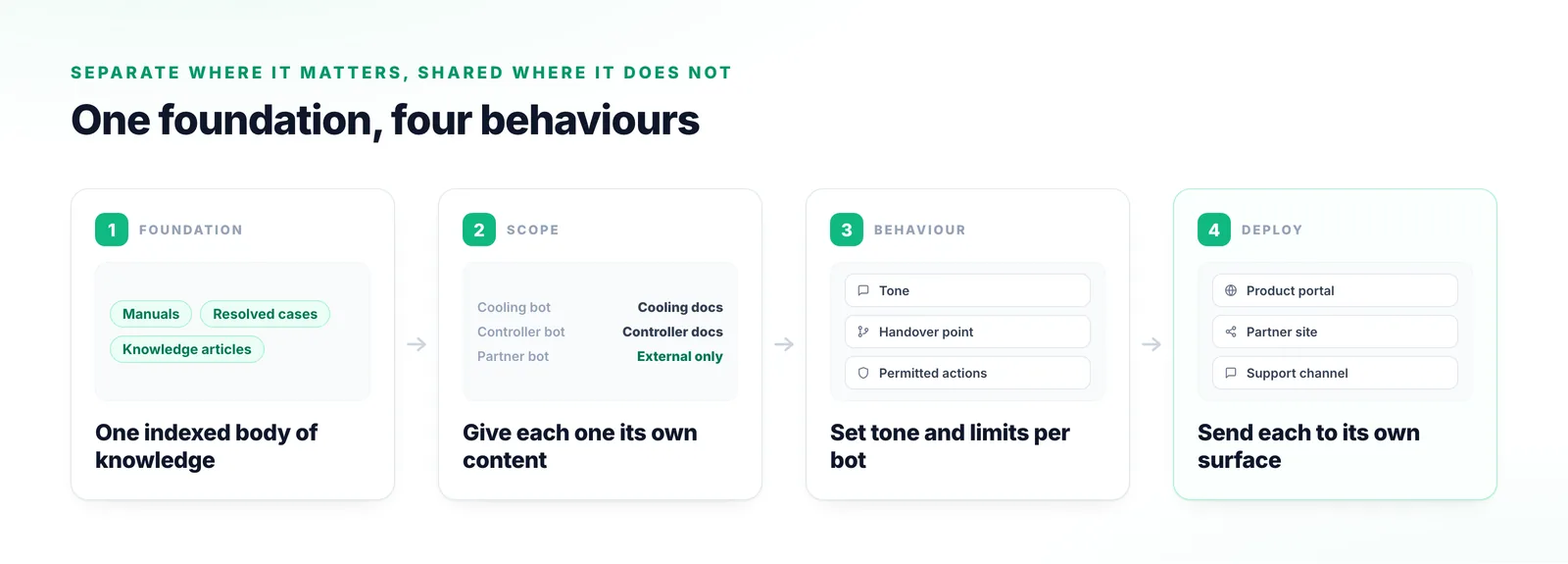
Four stages: one shared knowledge foundation, each bot scoped to the products and content that belong to it, behaviour configured per bot, and each deployed to its own surface.
The split runs between stages one and three: facts maintained once, behaviour set separately for each audience.

Why this beats both alternatives

It avoids the generic assistant and the four diverging knowledge bases at once.

Shared knowledge, separate behaviour

The things that should differ between bots are behavioural: tone, scope, permission, handover point. The things that should never differ are the facts. Splitting on that line avoids both failure modes.

Scope is a control, not just a quality setting

Giving a bot only the content that belongs to it is how a partner-facing assistant is prevented from reaching internal material, and it is normally the first question anyone asks.

Adding one is cheap

Because the foundation already exists, a bot for a new product or segment is a matter of scope and behaviour rather than a new project.
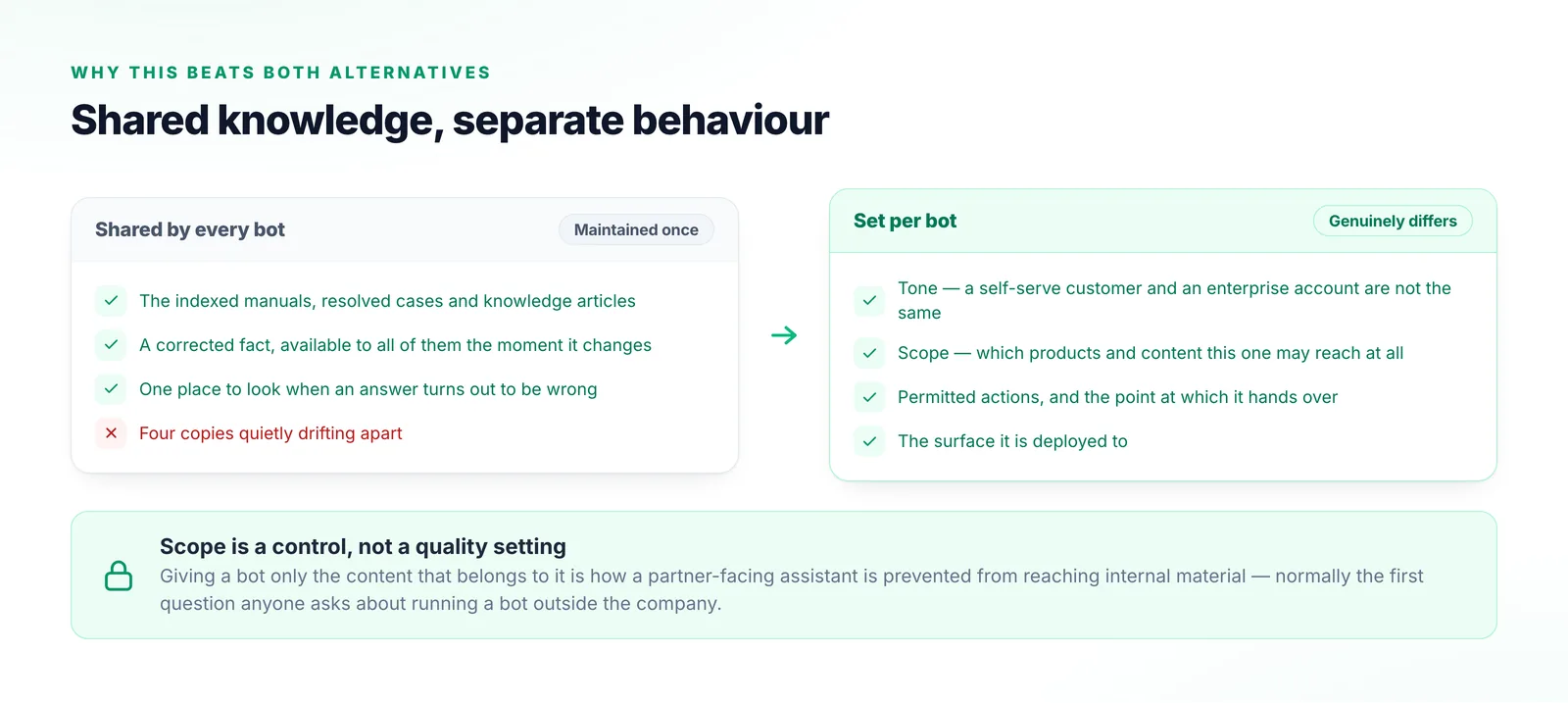
Two panels dividing what every bot shares — one indexed set of manuals, cases and articles maintained once — from what each one sets for itself, including tone, scope, permitted actions and handover point.
Everything on the left is maintained once. Everything on the right genuinely differs between a partner site and a self-serve portal.

Why the usual approaches fall short

Either the behaviour is wrong everywhere, or the facts drift apart.

A single general assistant

Averages across every product, segment and channel and is mildly wrong for all of them.

Four separately built bots

The behaviour is right and the knowledge diverges immediately. A corrected fact becomes four edits.

One bot with a very large prompt

Tries to encode every audience’s rules in one place, and becomes unpredictable.

A bot per channel with no shared index

The web bot and the Slack bot answer the same question differently.
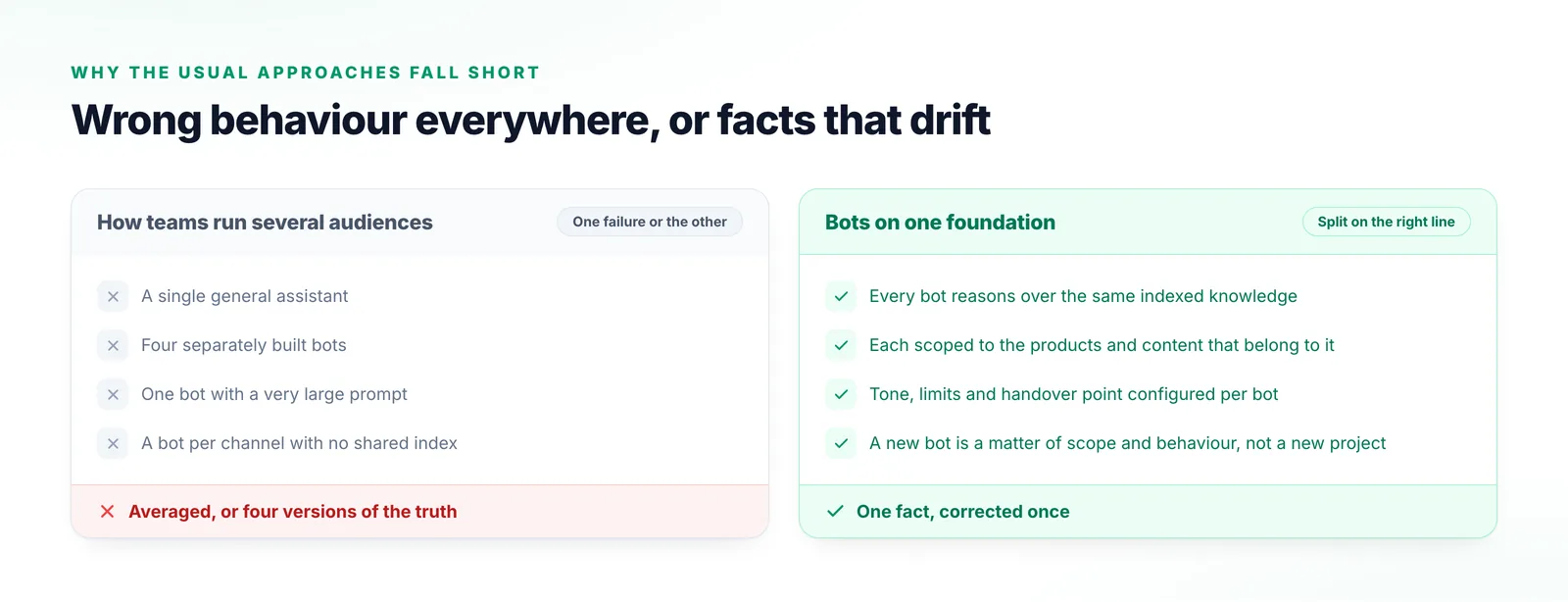
Two columns comparing a single general assistant, four separately built bots, one bot with a very large prompt and a bot per channel with no shared index against bots sharing one knowledge foundation.
A bot per channel with no shared index is the one customers catch first: the web and Slack answers differ, and they notice before you do.

What things are called

Scope and behaviour are the two things being set per bot.

Knowledge foundation
The shared index of manuals, resolved cases and articles every bot reasons over.
Scope
The products and content a particular bot is allowed to answer from.
Behaviour
Tone, opening question, handover point and permitted actions — configured per bot.
Surface
Where a bot is deployed: a portal, a website, a partner site, or a messaging channel.
AI Resolve
The pluggable Gen AI component that can be dropped into any website or portal.

Frequently Asked Questions

Because one bot has to average across audiences that genuinely differ. The tone for a self-serve customer is wrong for an enterprise account, and one product line’s vocabulary is meaningless on another. Averaging produces something nobody finds useful.

Support Channels

Map your bots to your audiences

Tell us the product lines, segments and channels you support and we will show you where one bot would be a compromise, and where it is genuinely enough.

Talk to us