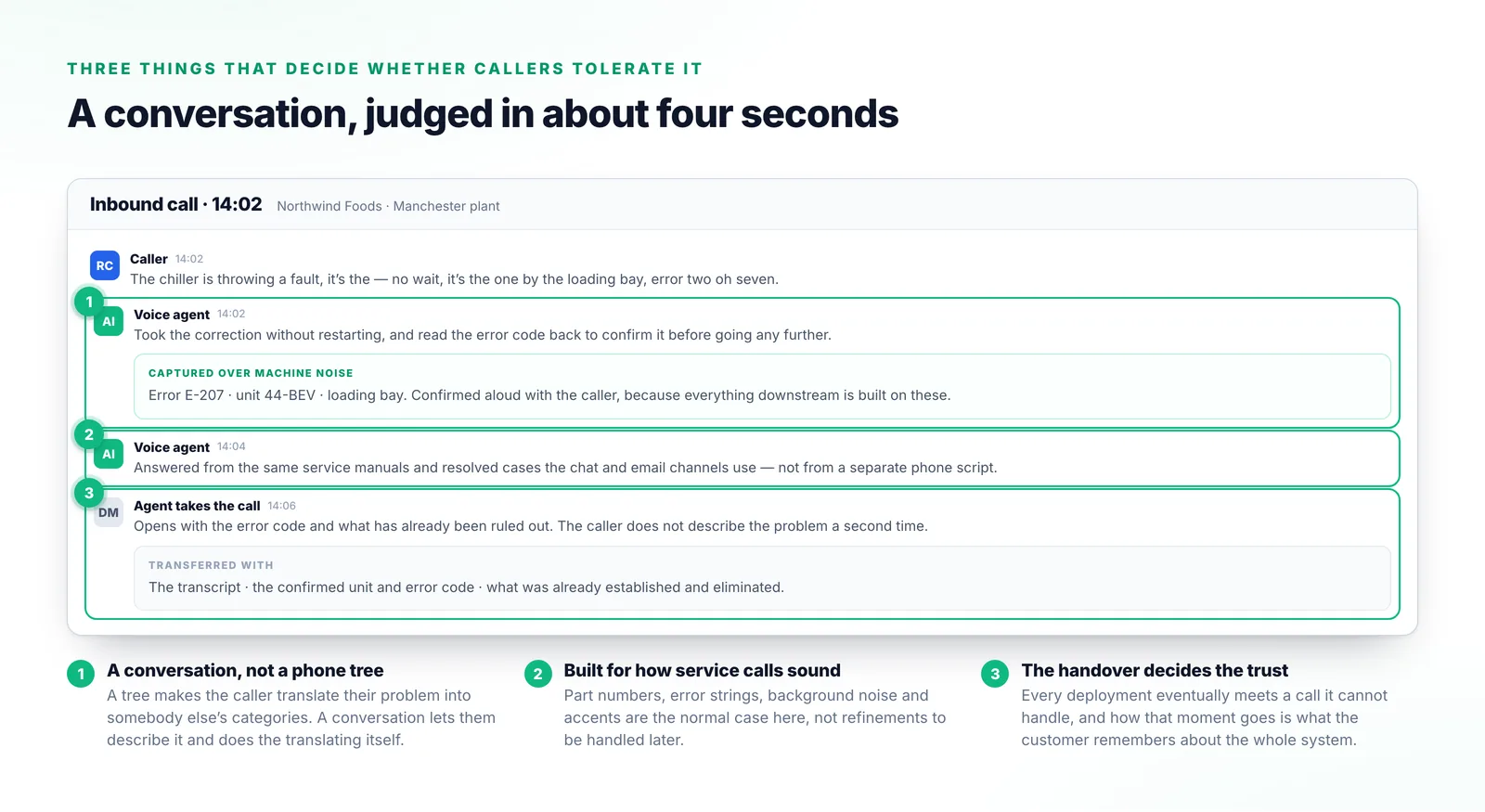
A conversation, not a phone tree
A tree makes the caller translate their problem into categories somebody else defined; a conversation lets them describe it and does the translating itself. People can tell which one they are in almost immediately.
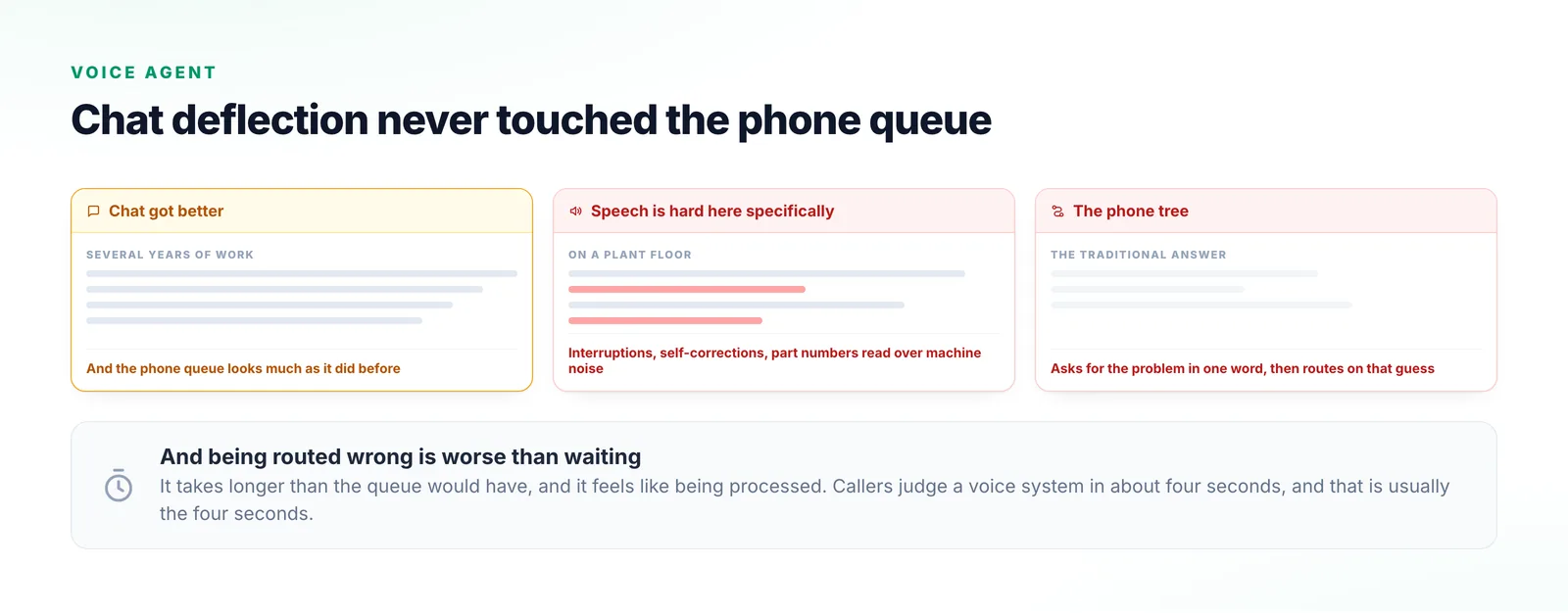
Phone is still the highest-volume channel in most service organisations and the one least touched by automation — because the things that make speech hard are exactly the things that make a service call a service call: interruption, background noise, accents, and part numbers read out fast.
Most support organisations have spent several years improving chat and self-service, and still have a phone queue that looks much as it did before. The customers who call tend to be the ones with the most urgent problems.
Speech is harder in the specific ways service is hard. People interrupt, correct themselves mid-sentence, and read a part number with the letters run together over the noise of the machine beside them. And a phone tree that asks for the problem in one word then routes wrong is worse than waiting.
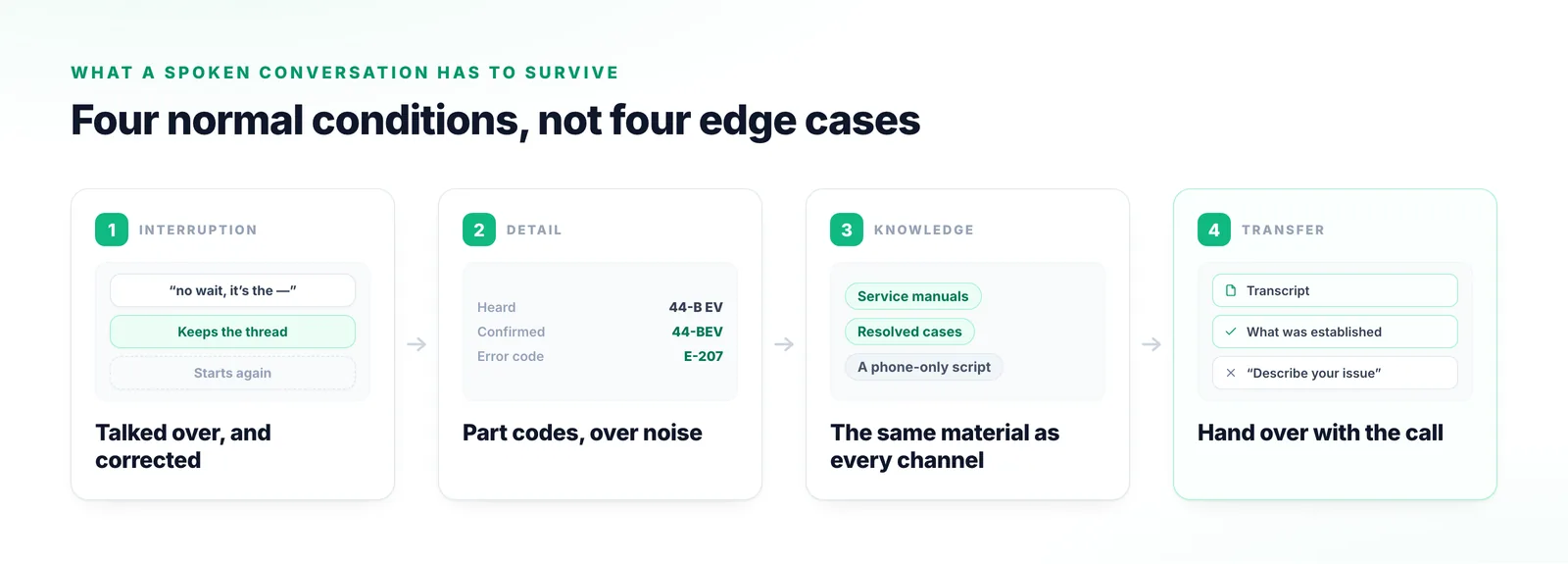
None of these are edge cases on a service call. They are the normal conditions.
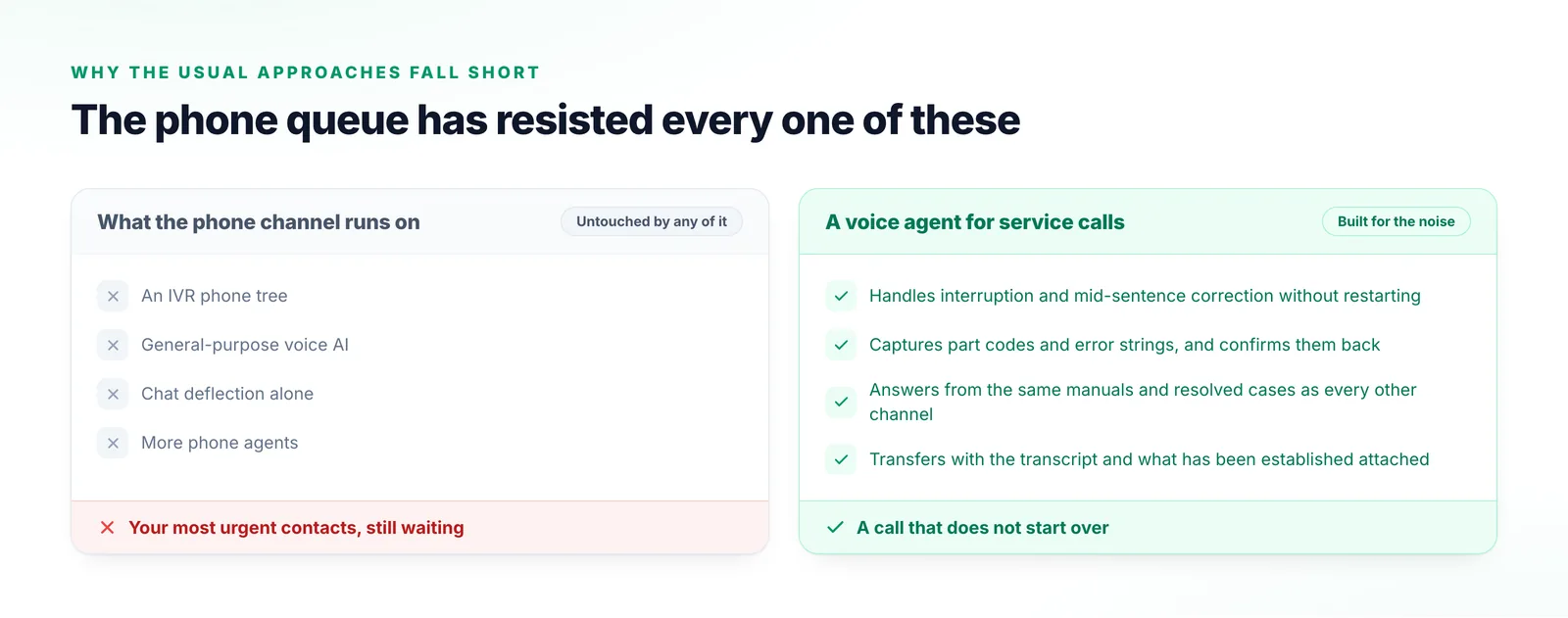
People talk over the system, change their mind halfway through a sentence, and correct a detail they already gave. A conversation that restarts every time is not a conversation.
Service calls are full of model numbers, part codes and error strings, spoken quickly and in noise. Everything downstream is built on them.
Voice is a surface, not a separate product. What it can answer comes from the same manuals and resolved cases as every other channel.
When it reaches its limit the caller goes to a person who already has the transcript and what has been established.
Customers form a judgement about a voice system in roughly four seconds.
A tree makes the caller translate their problem into categories somebody else defined; a conversation lets them describe it and does the translating itself. People can tell which one they are in almost immediately.
Technical vocabulary, part numbers, background noise and accents are the normal case here. A voice system that only performs in quiet, general-purpose speech does not survive a plant floor.
Every deployment eventually meets a call it cannot handle, and how that moment goes is what the customer remembers about the whole system.
The phone queue has resisted every one of these.
Asks the caller to classify a problem they have not diagnosed, then routes on that guess.
Handles everyday speech well and has never encountered your part numbering.
Helps the customers willing to type. The phone queue stays exactly where it was.
Works, scales linearly with cost, and does nothing about the calls that never needed a person.
The terms that come up when a voice deployment is being evaluated.
Where a call ends up alongside email, chat and portal requests in a single queue.
The same handover problem in a chat conversation, and exactly what carries across.
The deflection path for customers who would rather not talk to anyone at all.
Support Channels
Voice claims are easy to make in a quiet room. Send us recordings from your actual queue, with the accents and the part numbers, and we will show you how it handles them.
Talk to us