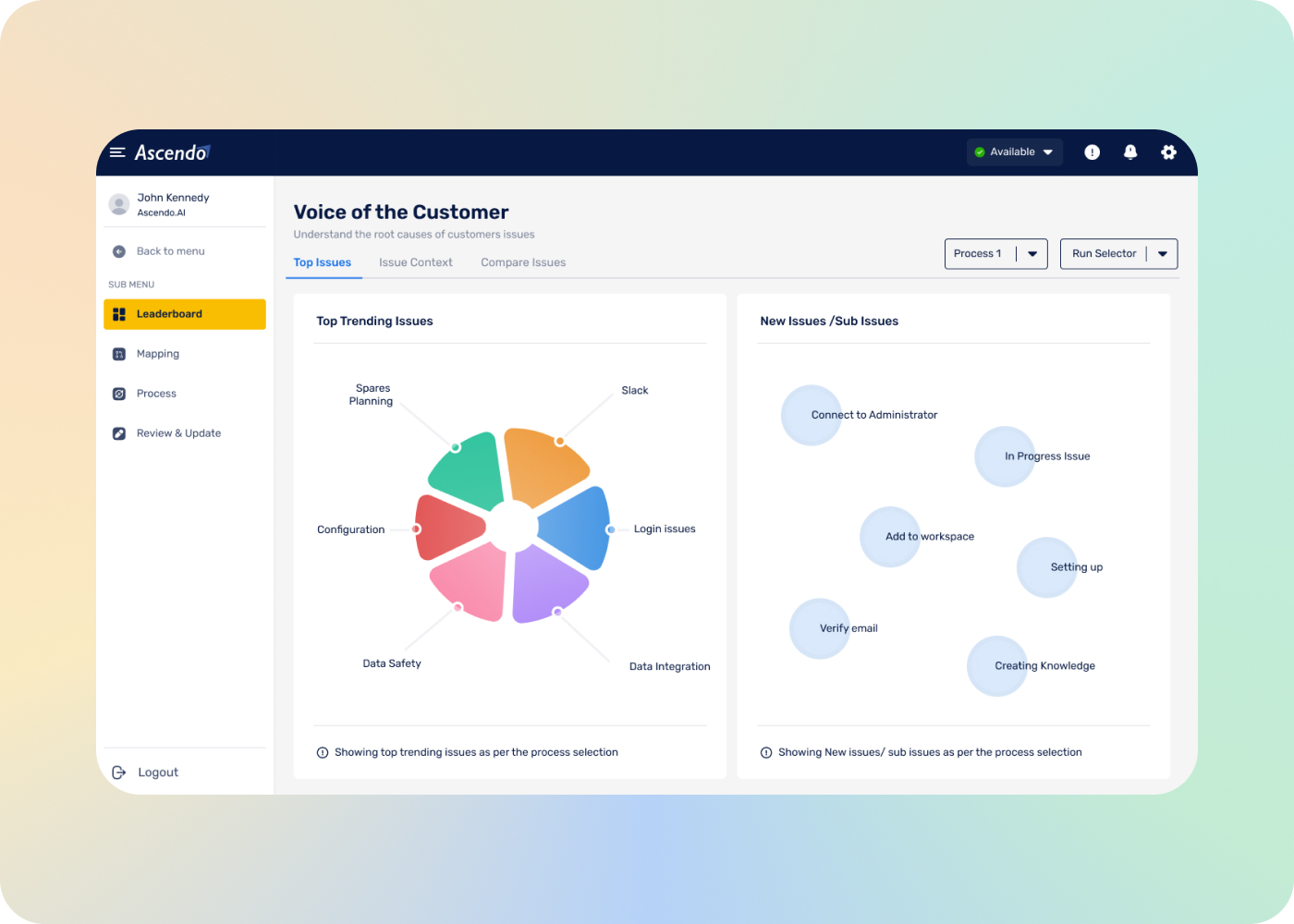
It hears what customers do not say directly
Feature requests are the small, easy slice. The valuable material is a customer explaining a workaround they invented, or four people misunderstanding the same screen.
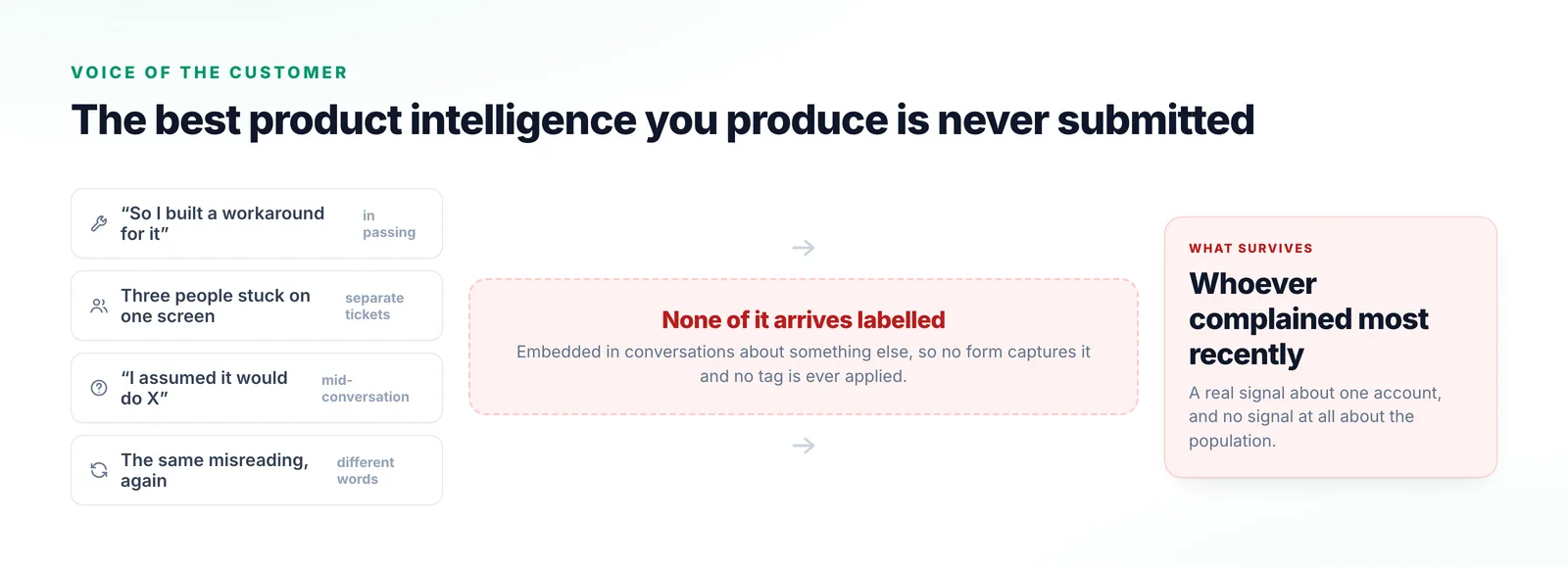
Your customers tell you what is wrong with your product every day, in the middle of asking for help with something else. Almost none of it gets counted: the workaround somebody mentions in passing, the step everybody gets stuck on, the feature people keep asking for by describing what they wish it did.
An explicit feature request is the easiest signal to collect and the rarest one to receive. What actually fills a queue is more oblique: a customer describing the workaround they built, three people getting stuck on the same screen.
None of it arrives labelled. It sits inside conversations about something else, so no form sees it and no tag is applied. What survives is whatever an individual happens to remember — a real signal about one account, and no signal at all about the population.
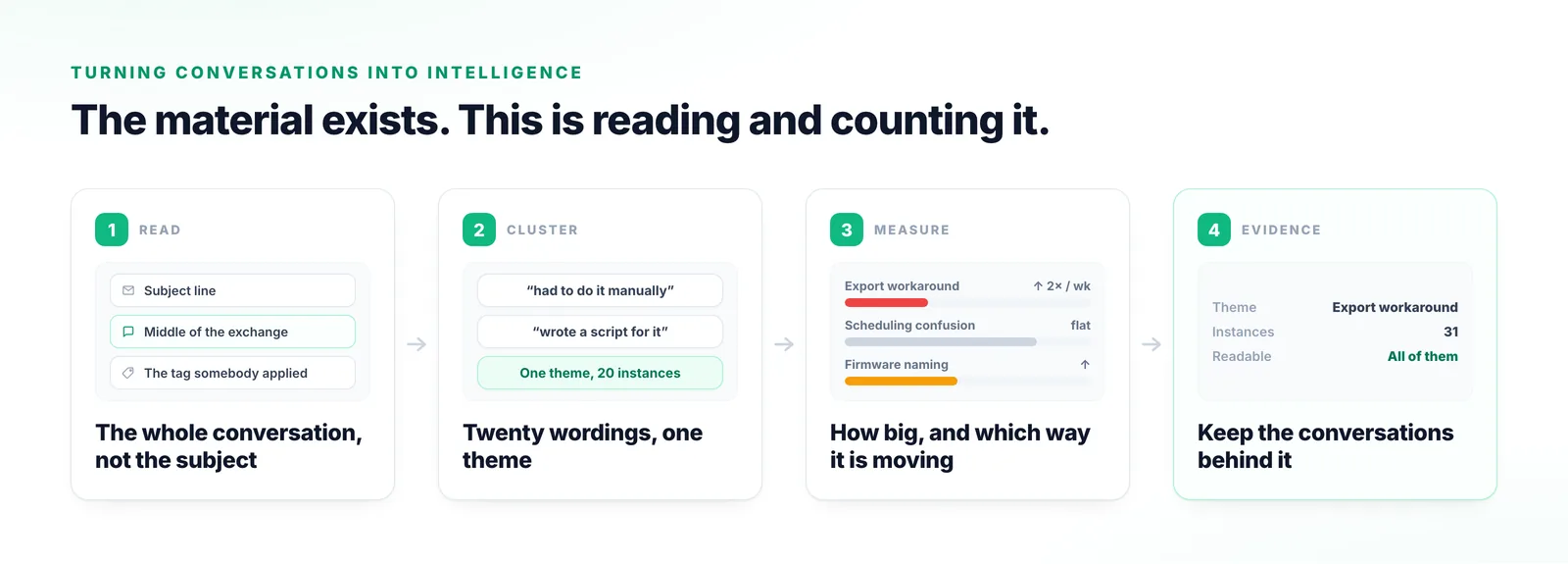
The material is already there. What is missing is reading and counting it.
The signal is rarely in the subject line. Confusion, workarounds and unmet expectations sit in the middle of exchanges about something else.
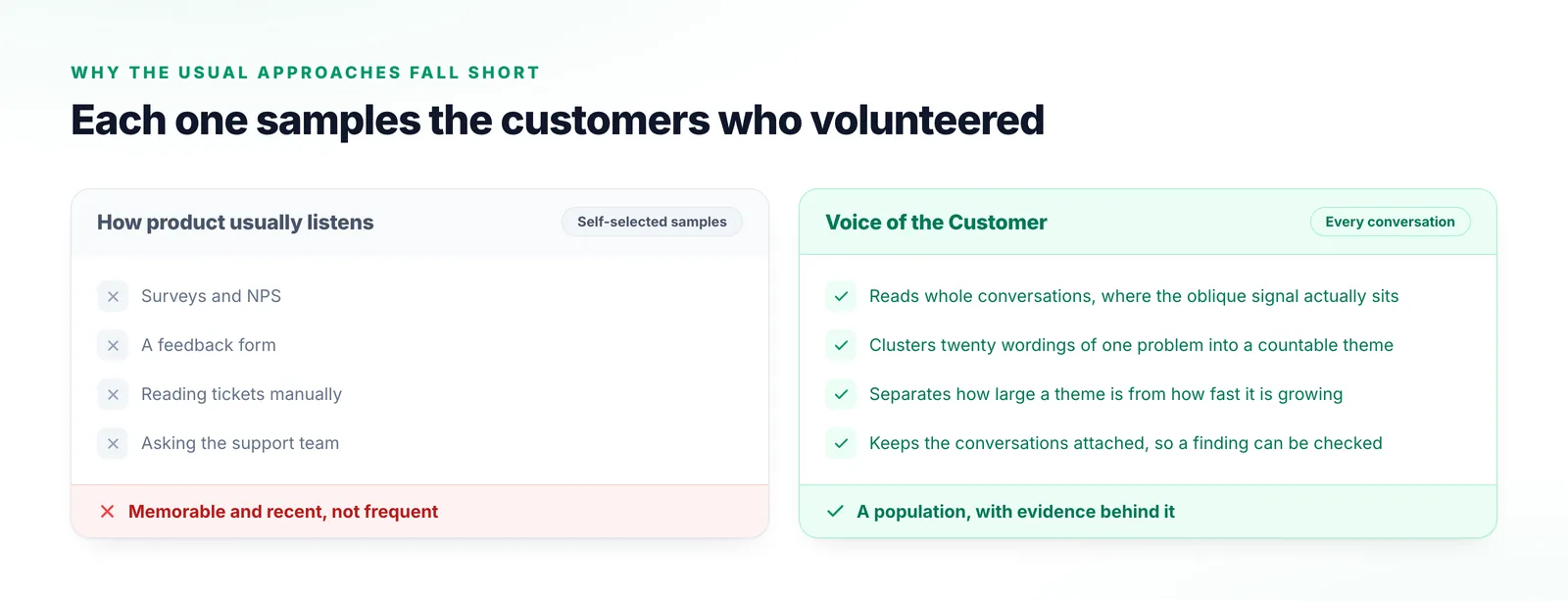
Twenty customers describing one problem in twenty ways become a single theme with twenty instances behind it.
How large a theme is and whether it is growing are different facts. Something small that doubles weekly is often more urgent than something large and flat.
Every theme keeps the conversations it came from, so anyone who doubts it can read them.
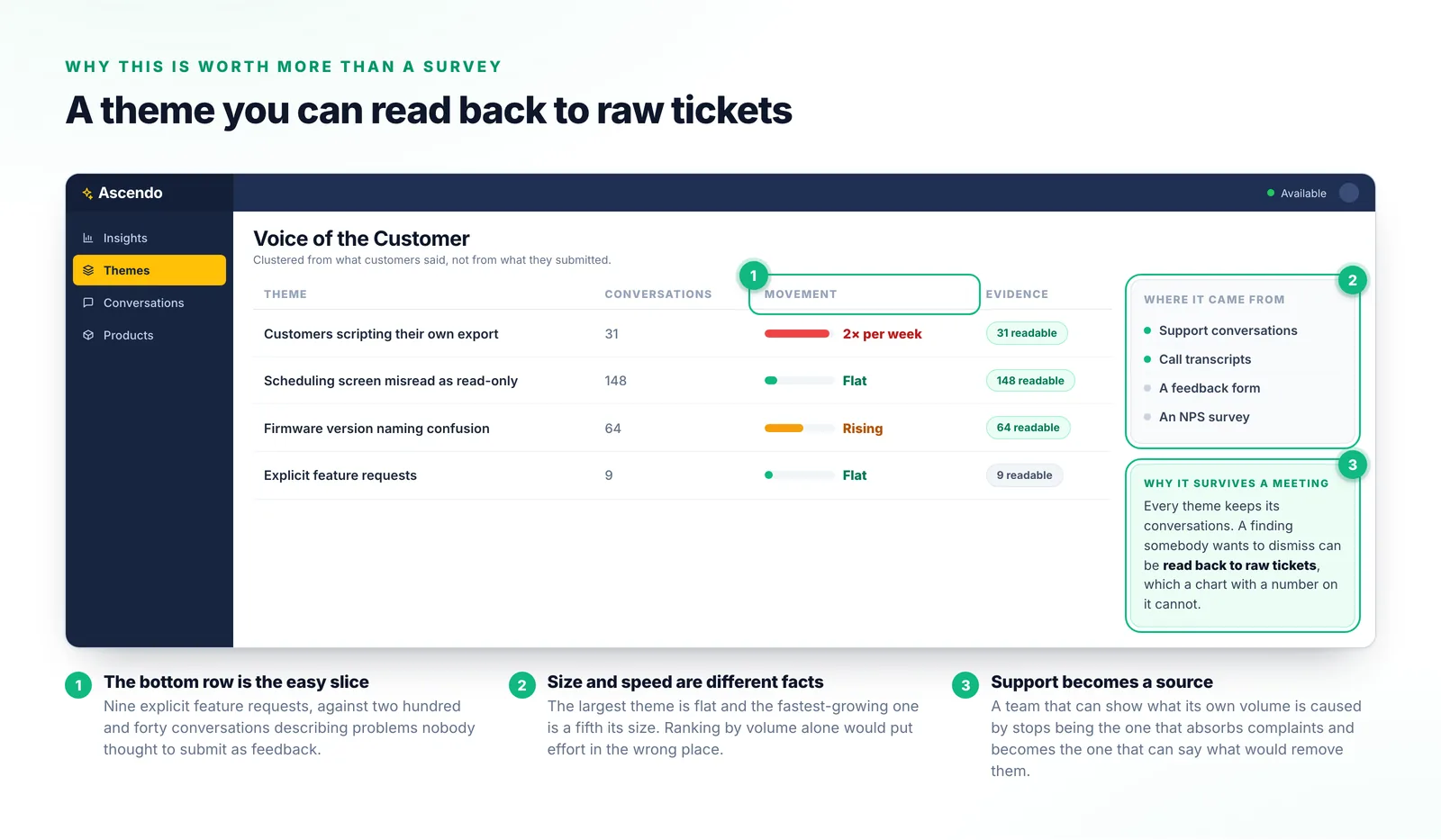
It reaches the material customers never think to submit as feedback.
Feature requests are the small, easy slice. The valuable material is a customer explaining a workaround they invented, or four people misunderstanding the same screen.
A support organisation that can show what its own volume is caused by changes its position in the company.
Every insight keeps its conversations attached, which matters because these findings are often unwelcome. A theme you can read back to raw tickets is hard to dismiss.
Each one samples the customers who chose to tell you something.
Asks people who chose to reply, afterwards, how they felt. No help in identifying what to fix.
Captures the small subset motivated enough to fill it in, and only the requests they knew how to phrase.
Finds real things in whatever sample the reader got through. Small emerging themes are invisible by definition.
Returns what is memorable rather than what is frequent. Memory cannot tell the two apart.
The vocabulary of reading a queue as intelligence rather than as workload.
The operational half: requests and complaints as a structured feed for product management.
The same conversations read for a different purpose: what your documentation is failing to answer.
What is driving volume right now, ranked by both volume and impact.
Voice of the Customer
Give us a quarter of support conversations and we will show you the themes inside them — including the ones nobody has ever filed as feedback.
Talk to us