Knowledge Agent

Knowledge Intelligence

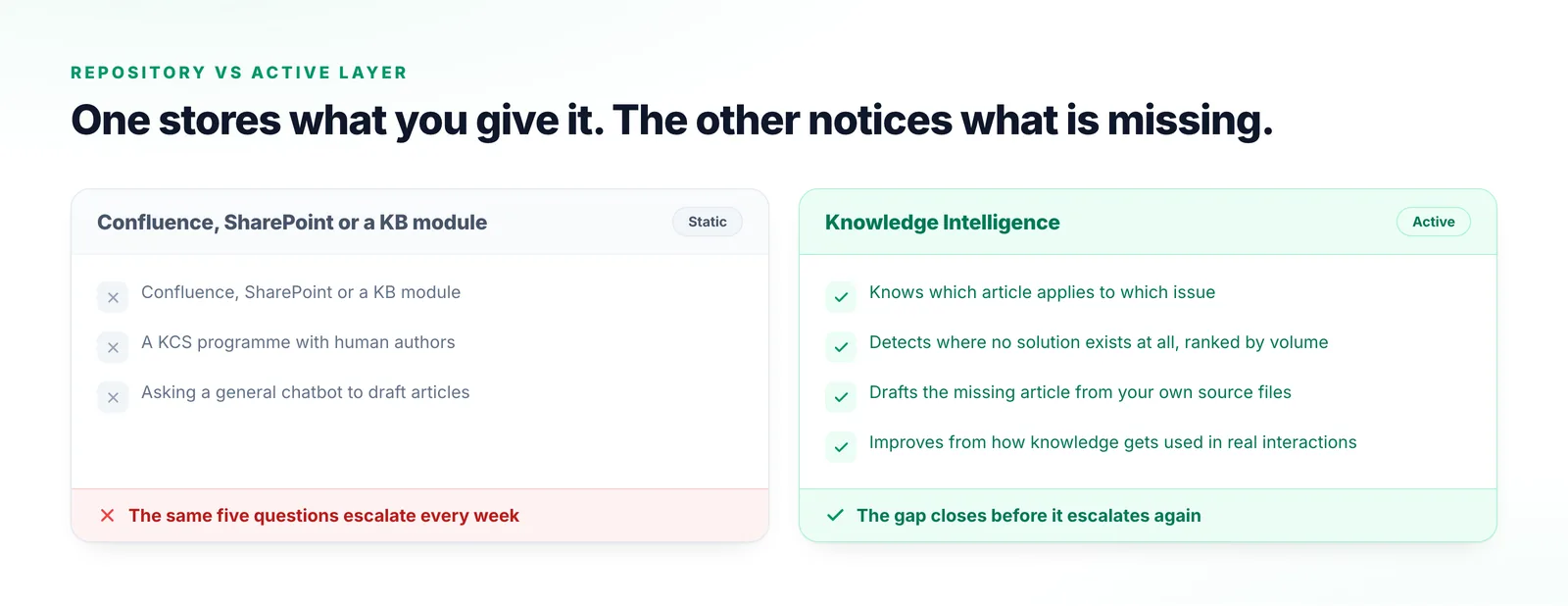
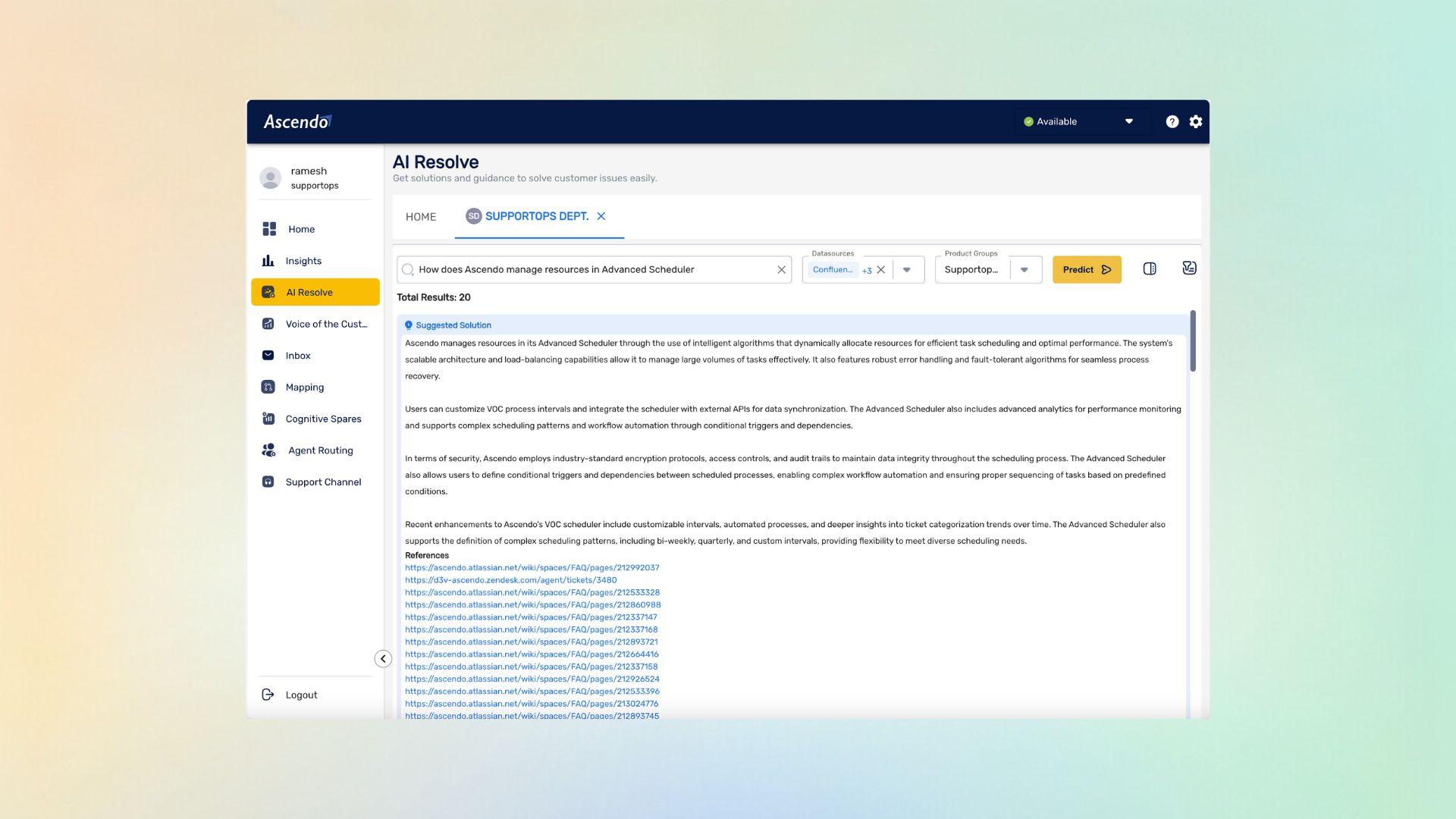
A knowledge base is a static repository your agents search by hand. Knowledge Intelligence is an active layer that knows which article applies to which issue, notices where you have no answer at all, and drafts the missing one from your own files.

  • Articles generated from your own source files
  • Templates control structure and section content
  • Human review before anything is published

Watch the full tour

Verify your work email once and every research paper, case study and product tour on ascendo.ai opens, right here, without leaving the page.

  • Takes about 30 seconds
  • Work email only, no spam

Nobody writes the article, so the gap never closes

Knowledge base authoring is slow, unrewarding work that competes with closing tickets. Given the choice, everyone closes the ticket. So the same five questions escalate every week, and the article that would have stopped them never gets written.

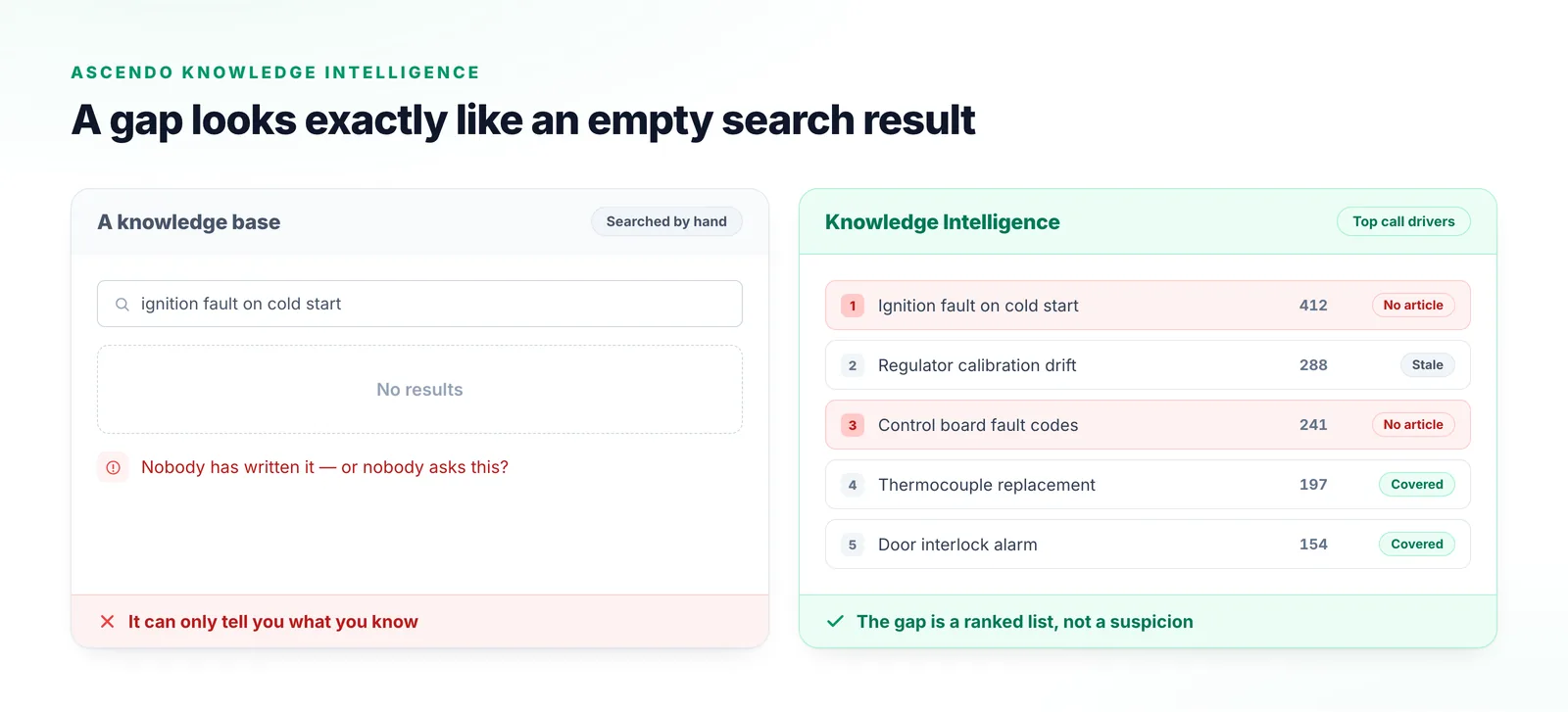
A wiki can only tell you what you know — a gap looks exactly like an empty search result. Knowledge Intelligence detects where no solution exists at all, and Top Call Drivers rank those gaps by the volume still arriving.

A knowledge base search returning no results beside an Ascendo top call drivers list, where the highest-volume issue types are flagged as having no article, a stale article or full coverage.
In a wiki, a missing article and an unasked question look identical. Ranking the highest-volume issue types against coverage turns the gap into a list you can work through.

How an article gets made

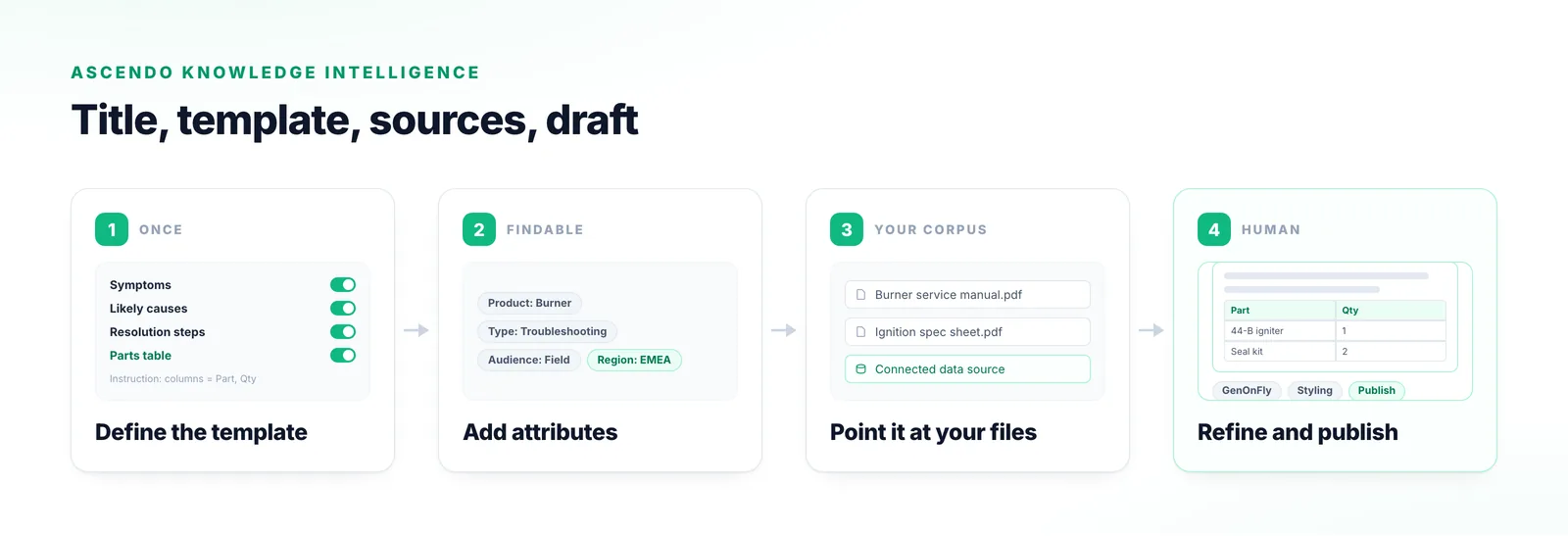
Title, template, sources, draft.

  1. Step 1

    Define the template

    Fixes the structure and controls what gets generated in each section, down to the columns in a generated table.

  2. Step 2

    Add attributes

    Metadata that organises the article for search and retrieval, so generated knowledge lands somewhere findable.

  3. Step 3

    Point it at your files

    Upload source files or select data sources already connected. The agent learns from them and drafts from the relevant content.

  4. Step 4

    Refine and publish

    Adjust for accuracy and tone, enrich with GenOnFly, restyle with the styling agent, then publish and export.

Four stages of Ascendo knowledge article generation: defining a template with per-section instructions, adding attributes, pointing it at source files, then refining and publishing the draft.
Nothing here is auto-published. The last step is a person adjusting a draft that an agent assembled from files you already had.

Three things worth noticing

What separates this from asking a chatbot to write your documentation.

Grounded in your files, not the internet

Generation runs against files you supply or have already connected, so the draft comes from your own manuals, tickets and documentation rather than the open internet.

“The knowledge agent learns from these files and will automatically process the relevant content to generate a draft.”
From the tour

Templates carry instructions, not just headings

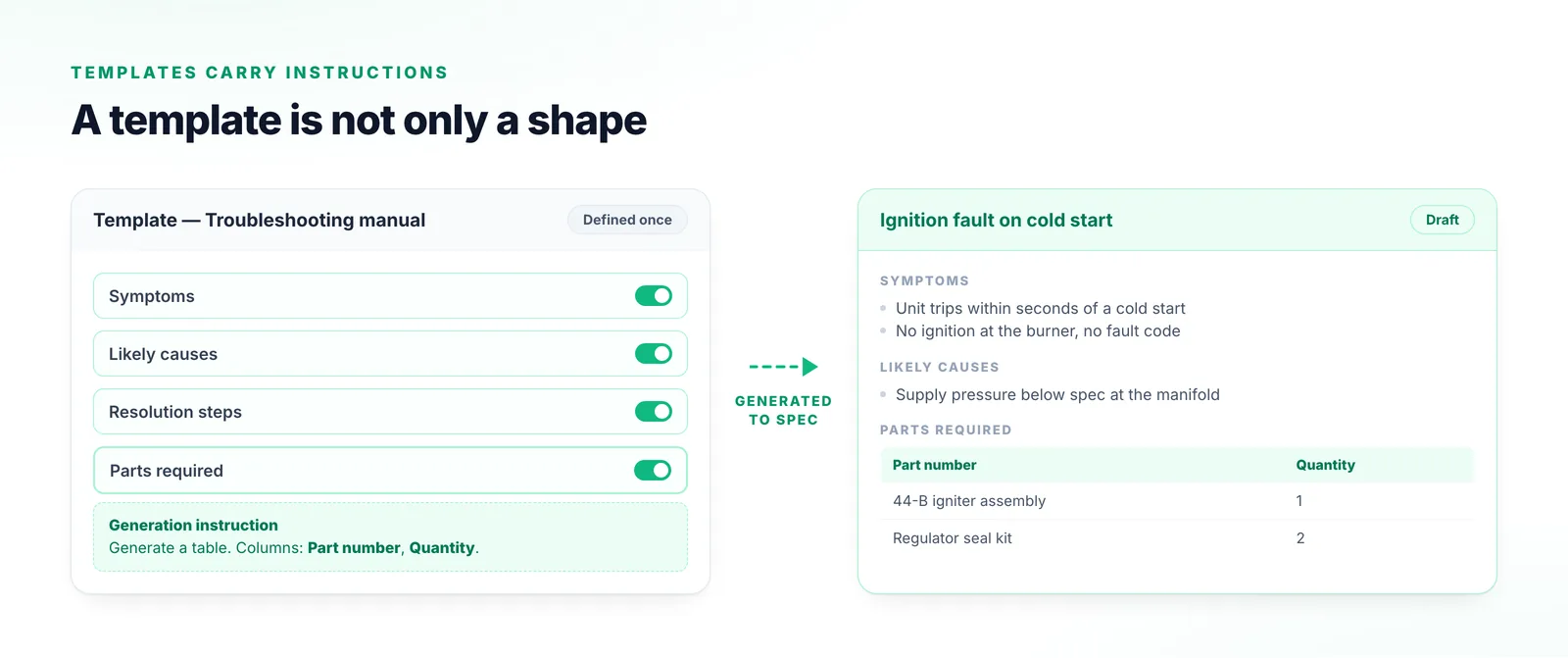
A template is not only a shape. Each section carries its own generation instructions, defined once and applied to every article built from it.

“Not only is the structure of the article defined in template, we also have the flexibility to control the content that will be generated in each section.”
From the tour

A draft, not a publication

A starting point a person refines before it goes anywhere. Nothing is auto-published, which for a knowledge manager is the whole conversation.

An Ascendo article template whose Parts required section carries the instruction to generate a table with Part number and Quantity columns, beside the generated article containing exactly that table.
The instruction lives in the template, so the table is not a lucky formatting outcome. It was specified once and applies to every article built from that template.

Why the usual approaches fall short

Each solves part of it and leaves the expensive part behind.

Confluence, SharePoint or a KB module

A capable repository with no gap detection, no generation and no usage feedback. It stores what you give it.

A KCS programme with human authors

The right methodology, but the authoring is manual, so articles lag reality by months and the backlog only grows.

Asking a general chatbot to draft articles

Not grounded in your corpus, with no template control, no review routing and no path to publish. Prose, not a workflow.

A static knowledge repository with no gap detection, generation or usage feedback, beside Knowledge Intelligence identifying relevant articles, detecting gaps and drafting the missing ones.
A repository stores what you give it. An active layer knows which article applies, notices what is missing, and drafts it.

What things are called

Terms used in this recording and its companion KCS walkthrough.

Knowledge Intelligence
The active knowledge layer, as opposed to a static repository you search by hand.
Template
Article structure plus per-section generation instructions.
Attributes
Metadata that organises an article for later search and retrieval.
GenOnFly agent
Adds new contextual content to an existing draft.
Styling agent
Reformats and restyles content that is already there.
Data source
A connected or previously uploaded corpus available for generation.
Top Call Drivers
The highest-volume issue categories. Together with Auto Categorization, this is the input gap detection runs on.
Data Enrichment
Extending existing knowledge as new issues are detected, rather than waiting for a review cycle.

Frequently Asked Questions

A knowledge base is a static repository that agents search manually. Knowledge Intelligence is an active layer that understands how knowledge is distributed across your systems, identifies which articles are relevant to a given issue, detects gaps where no solution exists, and improves based on how knowledge gets used in real interactions.

Knowledge Intelligence

Find out what your knowledge base is missing

Most teams cannot say what fraction of their articles were updated in the last year. We will look at your corpus and show you where the gaps are.

Talk to us