Meaning, not vocabulary
Rules fire on the words a customer happened to choose, so they miss synonyms and misfire on unusual phrasing. Reading intent means “it will not turn on” and “no power light” reach the same conclusion.
What a customer types and what they actually need are frequently different things. "It stopped working" could be a dead power supply, a lapsed licence, or somebody who was never trained on it. Reading the intent rather than the wording is what decides whether the routing, the priority and the first response are right or wrong.
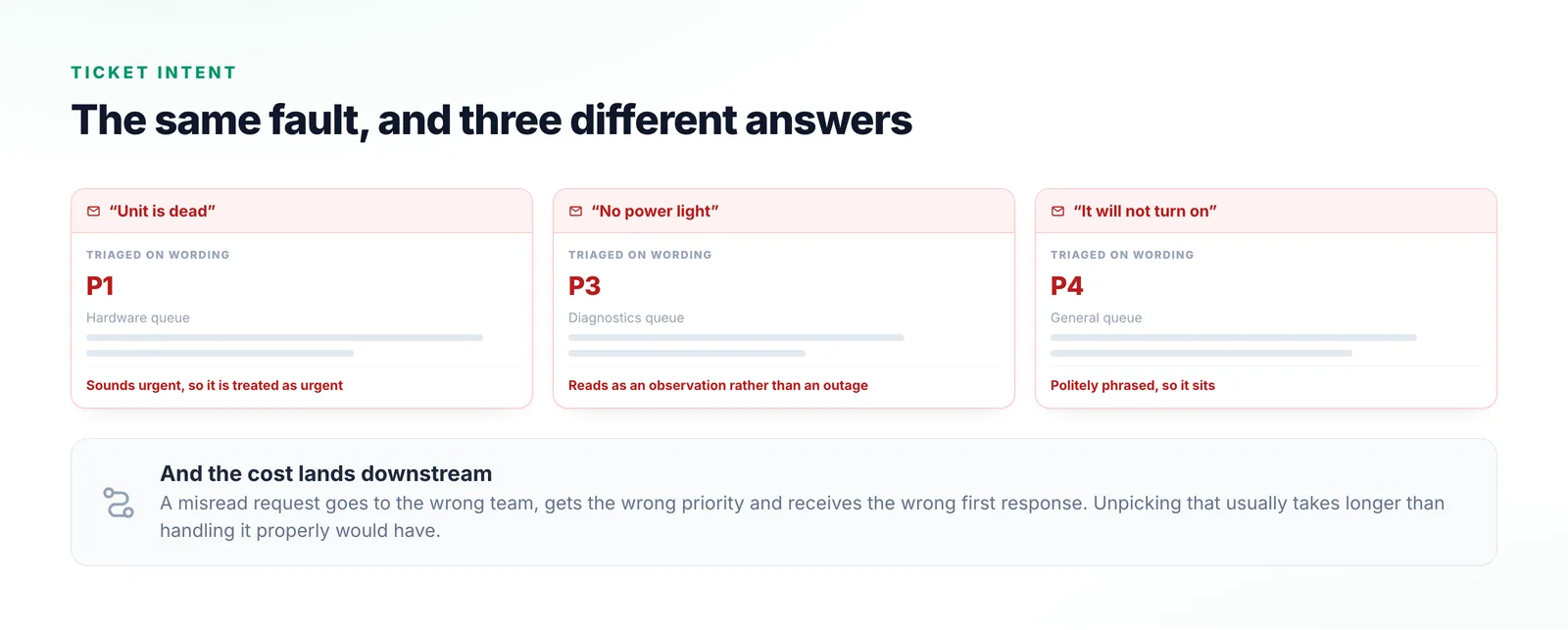
Customers describe symptoms, not causes, in whatever language they have. The same fault arrives as “unit is dead”, “no power light” and “it will not turn on”, and triage working on wording treats them as three different things.
Category dropdowns move the guess to the customer, which is why almost every queue has a large “Other” bucket. The cost lands downstream: a misread request goes to the wrong team with the wrong priority, and unpicking that takes longer than handling it properly would have.
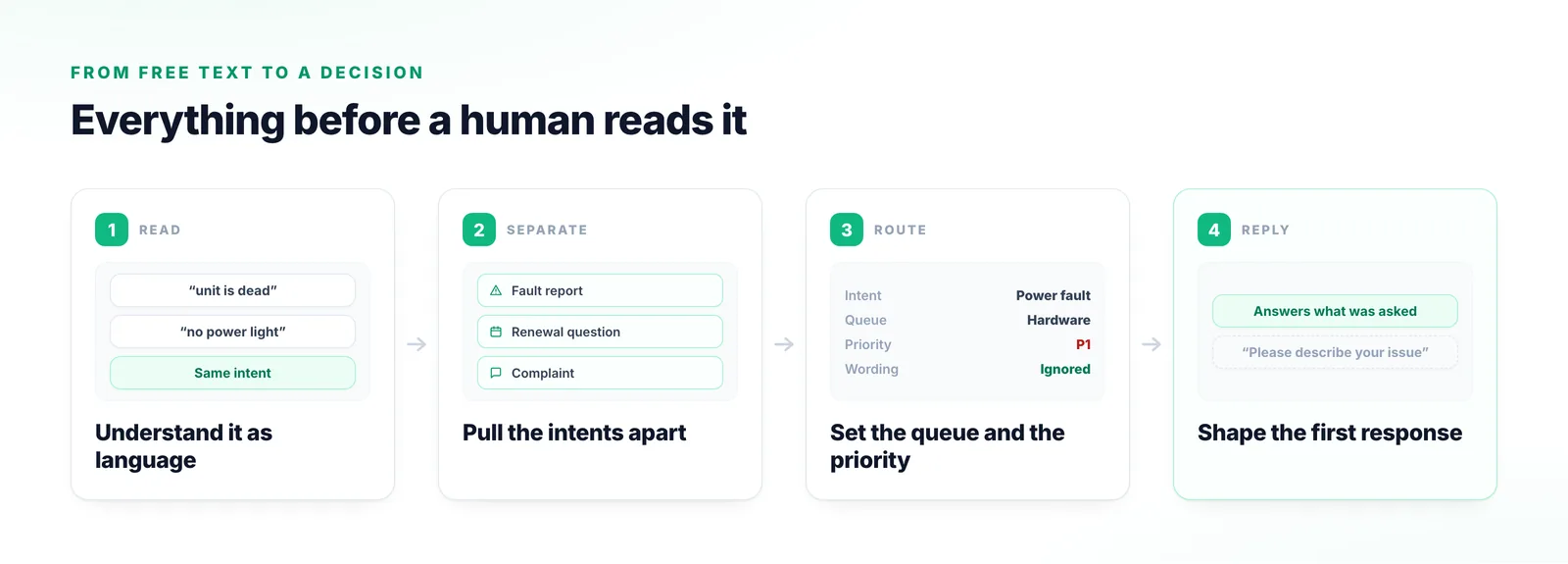
Three decisions get made before anyone works the case. All of them depend on this one.
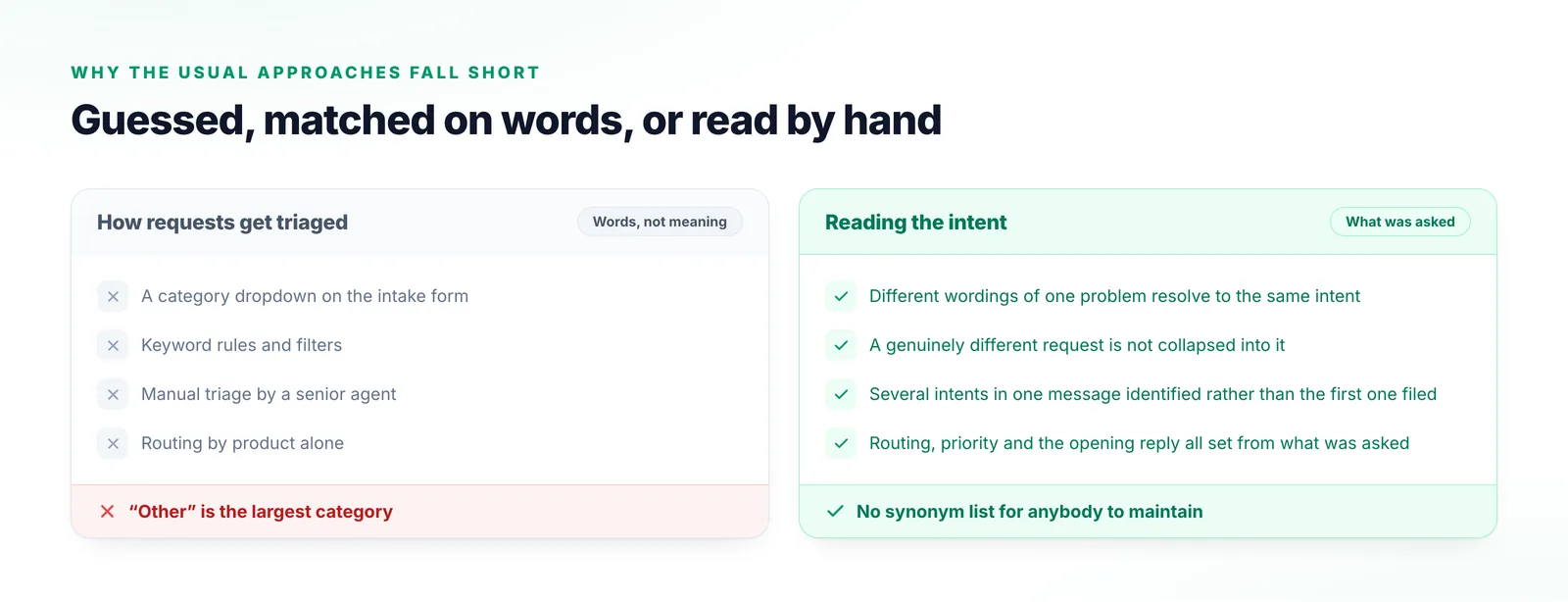
The request is understood as language rather than matched on keywords, so different wordings resolve to the same intent.
Real messages often carry more than one: a fault report with a billing question, or a how-to buried inside a complaint.
Intent rather than vocabulary drives where a request goes and how urgently, which stops a critical fault sitting in a general queue.
The opening reply is matched to what was being asked, so the customer is not made to re-explain.
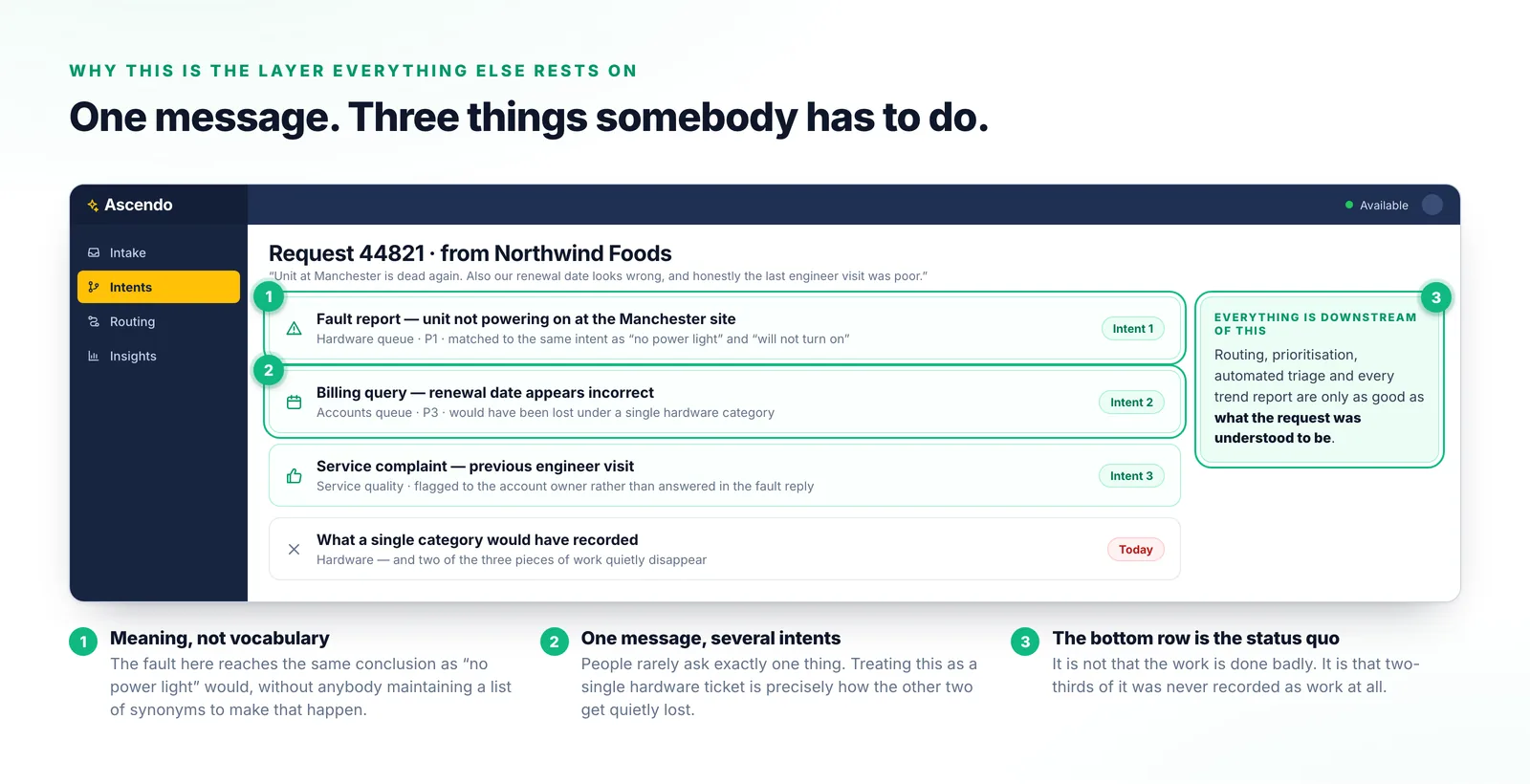
Get the reading wrong and every decision built on top of it inherits the error.
Rules fire on the words a customer happened to choose, so they miss synonyms and misfire on unusual phrasing. Reading intent means “it will not turn on” and “no power light” reach the same conclusion.
A message reporting a fault, asking about a renewal and complaining about the last visit is three pieces of work, and treating it as one is how two get lost.
Routing, prioritisation, automated triage and every trend report are only as good as what the request was understood to be.
Most queues are running two of these at once and getting the worst of both.
Moves the guess to the customer, who picks the nearest option and moves on.
Fire on words rather than meaning, and maintaining the rule set becomes a job nobody wants.
Accurate, and it spends your most expensive people on reading a queue.
Says nothing about urgency or what kind of help was wanted.
Intent, category and abstraction level get used interchangeably and are three different things.
What happens once intent is understood: the issue type applied to the request on arrival.
How coarse or fine those categories should be, and what that choice does to your reporting.
The ranked view of what is driving volume, built on top of this layer.
Voice of the Customer
The fastest test is on requests you have already triaged. Give us a sample and we will show you where the reading differs from what your team assigned, and which of the two was right.
Talk to us