Parallel, not sequential
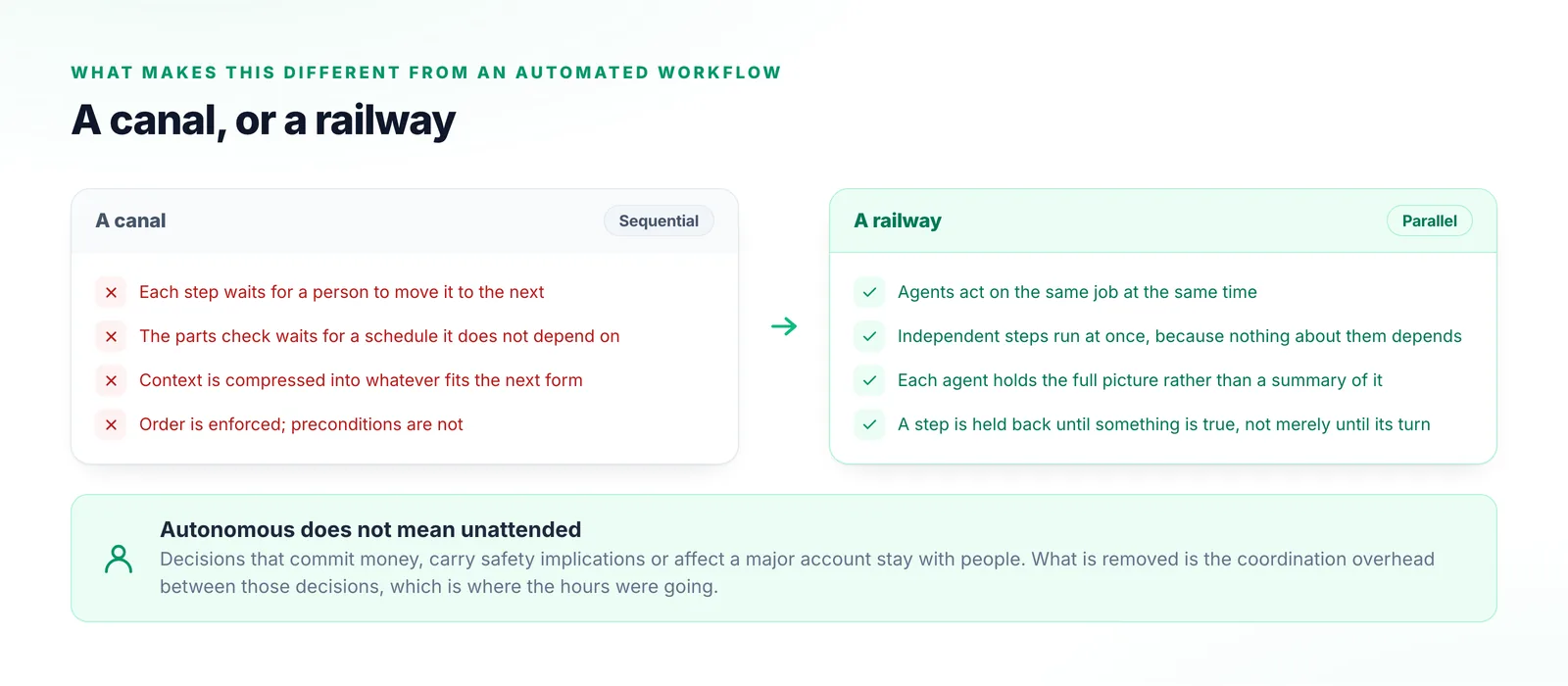
Steps that do not depend on each other happen at the same time. Checking the parts position does not need to wait for a schedule, and that waiting is most of where the time goes.
The individual agents are worth having on their own. What they build toward is different: an issue detected, diagnosed, matched to a technician with the right skills, with the part confirmed before anyone is dispatched — running as one continuous loop rather than a chain of people forwarding work to each other.
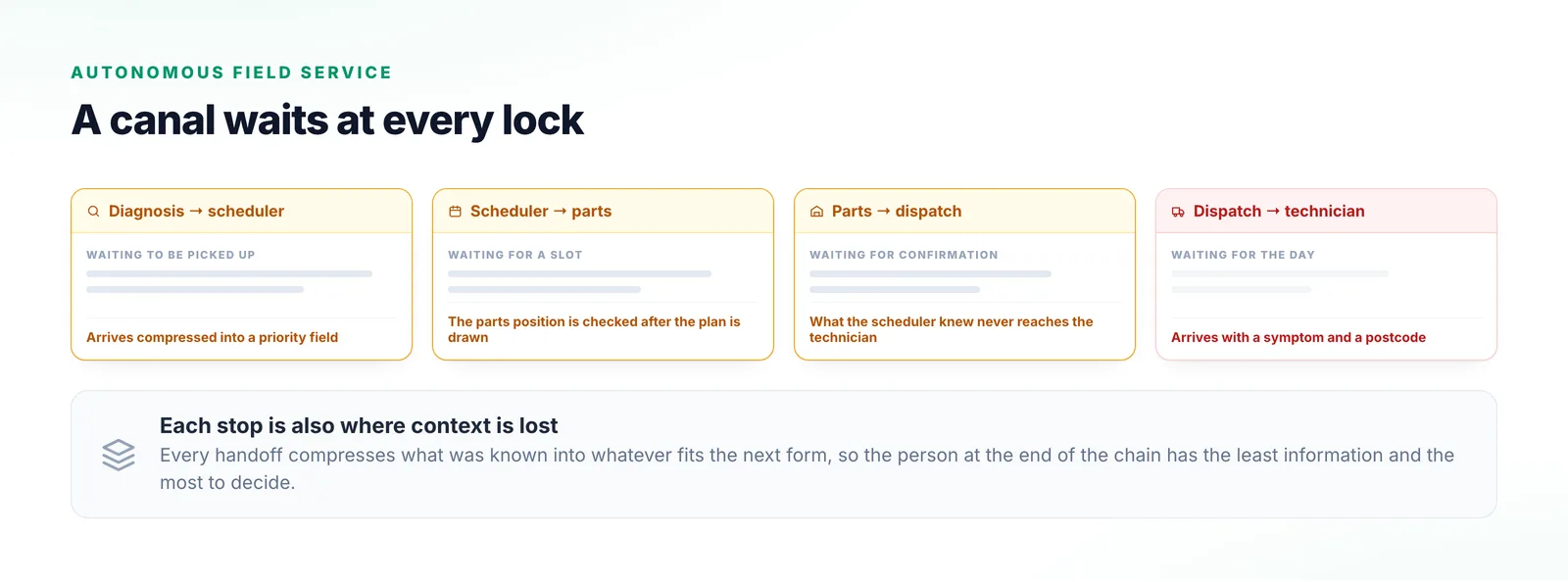
Most service organisations run work as a linear process where a job sits until somebody moves it to the next step. Ascendo’s own description of that is a canal, and the useful part of the metaphor is the waiting.
Each stop is also where context is lost. The diagnosis reaches the scheduler as a priority field; what the scheduler knew about parts never reaches the technician. The alternative is a railway: agents acting on the same job at once, each with the full picture.
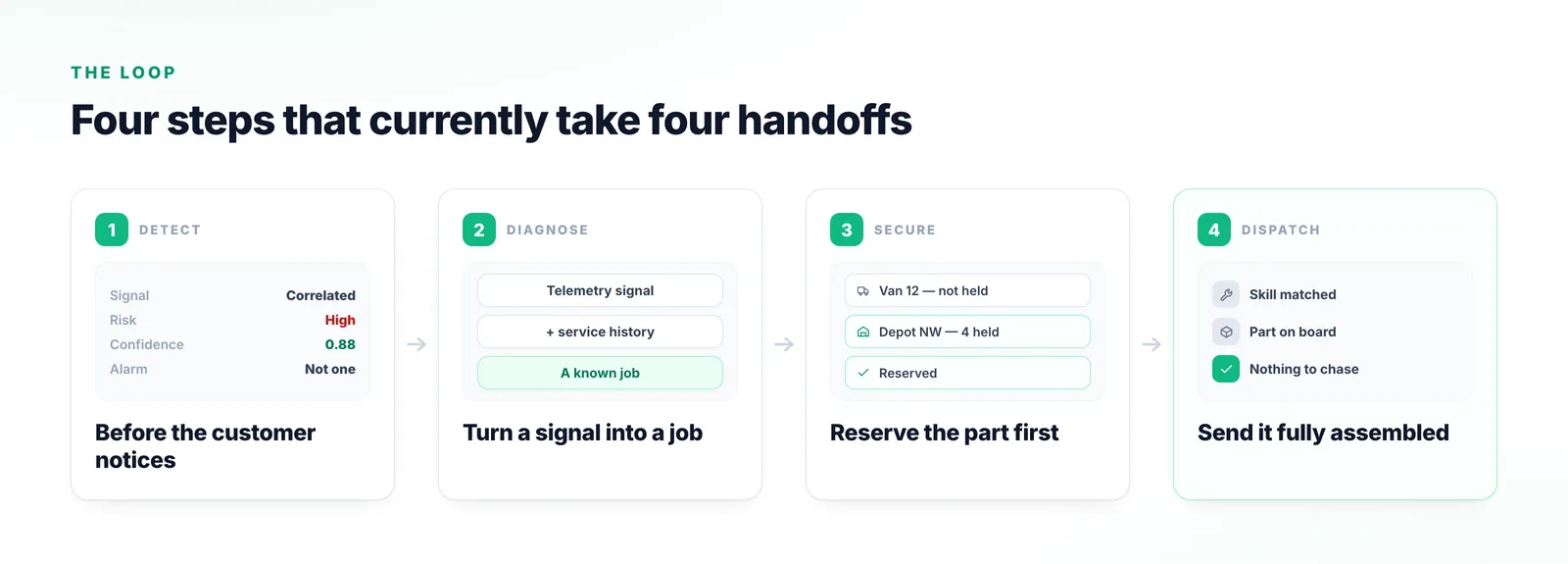
Four steps that today happen sequentially, days apart, with a person chasing each one.
Telemetry indicates a developing fault before the customer notices, arriving as a risk and confidence score rather than another alarm to triage.
The likely cause is established from the signal, the service history and the documentation, so what gets scheduled is a known job.
Availability is checked across the van and nearby depots and the part is reserved, before the visit is planned around it.
The technician is chosen on skills, location and parts position together, and the job goes out with everything lined up behind it.
Two of these are about time. The third is about who is still in charge.
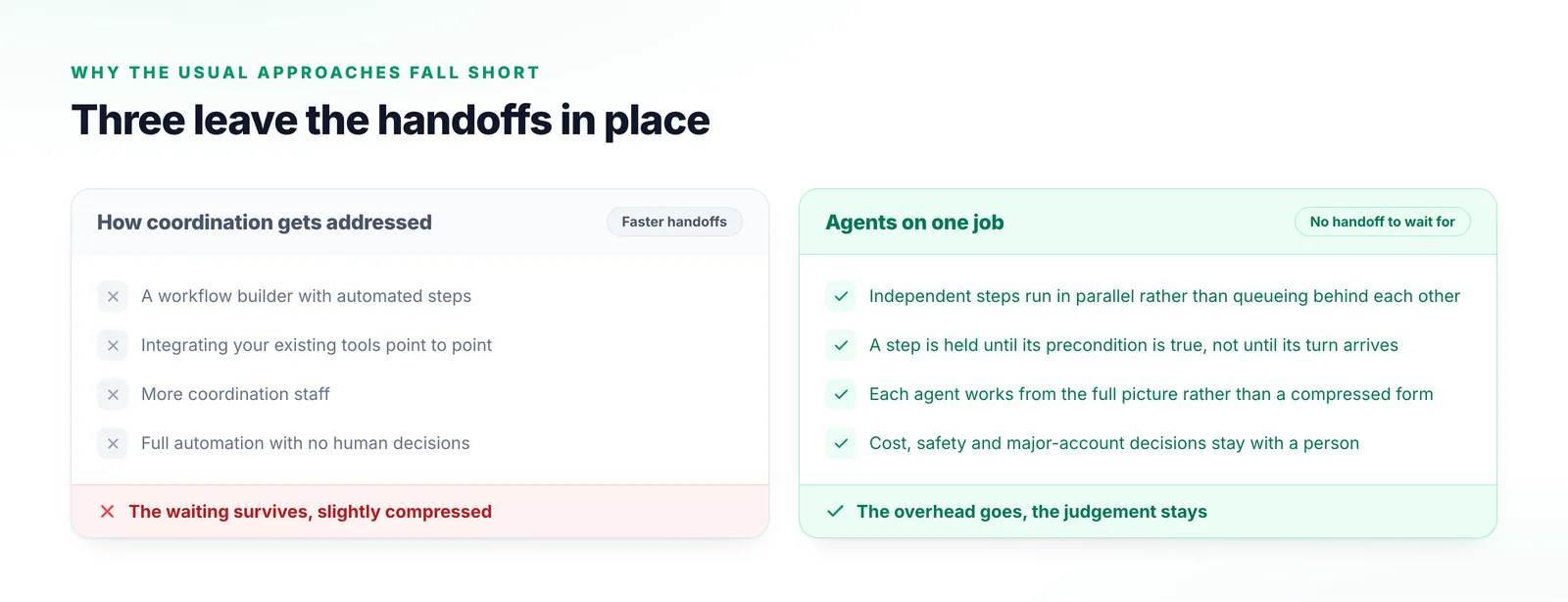
Steps that do not depend on each other happen at the same time. Checking the parts position does not need to wait for a schedule, and that waiting is most of where the time goes.
The interesting part of coordination is not sequencing — it is holding a step back until something is true. A return should not be raised before anyone knows which component failed.
Autonomous does not mean unattended. Decisions that commit money, carry safety implications or affect a major account stay with people. What is removed is the coordination overhead.
Three of these leave the handoffs in place. The fourth removes the wrong thing.
Runs a fixed pipeline in a fixed order. It cannot wait for a precondition.
Moves data between systems and leaves the decisions where they were.
Works, and scales linearly with volume, adding another place for context to be lost.
The decisions that carry cost and risk are the ones worth a person’s attention.
The canal and railway framing, and the terms underneath it.
The agent that sequences the others and holds a step back until its preconditions are met.
The individual agents inside this loop, and what each one is responsible for.
How much of an interaction proceeds without a person, set per issue type rather than globally.
Field Service
Pick a job that went badly last month. We will walk through where the waiting actually was, and how much of it this removes.
Talk to us