It works without being asked
The difference is who initiates. Assistance that has to be opened is forgotten once a pilot stops being watched; work already done when the agent arrives is not.
Most AI in support is a tool somebody has to remember to open. A teammate is a different thing: it picks up the routine work as it arrives, has the context ready before an agent opens the case, and puts its hand up when it is not sure — roughly what you would want from a good new hire who never gets tired.
Support tooling has a quiet failure mode: the capability is real, it demonstrates well, and six months later the people who were meant to use it have gone back to what they know, because using it was one more decision in a busy day.
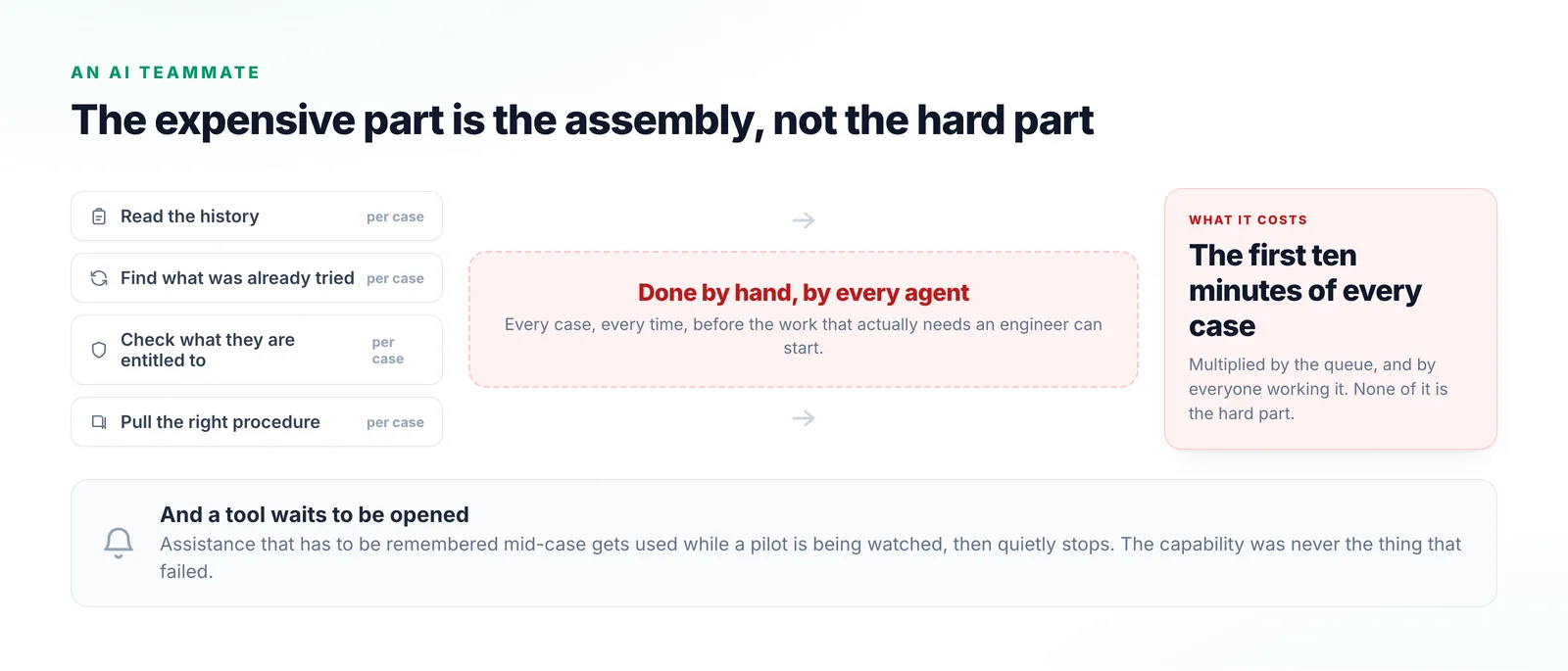
The work that actually consumes a support team is not the hard part either. It is the assembly before the hard part starts: reading the history, finding what the customer already tried, checking entitlement, pulling the procedure. Per case, every time, for every agent.
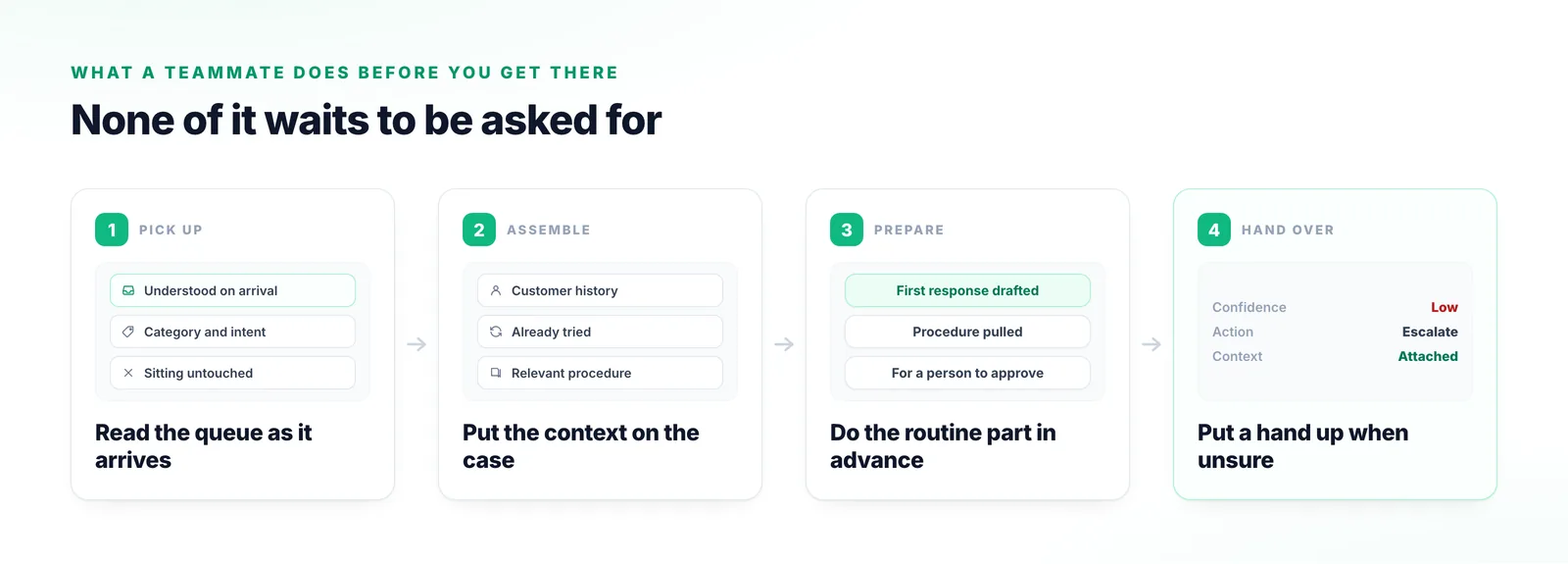
None of this depends on anyone remembering to ask for it.
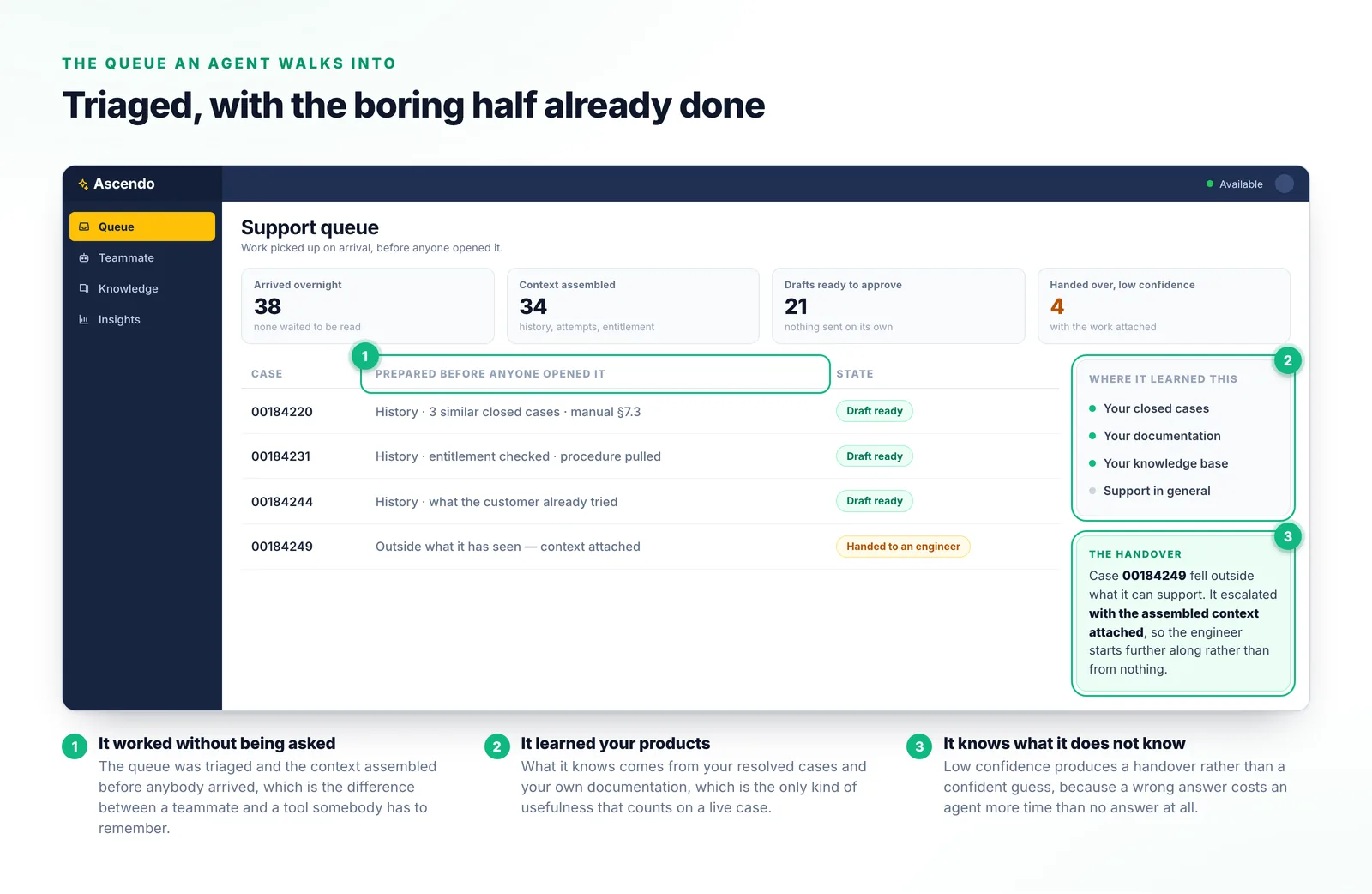
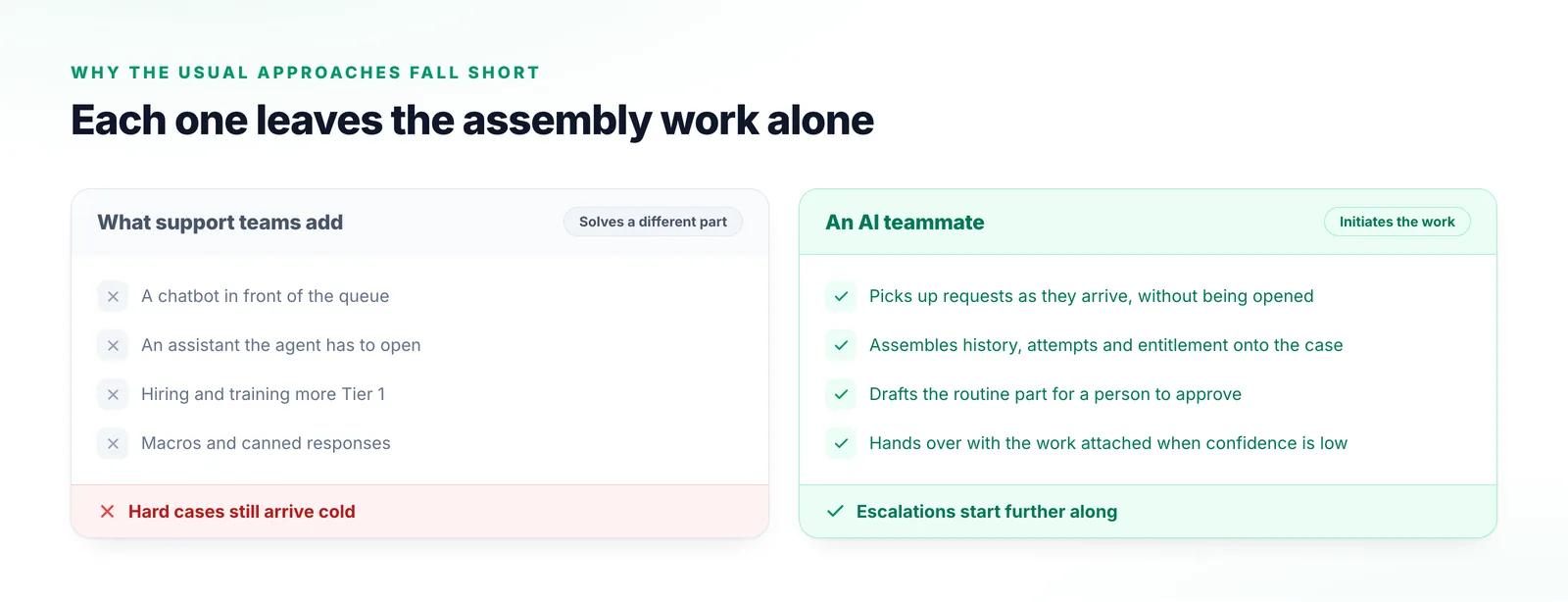
Incoming requests are read as they arrive, so the queue an agent sees is already triaged rather than raw.
History, what has been tried, similar closed cases and the relevant documentation are gathered onto the case before anyone opens it.
The repetitive work is prepared in advance, as a draft for a person to approve rather than an action taken for them.
Where confidence is low it hands over with the work attached, rather than a confident answer somebody has to disprove.
The distinction sounds like marketing until you look at what decides adoption.
The difference is who initiates. Assistance that has to be opened is forgotten once a pilot stops being watched; work already done when the agent arrives is not.
What it knows comes from your resolved cases, your documentation and your knowledge base, which is what makes it useful on a specific fault on a specific product.
A teammate that guesses confidently is worse than none, because somebody has to discover it was wrong. Outside what it can support, it hands over with the context attached.
Each of these solves a real part of the problem and leaves the expensive part alone.
Handles the easy contacts and hands everything else over cold.
Depends on someone remembering mid-case that it exists. Usage falls away once nobody is watching.
Works, slowly and expensively, and the knowledge leaves when they do. It also does nothing about the assembly work.
Fast for the cases somebody predicted. They do not read the history or know what was already tried.
Terms that come up when teams compare this with agent assist.
The same work at three settings: suggested, drafted for approval, or handled end to end.
The agent behind the resolution itself, reasoning across everything you have connected.
What happens when a case is genuinely hard and a human expert has to be pulled in.
AI Teammates
Give us a set of cases your team worked last month and we will show you what would already have been sitting on them before an agent opened the queue.
Talk to us