
AI Teammates

Cognitive Spares

Predict shortages before they breach your SLAs. Ascendo forecasts demand at the individual part and depot level using install base growth and real field failure rates, scores SLA risk by customer and contract, and rebalances stock across locations.

  • Forecasting at part and depot level, not in aggregate
  • SLA coverage scored by customer, product and region
  • Reorder points that update as the install base moves

Watch the full tour

Verify your work email once and every research paper, case study and product tour on ascendo.ai opens, right here, without leaving the page.

  • Takes about 30 seconds
  • Work email only, no spam

Capital in the wrong warehouse, stockouts in the right one

Meeting four-hour, eight-hour and next-business-day commitments means stocking parts across many depots, with customs rules shaping where a part can usefully sit.

The result is a paradox every planner recognises: capital tied up in inventory nobody needs, while a critical part stocks out at the depot that needed it most. The reason is timing — on a monthly cycle, a trend surfaces only after the stockouts it caused have breached SLAs.
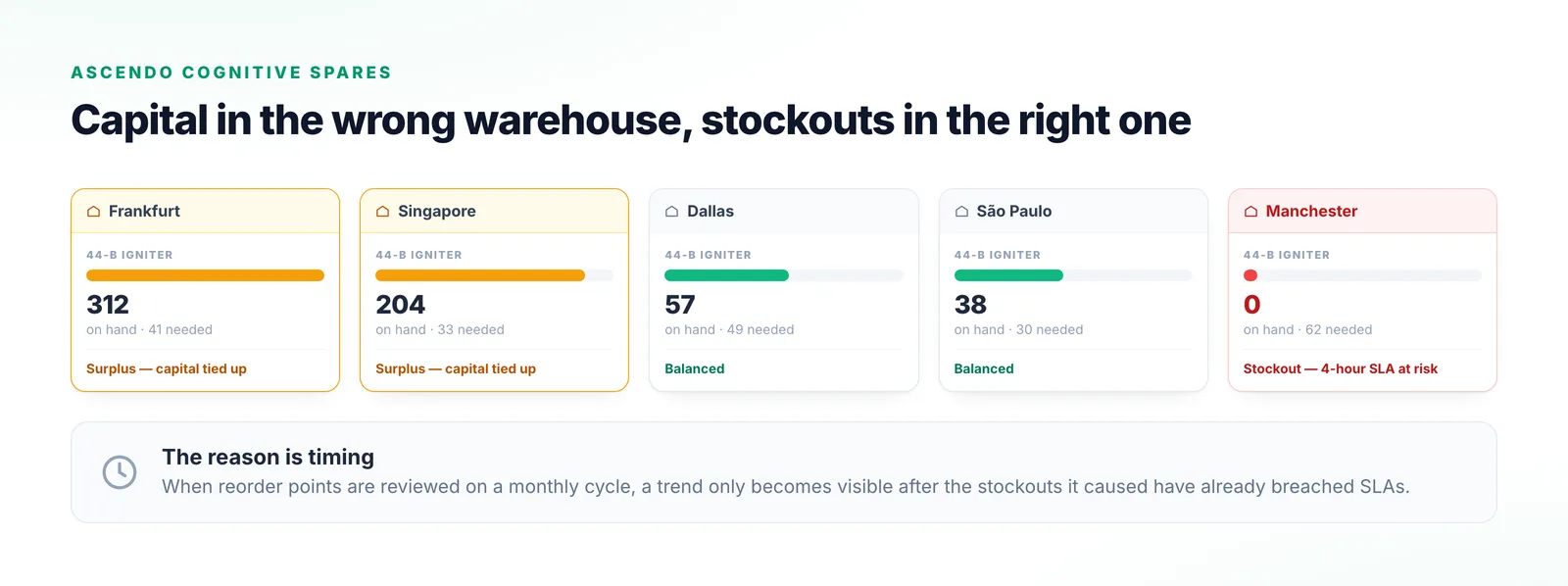
Five depots holding the same part: two carrying large surpluses, two balanced, and one at zero stock against sixty-two units of demand with a four-hour SLA at risk.
Two depots holding hundreds of the same part, and the one that needs sixty-two of them holding none.

The operating loop

Run continuously, not as a monthly review.

  1. Step 1

    Analyse the impact of changes

    The full shortage and surplus picture at any point in time, by part and depot, with substitutions and cost impact.

  2. Step 2

    Address shortage by priority

    Knowing the level of risk, not simply that it exists, decides between moving parts and buying new stock.

  3. Step 3

    Understand SLA coverage

    By customer, product, depot and region, so effort follows business impact rather than whoever shouted most recently.

  4. Step 4

    Keep reorder points current

    Recommended at part and location level, updating as the install base grows and failure rates shift.
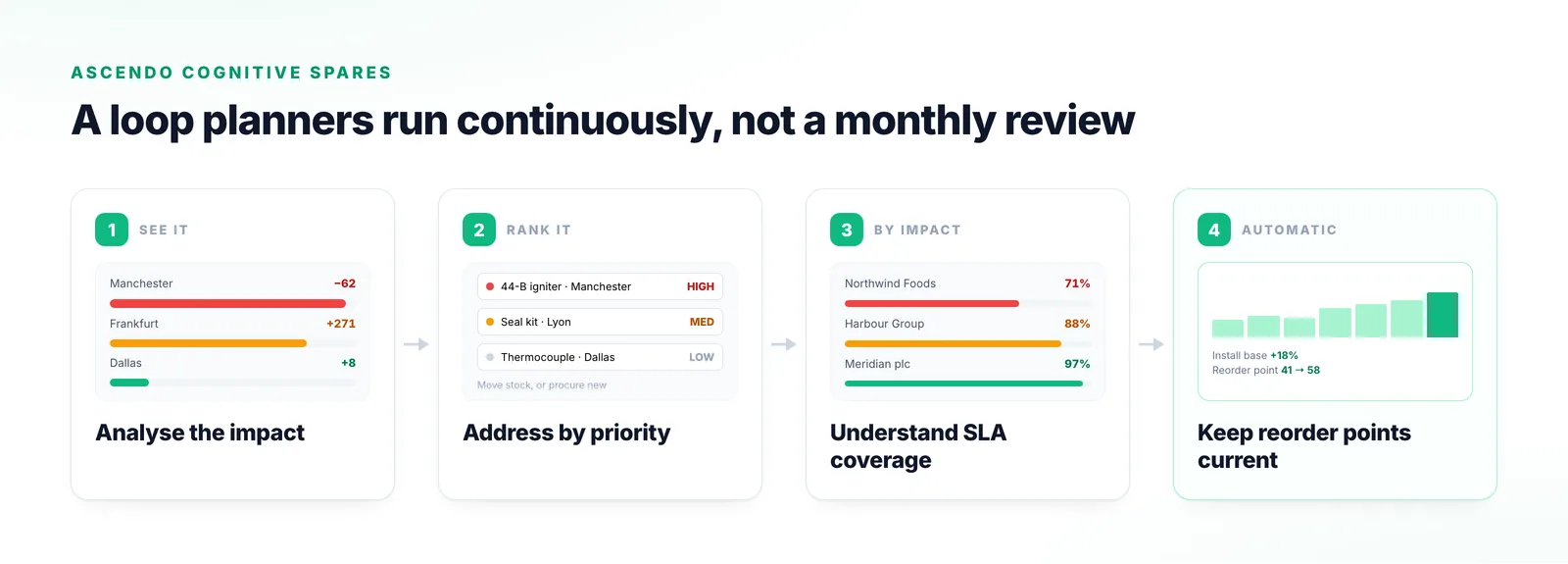
The four-step Ascendo spares planning loop: analysing shortage and surplus by depot, ranking shortages by risk, reading SLA coverage by customer, and updating reorder points as the install base grows.
Each step feeds the next: shortage by depot, then risk ranking, then coverage per customer, then a reorder point that moves on its own.

Why the last mile is the whole problem

Forecasting is table stakes. Allocation is where SLAs are won and lost.

Accuracy at the wrong level does not prevent stockouts

A capable data science team can forecast aggregate demand well. But that does not tell a planner which depot needs which part this month, so allocation stays manual.

Signals from the field, not just from past orders

ERP reorder rules run on historical averages and do not know the install base grew. You end up overstocked on legacy parts and short on the new ones.

SLA coverage as the number you manage

Coverage as a percentage per customer turns a vague worry into something a leader can act on. Most planning teams cannot state that number today.
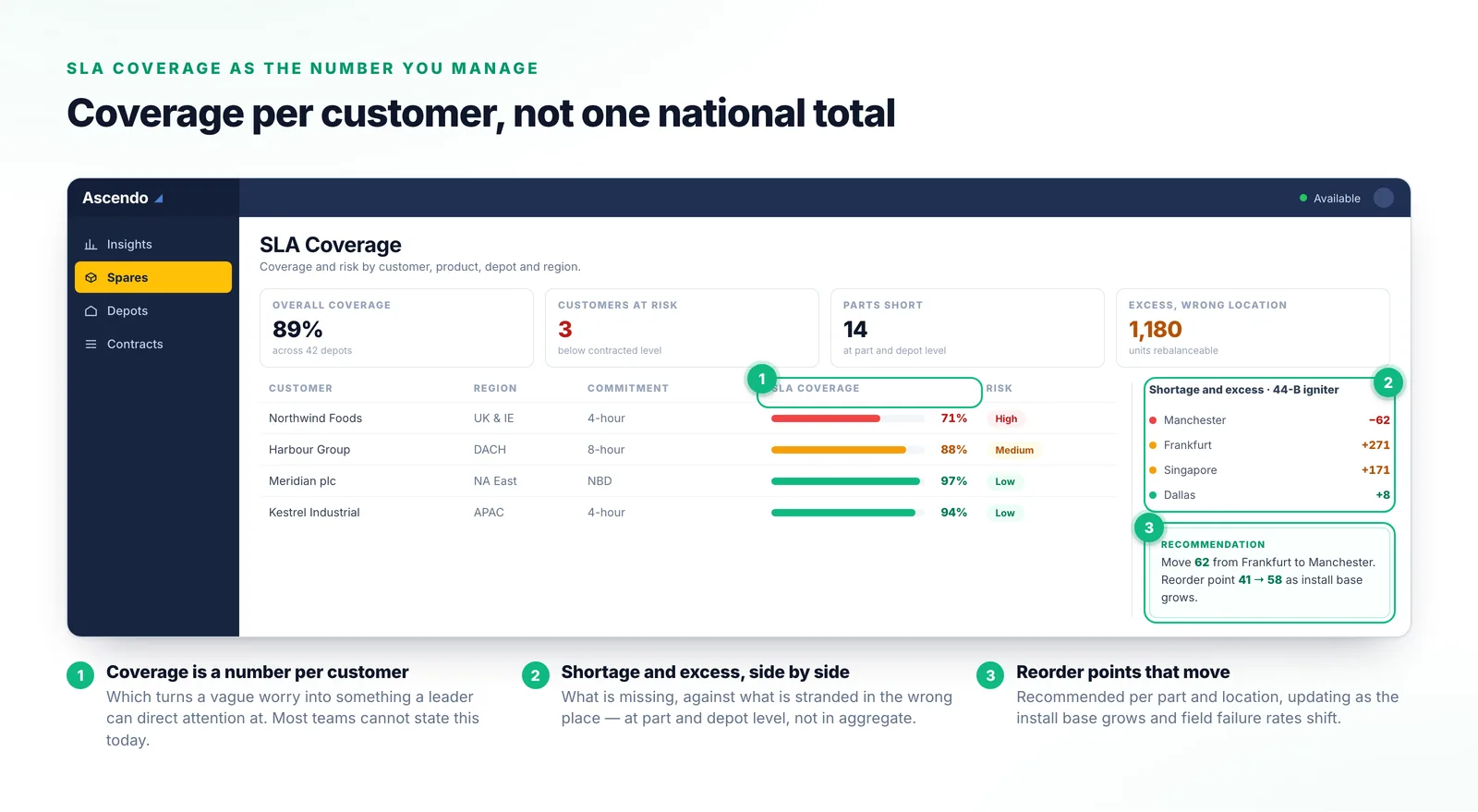
An Ascendo SLA coverage view showing coverage as a percentage per customer with risk levels, shortage and excess for one part across four depots, and a rebalancing and reorder point recommendation.
One customer sitting at 71% against a four-hour commitment — and the surplus that would fix it stranded in Frankfurt.

Why the usual approaches fall short

Each is competent at something. None closes the loop at the depot.

Spreadsheets and manual review

Reactive by design. By the time a trend is visible, the stockouts it caused have already breached SLAs.

ERP-native reorder rules

Historical averages that do not update as the install base shifts, leaving you overstocked on old parts and short on new ones.

Generic AI demand forecasting

Predicts aggregate demand accurately, then hands a planner a number they still have to allocate across depots by hand.
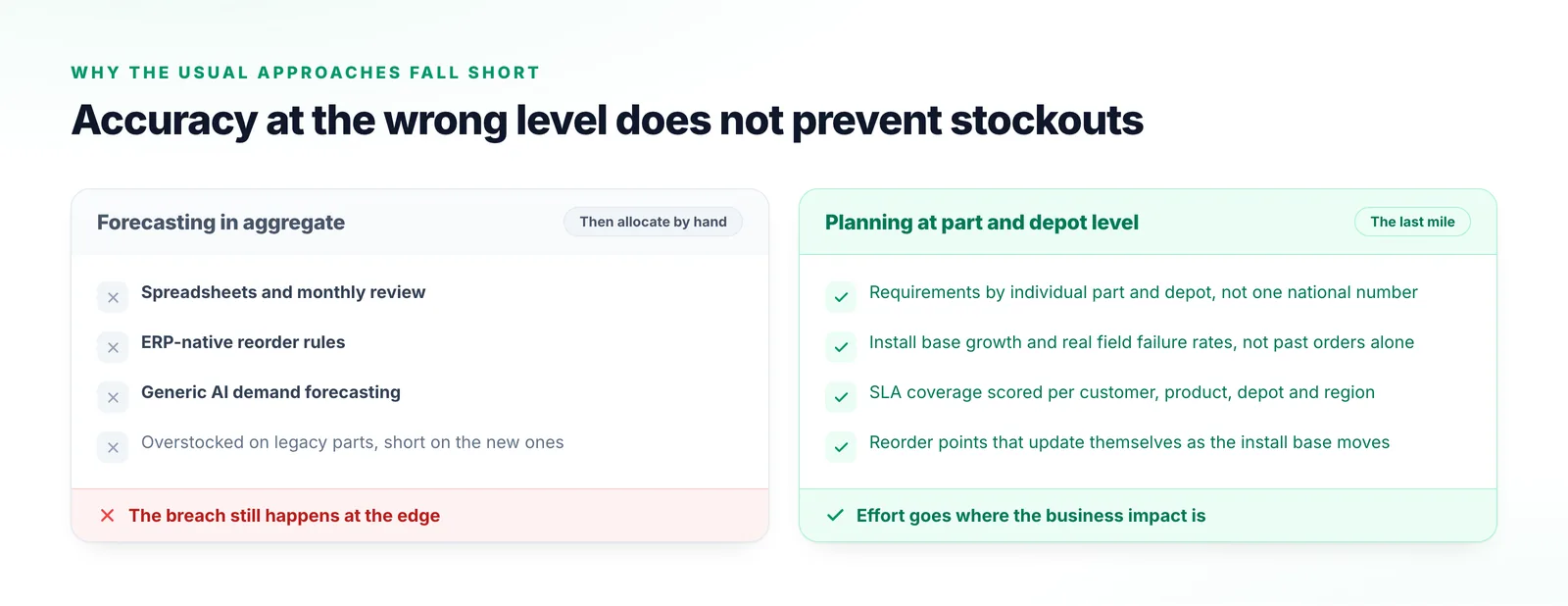
Spreadsheets, ERP reorder rules and generic AI forecasting all producing aggregate numbers a planner must allocate by hand, beside planning at individual part and depot level.
Three competent approaches that all stop at a number somebody still has to split across depots by hand.

What things are called

Planning vocabulary, some of it specific to field service.

Depot
A stocking location serving an SLA region.
SLA coverage
The share of commitments the current stock position can meet. The headline number in the app.
Reorder point
The stock level that triggers replenishment, recommended here at part and location level.
Install base
The population of deployed equipment under service.
Four-hour, eight-hour, NBD
Standard field service response commitments, where NBD is next business day.
Shortage and excess
The core calculation: what is missing against what is stranded in the wrong place.

Frequently Asked Questions

This does not replace them, and it should not. Your ERP stays the system of record. The gap it leaves is that reorder rules are historical averages which do not update as your install base shifts. Ascendo layers install base movement and field failure signals on top and writes recommendations back.

Cognitive Spares

Do you know your SLA coverage by customer?

Most planning teams cannot answer that as a number. We will run an analysis against your install base and consumption history and show you where the risk sits.

Talk to us