The New-Collar Renaissance: How AI, Skill Trades, and Intelligent Automation Are Reshaping Field Service
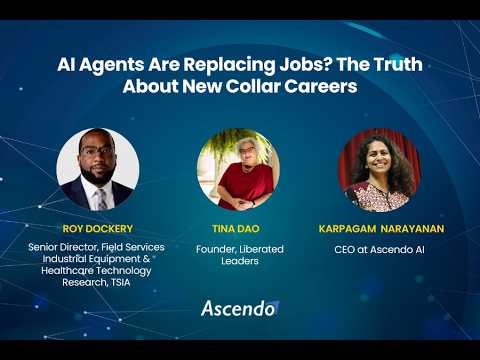
In the latest episode of Experience Dialogue, Ascendo AI CEO Kay Narayanan sat down with Tina Dao, Founder of Liberated Leaders, and Roy Dockery, Senior Director of Field Services Research at TSIA.
Watch the full session on YouTube
The conversation explored a major shift across industries: the rise of the New Collar workforce and how AI for field service, AI workflow automation, and enterprise AI agents are transforming how organizations hire, train, and operate.
As industries face retiring experts and growing service complexity, companies are realizing that traditional hiring alone cannot solve the problem. The future lies in combining human talent with intelligent AI systems.
The New-Collar Workforce Meets Industrial AI
For years, skilled trades were undervalued compared to traditional white-collar roles. But today, industries like healthcare technology, telecom, and energy are facing massive talent shortages in roles tied to field service management, asset management software, and equipment maintenance software.
Roy Dockery highlighted that companies can no longer rely on outdated hiring models. Instead of focusing only on experience, organizations must move toward skills-based hiring and leverage AI for business operations to support new talent.
This is where industrial AI and AI agent platforms play a critical role. By embedding intelligence into workflows, companies can empower technicians to perform at higher levels, regardless of years of experience.
AI as a Force Multiplier for Technicians
One of the most powerful ideas discussed was how AI service automation can remove friction from a technician's day-to-day work.
Instead of spending time on manual documentation, data collection, or system updates, technicians can rely on AI agents, AI copilots, and AI workflow automation software to handle these tasks in the background.
Roy described a future where technicians are supported by AI virtual agents that manage:
- Work order notes
- Parts reconciliation
- Asset data capture
- Service documentation
This shift enables technicians to focus on what truly matters: solving problems and improving the AI customer experience.
In this model, AI does not replace workers. It enhances productivity through AI agent automation and AI-powered service intelligence.
Faster Onboarding with AI-Powered Learning
Traditional onboarding in field service can take months or even years. But with AI knowledge bases, AI diagnostics, and real-time guidance, companies can dramatically reduce training time.
Instead of learning everything upfront, new hires can rely on AI-powered analytics and AI support automation to guide them during real-world tasks.
This aligns with a broader shift toward AI automation software that enables:
- Faster onboarding cycles
- Real-time troubleshooting support
- Continuous learning in the field
As Roy explained, organizations can now bring technicians to productivity much faster by combining foundational training with intelligent AI support systems.
Skills Over Experience in the Age of AI Agents
A key takeaway from the discussion was the move toward skills-based hiring.
In a world powered by autonomous AI agents and generative AI agents, the ability to learn and adapt is more valuable than traditional experience.
Tina Dao emphasized that the most critical skill for the next generation is simple but powerful: learning how to learn.
This shift is especially important as more companies adopt AI for customer support and AI in customer support environments, where employees must collaborate with both humans and AI systems.
Human Skills in an AI-Driven Workforce
As organizations adopt AI enterprise software and build digital workforces, human skills become even more important.
Tina introduced the idea that what we call "soft skills" are actually essential skills. These include:
- Communication
- Emotional intelligence
- Clarity in decision-making
- Collaboration with AI systems
In fact, working effectively with AI customer service agents and enterprise AI agents requires the same clarity and structure as working with human teams.
This is especially relevant in environments powered by AI for customer service, where human and AI interactions must be seamless.
The Future of Field Service Is Hybrid
The future of service operations lies in combining human expertise with AI capabilities.
With technologies like predictive maintenance, AI predictive maintenance, and service management software, organizations can move from reactive operations to proactive, intelligent systems.
This hybrid model includes:
- Humans focusing on complex decision-making and customer interaction
- AI handling repetitive workflows and data-driven tasks
- Seamless collaboration through AI agent workflows
As industries evolve, the companies that succeed will be those that embrace this balance and invest in both people and technology.
Final Thoughts
The New Collar movement is not just about redefining jobs. It is about redefining how work gets done.
By combining skilled talent with AI for field service, AI agents, and AI workflow automation, organizations can bridge the talent gap, improve efficiency, and deliver better outcomes for customers.
The future is not human versus AI. It is human plus AI.
The research behind this session is written up in full in the NEW COLLAR blueprint — a 23-page report covering Physical AI and the Digital Organism, the wage premium opening between AI-using and non-AI-using technicians, ten sector deep dives, and how the picture differs across the US, EMEA, APAC and Australia.