Reimagining Healthcare Technology Management: The Role of Agentic AI in a Talent-Short Industry
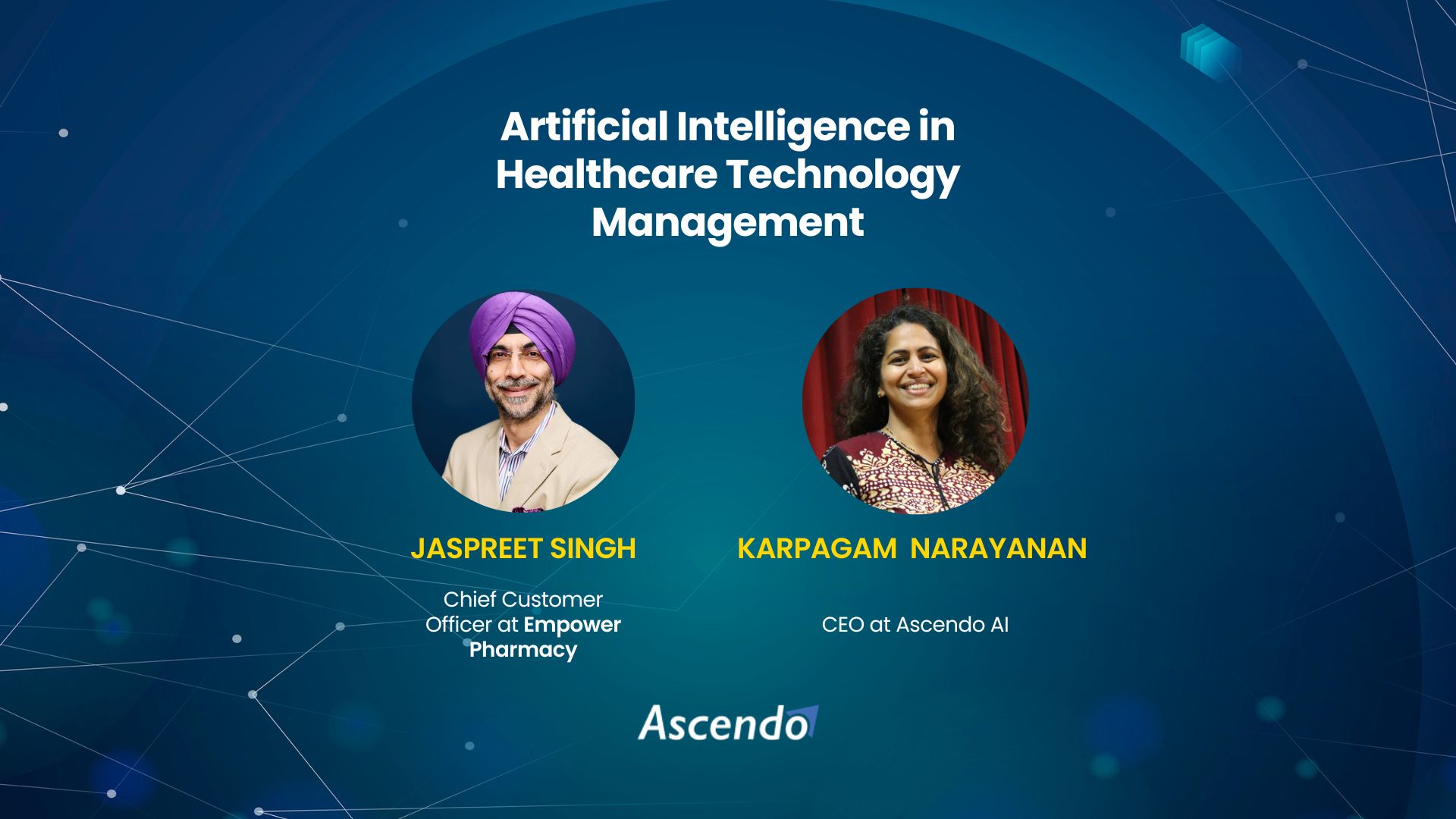
In the latest episode of the Experience Dialogue, Ascendo AI CEO Karpagam Narayanan sat down with Jaspreet Singh, a veteran Chief Customer Officer with 30 years of leadership at Microsoft and Autodesk.
Jaspreet is now applying "Big Tech" logic to one of the most regulated and high-stakes sectors in the world. The discussion focused on a critical inflection point for the Healthcare Industry: how to maintain high-quality patient outcomes when 60% of the specialist workforce is retiring, and 90% of technical roles remain unfilled. The answer lies in the strategic deployment of Agentic AI.
The HTM Crisis: Beyond the Talent Shortage
For those in Healthcare Technology Management (HTM), the "talent war" isn't a future threat—it's a daily operational reality. The industry is currently facing a massive "dearth of specialists," leaving organizations reliant on generalists to manage complex medical device ecosystems.
Jaspreet argues that we cannot "hire" our way out of this problem. Instead, we must use Agentic AI as a force multiplier to bridge the gap between human IQ and technical execution.
"If I can bring the productivity of every specialist up by 50%, the healthcare shortage effectively shrinks by half. We aren't just replacing tasks; we are amplifying human capability."
Agentic AI: Turning "Mundane" into "Meaningful"
What distinguishes Agentic AI from standard automation is its ability to handle complex workflows autonomously. In a field service or clinical setting, technical experts are often bogged down by administrative "noise"—manual data entry, inventory checks, and SOP verification.
By deploying agentic workflows, Jaspreet's team achieved a 10-20% productivity boost in just eight weeks. These "Silicon Employees" handle the manual triggers, allowing "Carbon Employees" to focus on the elements that AI cannot replicate: Empathy, Novelty, and High-Level Governance.
| Aspect | Carbon Employees (Human) | Silicon Employees (Agentic AI) | | --- | --- | --- | | Core Strength | Empathy, IQ, EQ, Complex Judgment | Speed, Pattern Recognition, 24/7 Execution | | Focus Area | Patient/Provider Interaction | Mundane Admin, SOP Triggers, Data Sync | | Key Role | Strategic Decision Maker | Autonomous Workflow Manager |
Leadership in the Age of Agentic Workflows
Transitioning a traditional healthcare organization to an AI-native model requires a shift in leadership. In regulated environments where HIPAA, PII, and PHI are non-negotiable, change management can be slow.
Jaspreet suggests that HTM leaders must move from being "taskmasters" to "role models." To stay relevant 10 years down the road, companies must:
-
Be AI-Native First: Leaders must dabble in the tech themselves. If leadership isn't using AI for their own presentations and analysis, the frontline won't adopt it for medical device support.
-
Bifurcate Departments: Identify which roles are "Human Only" (complex patient counseling) vs. "Human + AI" (diagnostic troubleshooting) vs. "AI Only" (prescription scanning and inventory routing).
-
Shrink Onboarding: Use AI to transform 12-week training cycles into 2-week "sprints" by putting institutional knowledge directly into the agentic workflow.
The 10-Year Horizon
The healthcare industry is at a crossroads. We can continue to struggle with a shrinking specialist pool, or we can embrace the hybrid workforce. As Jaspreet notes, the goal of Agentic AI isn't to take jobs—it's to create new ones that allow humans to operate at the very top of their license.
Watch the full session on how Agentic AI is scaling Healthcare Technology Management: Link to YouTube Video